49 works in this view — arrow keys or swipe to move between them.
Dance in Art
Augusta Maywood
Unknown artist
- Collection:
- Prints depicting dance
- Source:
- New York Public Library
- Rights:
- Public domain — free to use, share and adapt.
- Recorded as:
- Public Domain
Maywood was a pioneer: an American-trained dancer who achieved international stardom and choreographed works in Europe, breaking the mold of American dancers as peripheral figures in European-dominated ballet. This portrait documents her celebrity at a moment when Romantic ballet was establishing itself as a dominant theatrical form, and when the ballerina—ethereal, elegant, publicly celebrated—had become a cultural icon.
What you are looking at
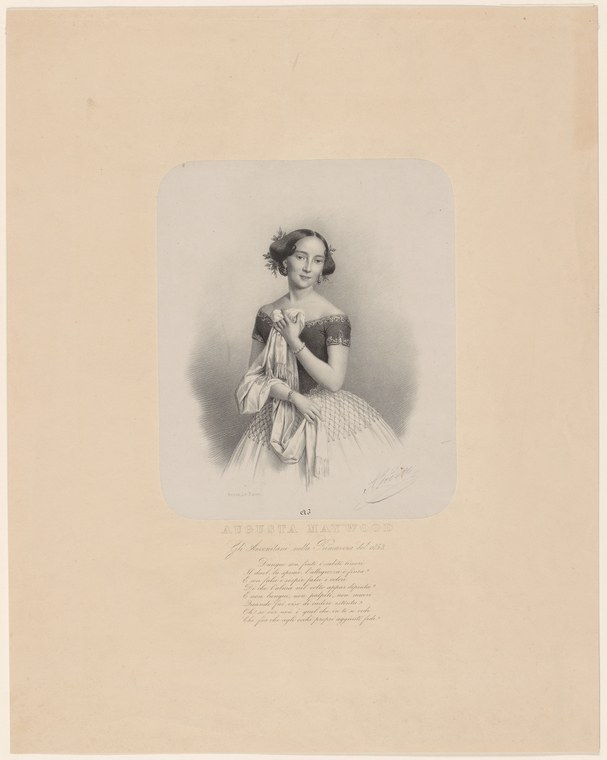
A three-quarter-length portrait of a young woman, identified as Augusta Maywood, set against a neutral gray background. She stands in an elegant contrapposto stance, her weight shifted onto her right leg. She wears a dark off-shoulder dress with short puffed sleeves in the Romantic-era style, and a voluminous white skirt with pronounced pleating that suggests the silhouette of mid-nineteenth-century fashion. Her dark hair is arranged in ringlets typical of the 1830s–40s. She holds a pale shawl or scarf loosely in both hands at waist level, the fabric draped with studied grace. Her gaze is directed slightly away from the viewer, giving the portrait an air of contemplative poise characteristic of theatrical portraiture. Below the image runs a text inscription in cursive script, typical of published theatrical prints of the period.
The dancing
The figure is presented in an elegant, balletic stance that emphasizes verticality and elongation. Her posture is upright with a gentle S-curve, the characteristic line of Romantic ballet. The arms are held expressively rather than in a technical ballet position, with the shawl creating flowing lines that extend the upper body's geometry. The positioning suggests not a moment of active dancing but rather a posed presentation—the kind of official portrait a celebrated dancer would sit for, frozen in an attitude that conveys both dignity and the graceful deportment required of her profession.
The dance depicted
Augusta Maywood was a leading American and European ballet dancer of the mid-nineteenth century, renowned in the Romantic ballet repertoire. This engraved portrait is likely from the 1830s or 1840s, when she was at the height of her fame in European theaters. The presentation—the elegant Romantic-era gown, the posed balletic composure, the careful draping of drapery—speaks to the theatrical prestige of prima ballerinas in this period. Rather than capturing a specific moment in a choreographed work, the image presents Maywood as a public figure and star, a convention of theatrical portraiture that emphasized the dancer's status and off-stage elegance as much as her dancing ability.
How it was made
This is a steel engraving, a reproductive print technique that allowed for mass circulation. Steel plates could be printed in far larger editions than copper, making theatrical stars' portraits widely available to audiences and collectors. The fine hatching visible in the background and the careful modeling of light and shadow on the face and drapery are characteristic of skilled engraving work. The inscription beneath suggests this was a commercial print sold separately or as part of a series of theatrical portraits—a standard practice in nineteenth-century entertainment publicity.
About this work
This is a formal theatrical portrait of Augusta Maywood, one of the great American-born prima ballerinas of the Romantic era. It documents not a dance itself but the cultural status of a celebrated performer, presenting her in the elegant off-stage guise that nineteenth-century audiences expected of their stars. The image belongs in a dance collection both for what it shows of Romantic ballet aesthetics—the silhouette, the deportment, the visual language of the form—and for what it reveals about how dancers were marketed, celebrated, and remembered in their own time. The engraved portrait was a primary means by which nineteenth-century audiences encountered their theatrical heroes beyond the stage.
How to look at it
Observe how the artist positions Maywood not in a dynamic leap or turn but in a moment of repose that nonetheless conveys balletic grace—the elongated neck, the refined tilt of the head, the subtle curve of the torso. Notice the care taken with the fabric of the skirt: its volume and pleating create the visual silhouette of the Romantic tutu, but here worn in street dress rather than stage costume, collapsing the boundary between performer and public figure. The inscription below would originally have been readable and would confirm Maywood's identity and perhaps the date and context of the print.
The artist
The artist is not recorded in the catalogue. The style and quality of the engraving suggest a professional theatrical print shop of the mid-nineteenth century, likely operating in London or another major European theater center where Maywood performed. Such portraits were often unsigned or attributed only to the print publisher rather than the engraver.
The period
This portrait dates to the Romantic era of ballet (approximately 1830–1850), when the form underwent radical transformation: the introduction of pointe work, the development of the ethereal Romantic sylph ideal, and the emergence of the ballerina as the dominant theatrical figure, often partnered by a male dancer cast as a supernatural or exotic being. Maywood danced during this transition and was celebrated in roles that embodied Romantic ideals. Engraved theatrical portraits became a major form of mass-market celebrity imagery in this period, allowing audiences to take home likenesses of their favorite performers.
Where it lives
The print is held in the New York Public Library's collection of prints depicting dance. It is catalogued with minimal information, suggesting it was acquired as part of a larger collection of theatrical prints without detailed documentation of its individual history.
Dance in this work
Questions about this work
Who was Augusta Maywood?
Maywood (1825–1876) was an American-born ballet dancer and choreographer who became an international star during the Romantic ballet era. She trained in Philadelphia and New York, then moved to Europe where she performed at major theaters in London, Paris, and Milan, and created her own ballets. She was one of the first American dancers to achieve prominence on European stages.
Why is she dressed in street clothes, not a costume?
This is a formal portrait, not a depiction of her dancing. Nineteenth-century theatrical portraits typically showed performers in elegant civilian dress to emphasize their status and refinement as public figures. The fashionable silhouette and graceful pose convey her identity as a dancer without showing her in actual stage costume or movement.
What is an engraving and why does it matter?
An engraving is a print made by incising lines into a metal plate. Steel engravings could be printed in large numbers, making them affordable and widely distributed. Theatrical portraits in this form were a primary way nineteenth-century audiences encountered their favorite performers and circulated their likenesses in homes and collections.
What style of ballet did Maywood dance?
Maywood was a star of Romantic ballet, the dominant theatrical form of the 1830s–1850s. This style emphasized ethereal, otherworldly qualities, often featuring supernatural characters like sylphs and spirits, and introduced technical innovations like pointe work. The elegant, graceful posture shown in this portrait—the elongated line and refined bearing—embodies Romantic ballet aesthetics.
More dance artwork





