49 works in this view — arrow keys or swipe to move between them.
Dance in Art
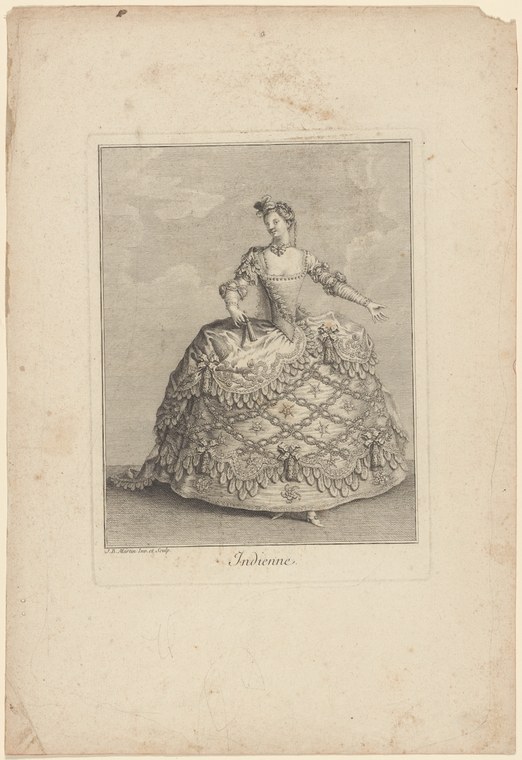
Indienne
Unknown artist
- Collection:
- Prints depicting dance
- Source:
- New York Public Library
- Rights:
- Public domain — free to use, share and adapt.
- Recorded as:
- Public Domain
This print preserves the visual knowledge of 18th-century dance training and theatrical costume at a moment when neither photography nor detailed written movement notation existed. For dancers and historians, it shows the actual proportions of court dress in motion, the postural carriage expected of trained bodies, and how the human figure was meant to frame and move within this restrictive, sculptural silhouette. The work is a primary document of embodied training and aesthetic ideals.
What you are looking at
A single female dancer occupies the center of this engraved composition, posed in a three-quarter view against a plain background. She wears an elaborate costume of the mid-18th century: a fitted bodice with short, off-shoulder sleeves and a massive skirt constructed from layers of gathered, scalloped fabric that extends to the floor. The skirt displays the characteristic silhouette of 1750s court dress, with the fabric caught and looped to reveal decorative patterning or embroidery beneath. Her posture is upright and dignified, with one arm extended gracefully outward at approximately shoulder height, while the other rests near her body. Her gaze is directed downward and away, her bearing formal and refined. The engraving technique has rendered fine detail in the fabric textures—the intricate pleating, the delicate scalloped edges, and the ornamental patterning are all precisely articulated. The composition is spare: the figure stands alone in a neutral void, suggesting this is a study of costume and deportment rather than a narrative scene.
The dancing
The dancer stands in a lifted, elongated posture characteristic of 18th-century court movement—the body is controlled and vertical, with no dramatic weight shift or stride. The extended arm creates an open line from shoulder to fingertip, the hand rendered with refined delicacy. Her other arm hangs naturally but with evident tension, suggesting trained placement rather than ease. The posture shows no jumping, turning, or complex footwork; instead it documents the standing and gesture vocabulary of formal court dance. The lowered gaze and averted face follow the period convention of modest, regulated deportment. This is a portrait of a trained body in repose or at the moment of a simple, contained movement.
The dance depicted
The inscription 'Indienne' below the figure likely refers to a specific character or costume type from 18th-century theatrical or court dance, possibly drawn from the fashionable exoticist imagery of the era. The term could indicate a dance associated with 'exotic' or colonial imagery popular in European aristocratic contexts of the mid-1700s, though without further documentation it cannot be definitively placed within a named dance form. The garment and posture align with the vocabulary of Baroque court dance and theatrical ballet of the period—the pulled-up carriage, the shaped arm, the regulated breathing and stance are consistent with training in these forms. However, the image alone does not establish whether this depicts an actual danced movement or a static costume study.
How it was made
This is an engraving on paper, rendered in fine, precise lines characteristic of 18th-century reproductive printmaking. The technique allowed for the sharp articulation of textile detail—every gathered fold, every scalloped edge, every embroidered or patterned surface is rendered with remarkable specificity. Engravings of this type, showing a single figure in costume, were produced in considerable numbers during the 18th century and circulated widely among the educated classes as reference materials, fashion documents, or theatrical souvenirs. The clarity and finish suggest a professional workshop rather than amateur production. Such prints served dancers, costume makers, and the fashionable public as guides to deportment, dress, and the appearance of celebrated performers.
About this work
This engraving documents a female dancer or character in the costume of mid-18th-century court and theatrical dance, identifiable through the inscription 'Indienne' and the elaborate formal dress of the period. The work combines documentary precision with performative display: it records both the material fact of the garment and the postural vocabulary of aristocratic dance training. The figure's dignified carriage, lifted frame, and graceful arm placement speak to years of disciplined practice in the ballroom and theater. The work belongs in dance history as evidence of how dancers moved, how they were dressed, and what bodies performing in this era were trained to look like—not as narrative spectacle, but as refined, embodied discipline.
How to look at it
Attend first to the construction and geometry of the skirt: the way the layers catch and loop reveals how the garment was cut and how it moved with the body. Notice the precise posture—there is no slack or collapse in this frame; every line is held with intention. The extended arm demonstrates the 'épaulement' or shaped carriage prized in this era: the arm is rounded, lifted at the shoulder, the hand continues the line with articulated grace. The lowered gaze and composed expression were not incidental to the dance but central to it—this was an era when noble restraint and formal beauty were the goal, not expression or naturalism. The engraving allows us to see both the static form and, by extension, the quality of movement such training produced.
The period
The mid-18th century saw the full codification of French court dance technique and the expansion of professional theatrical dance in Europe. Elaborate costume prints like this circulated among aristocratic patrons, dancers, and the fashionable public as both fashion documents and records of theatrical performance. The term 'Indienne' reflects the period's fascination with exotic imagery drawn from colonial expansion—a taste that influenced both costume design and the thematic material of court entertainments and early theatrical ballet. Engravings served as a primary medium for the circulation of visual knowledge about performance, costume, and deportment before the age of photography.
Where it lives
The work is held in the New York Public Library's Prints collection, catalogued under works depicting dance. It is part of the Library's significant holdings of 18th-century European theatrical and dance-related prints.
Dance in this work
Questions about this work
What does 'Indienne' mean?
The term likely refers to a theatrical or dance character associated with 'exotic' or colonial imagery fashionable in mid-18th-century Europe. It may denote a specific role in court entertainment or theatrical ballet, though without additional documentation, the precise reference cannot be confirmed. Such exoticist costumes and characters were popular among aristocratic audiences and frequently appeared in ballets and court spectacles of the period.
Is this a portrait of a real dancer?
The engraving is a costume study rather than a portrait—it documents a character type or role and its associated garment. Whether it represents a specific celebrated performer or a generalized ideal of the costume and carriage for this role cannot be determined from the image alone. The precision and finish suggest it was made for circulation among dancers and patrons, not as a unique record of one individual.
What was the skirt made of?
The elaborate layered, scalloped construction visible in the engraving suggests the skirt was made of silk or fine linen with multiple tiers of gathered or pleated fabric. The loops and catches that shape it would have been achieved through careful cutting, gathering, and possibly stitched fastening to create the sculptural silhouette. The patterning visible beneath suggests embroidery or woven ornament on the under-layers. Such garments were extremely time-consuming and expensive to make, and typically worn only by aristocratic dancers or professional performers.
More dance artwork





