49 works in this view — arrow keys or swipe to move between them.
Dance in Art
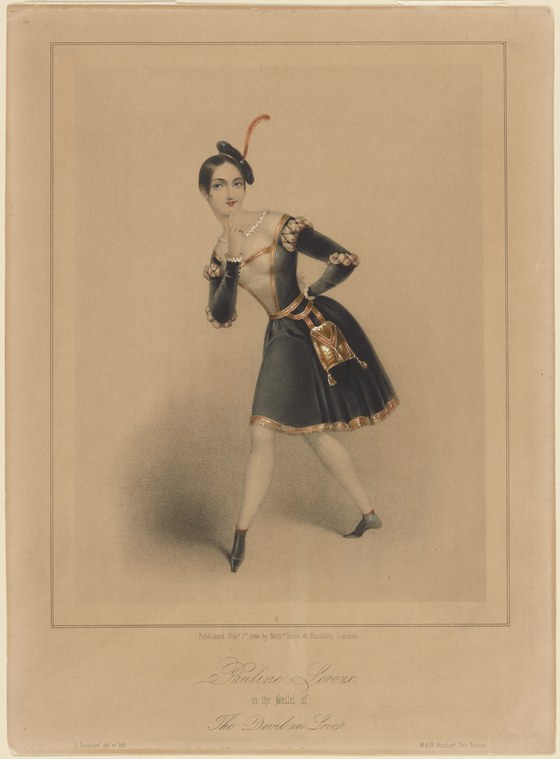
Pauline Leroux, in the ballet of The devil in love
Unknown artist
- Collection:
- Prints depicting dance
- Source:
- New York Public Library
- Rights:
- Public domain — free to use, share and adapt.
- Recorded as:
- Public Domain
This is one of the few surviving visual documents of how Romantic ballet dancers dressed and presented themselves in character. Named dancer portraits like this one anchor our understanding of individual performers and roles to specific visual evidence, revealing costume details, body carriage, and aesthetic values that written accounts alone cannot convey. For scholars of performance history, Romantic ballet, or the role of commercial portraiture in constructing celebrity, this work provides direct testimony.
What you are looking at
A single female dancer stands alone against a neutral, softly shaded background in three-quarter view, facing the viewer with her weight shifted to one leg. She wears a dark short dress with a low square neckline, trimmed with gold or bronze ribbon at the bodice, armholes, and hem; her arms are bare and posed expressively. A feathered headdress crowns her dark hair, and she wears what appears to be a jeweled choker or necklace. Her posture is elegant and engaged, with one leg bent and the other supporting her weight—a pose suggesting motion or a held moment within a choreographic phrase. The overall effect is of a dancer captured mid-performance, or in a formal portrait stance that emphasizes her grace and the costume's theatrical qualities.
The dancing
The single figure demonstrates an assured, balanced stance with weight primarily on her back leg, her front leg bent at the knee in a relaxed but engaged position. Her arms are held with intentional placement—one lower and across her body, the other raised and bent—in a pose that suggests either a held moment of performance or a conventional attitude of theatrical display. The body carriage is upright and confident, the torso lifted, the head held high. The pose is sufficiently controlled and symmetrical to suggest formal training, though the specific technical vocabulary—whether this represents a position from ballet vocabulary or from another theatrical dance tradition—cannot be determined from stillness alone.
The dance depicted
This image likely depicts a performer in a Romantic-era theatrical ballet, a form that dominated European stages in the 1830s–1850s. The inscription names Pauline Leroux in 'The Devil in Love' (Le Diable Amoureux), a ballet that was performed during this period. Leroux was a professional dancer of the Romantic ballet era, when ballerinas were celebrated in elaborately costumed roles that emphasized otherworldly or exotic characters. The short skirt, theatrical headdress, and jeweled ornaments are consistent with the Romantic ballet costume vocabulary. However, without access to historical documentation of this specific ballet or Leroux's known roles, the precise choreographic style and technique demonstrated cannot be confirmed from the image alone.
How it was made
This is a hand-colored lithograph or engraving, as evidenced by the tonal gradations, the fine linear detail in the costume, and the characteristic soft shading of the background—a technique that achieved subtle modeling of form through successive passes of ink or pigment. The hand coloring of the dress, trim, and headdress was a common practice for theatrical portraiture of this era, as it allowed for vivid reproduction of stage costume colors in a medium economical enough for wide distribution. Such prints were often sold as souvenirs of celebrated performances and dancers, making them accessible to theater-goers and collectors across Europe. The technique's ease of reproduction meant that likenesses of famous performers could circulate quickly and widely.
About this work
This is a theatrical portrait of a named performer, Pauline Leroux, in a specific ballet role during the Romantic era of European dance. The print documents both a dancer and the visual conventions of mid-19th-century ballet costume and performance style. Leroux is shown in full character dress—short tutu, jeweled ornaments, and a feathered headdress—a standardized costume vocabulary that signaled to contemporary viewers the genre, era, and social status of the character she portrayed. The solitary pose, the formal framing, and the hand coloring all situate this within a commercial portrait tradition aimed at theater audiences.
Works of this kind are invaluable to dance historians because they preserve specific evidence of how dancers actually dressed, stood, and carried themselves on stage during a pivotal moment in ballet history. The print itself is a historical artifact of theatrical celebrity and commerce in the 19th century.
How to look at it
Observe the dancer's posture and the specificity of her costume: the cut of the dress, the placement and material of the trim, the headdress, and the jewelry all convey information about the character and the era in which this was staged. Notice how the artist has positioned the figure to display the costume fully while maintaining a sense of graceful movement—neither static nor violently action-filled, but poised. The hand coloring, particularly the contrast between the dark dress and the gold trim, would have been eye-catching and readable from a distance, appropriate for a souvenir of a stage performance.
The artist
The artist is not recorded in the catalogue. The print's style and quality suggest it was produced by a professional theater portraitist or lithographer working in Paris or another major European theater center during the 1830s–1850s. Such prints were typically commissioned by dancers or theaters to capitalize on the popularity of specific performers and roles, and they were executed by skilled technicians rather than named fine artists.
The period
This print belongs to the Romantic era in ballet (approximately 1830–1870), when the art form was at the height of its popularity and cultural prestige in Europe. Romantic ballet introduced the now-iconic pointe shoe, the ethereal tutu, and narratives centered on supernatural and exotic female characters. The printing and publishing of named performer portraits became a thriving commercial enterprise, as theater attendance and the celebrity of individual dancers drove demand for likenesses. This period also saw the development of the ballerina as a celebrated public figure—the print both documents and promotes Pauline Leroux as such a figure.
Where it lives
This work is held in the New York Public Library's Prints collection, a specialized holding that documents theatrical and dance history through visual media. The collection includes thousands of such performer portraits, which collectively provide a visual archive of 19th and early 20th-century stage practice.
Dance in this work
Questions about this work
Who was Pauline Leroux?
Pauline Leroux was a professional ballet dancer who performed during the Romantic era, likely in the 1830s–1850s. Beyond the evidence of this print and the inscription naming her role in 'The Devil in Love,' biographical details about her career are not readily available. She was one of many dancers celebrated enough to warrant commercial portrait publication, which indicates she was a recognized performer of her time.
What was 'The Devil in Love' ballet?
Le Diable Amoureux (The Devil in Love) was a Romantic-era ballet, though the precise date of composition, choreographer, and performance history require further research. The title suggests a narrative common to the period: a supernatural being (the devil, a spirit, or an exotic other) interacting with the human world. Leroux's role in the ballet, as evidenced by her costume, was likely that of an otherworldly female character.
Why is her dress so short?
The short tutu was the defining silhouette of Romantic ballet from the 1830s onward, replacing the longer skirts of earlier ballet eras. The shortened skirt allowed greater visibility of the dancer's legs, footwork, and technique, and it became an aesthetic marker of the modern ballet style. The shortness also reinforced the ethereal, otherworldly quality of Romantic ballet characters.
What does this print tell us about 19th-century dance?
This portrait documents several important aspects of Romantic ballet: the standardized costume vocabulary (short dress, pointe shoes, elaborate headdress), the centrality of the ballerina as a celebrated public figure, and the commercial culture of theater in which prints of famous dancers were produced and sold as souvenirs. It also shows how costume and headdress were used to signal character type and narrative context to audiences.
More dance artwork





