49 works in this view — arrow keys or swipe to move between them.
Dance in Art
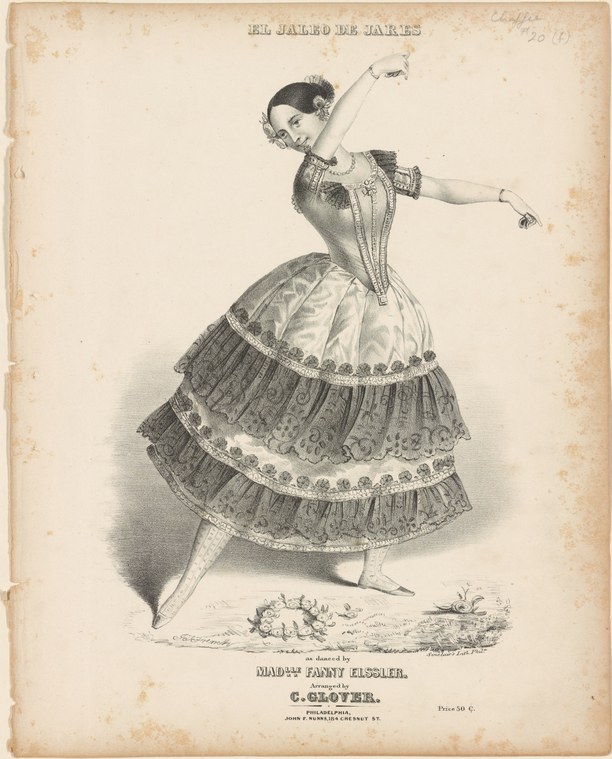
El jaleo de Jeres as danced by Madlle Fanny Elssler
Unknown artist
- Collection:
- Prints depicting dance
- Source:
- New York Public Library
- Rights:
- Public domain — free to use, share and adapt.
- Recorded as:
- Public Domain
Elssler's *El jaleo* was one of the defining works of Romantic-era ballet and one of the first major Western theatrical appropriations of flamenco and Spanish dance forms. Seeing how this dance was visualized—in costume, pose, and setting—reveals how 19th-century European artists and audiences understood both ballet technique and cultural otherness. The work's fame and Elssler's star power also demonstrate the centrality of the female dancer as a public figure and commodity in this period.
What you are looking at
A solo female dancer in mid-performance, captured in a single dramatic moment against a plain background. She wears a corseted bodice with short puffed sleeves and a voluminous skirt composed of multiple deep flounces or tiers, each trimmed with ornate braid or lace in a contrasting pattern. The skirt's construction—with its gathered, ruffled layers—creates a bell shape that extends to her ankles, with her legs visible in ballet-length tights and soft slippers. Her pose is one of exuberant elevation and extension: one arm is raised high overhead in an arc, the other extended outward for balance, and her body leans back in a graceful curve as if caught mid-leap or sustained jump. Her head is tilted back, her dark hair styled in the fashion of the 1840s. At the bottom of the print, a small vignette shows rural figures and a donkey—a reference to the Spanish setting of the dance. The composition is frontal and statuesque, presenting the dancer as the focal point in what appears to be a theatrical or performance pose rather than a casual social moment.
The dancing
A single dancer in an extended, lifted position with excellent verticality and control. Her raised arm frames her head and extends the line of her body upward; her working leg is engaged and her supporting leg is fully engaged under her torso, suggesting considerable strength. The posture is upright and balletic—this is not a grounded folk gesture but a trained, theatrical movement. The dancer's apparent weightlessness, the extension of limbs in space, and the clarity of her frame all demonstrate technical ballet training. The ornate costume and the solitary, highlighted pose emphasize her as a star performer rather than one member of an ensemble.
The dance depicted
This is *El jaleo de Jérez*, a Spanish dance that became a sensation in European ballet theaters during the 1830s–1840s. The title references the jaleo, a flamenco celebration or festive shout, and Jérez de la Frontera, a city in Andalusia. Fanny Elssler (1810–1884) was one of the most celebrated dancers of the Romantic era, and her performance of this work—marketed as authentically Spanish yet thoroughly choreographed for the ballet stage—became one of her signature roles. The combination of the theatrical tutu-like skirt, the balletic port de bras, and the reference to Spanish folk tradition in the engraving's title and vignette all confirm this identification. Elssler's *El jaleo* represented a crucial moment when European ballet absorbed and aestheticized non-Italian, non-French forms, creating what was marketed as exotic spectacle.
How it was made
This is a lithographic or engraved print, likely hand-colored or printed in tones. The fine linear detail in the skirt's decoration, the subtle shading on the figure, and the precision of the composition suggest professional theatrical print production—the kind of souvenir or publicity image circulated to promote a star dancer and her celebrated roles. The technique allowed for rapid reproduction and distribution, making Elssler's image and her signature role widely known across Europe and potentially America. Such prints were collected, sold at the theater, and pasted into scrapbooks, becoming a primary form of dance documentation and celebrity circulation in this period.
About this work
This print documents a key moment in early-19th-century dance history: the Romantic-era ballet's absorption and performance of Spanish/Andalusian dance traditions. Fanny Elssler's *El jaleo de Jérez* was a crossover sensation—a work that claimed ethnic authenticity while employing the technical vocabulary and theatrical apparatus of ballet de cour. The image crystallizes how Romantic ballet positioned itself: as a vehicle for displaying individual female dancers (especially at their technical and physical peak), as a conduit for European fascination with distant or marginalized cultures, and as spectacle built on the contrast between the trained, corseted, ethereal body and the supposed wildness or authenticity of the dance being performed. The print's circulation and collectibility made Elssler's likeness synonymous with this role and this aesthetic moment.
How to look at it
Notice the print's careful balance of elevation and earthiness: the dancer is clearly in a high, trained balletic position, yet the title, costume, and vignette invoke Spain and folk tradition. The artist has frozen a moment of apparent weightlessness and control—a peak moment in the dance, not a step in progress. Observe how the flounces of the skirt are rendered: they are decorative and voluminous but not obscuring; the body and its line remain visible and read as disciplined and trained. The raised arm and extended body create a sense of upward momentum and expansiveness. Compare this image to contemporary prints of Taglioni or other European ballet stars: Elssler is posed with similar technical authority, suggesting that the ballet world's hierarchy and training methods ultimately absorbed and standardized even culturally foreign forms.
The artist
The artist is not recorded in the catalogue, but the print's professional quality, theatrical subject, and publication format suggest it was produced by a commercial print house in Paris, London, or another major European city. Such souvenir prints were typically created by staff engravers or lithographers working from theater sketches or live observation, without independent artistic authorship being attributed. The work is a product of the theatrical and commercial apparatus of Romantic ballet rather than an autonomous artistic statement.
The period
In the 1830s–1840s, Romantic ballet was at its height, characterized by an emphasis on the female dancer, pointe work, flowing skirts (tutus), and an aesthetic celebrating ethereal, otherworldly beauty. Simultaneously, European culture was seized by *Orientalism* and exoticism—a fascination with non-European cultures filtered through European fantasy. Spain, in particular, was a subject of romantic fascination for northern European audiences (see also Victor Hugo's *Hernani* and Mérimée's *Carmen*). Elssler's *El jaleo*, performed from 1836 onward, capitalized on both trends: it positioned ballet technique as universal and superior while packaging Spanish/Andalusian dance as a picturesque spectacle. The work was part of Elssler's deliberate competition with her rival Marie Taglioni for dominance of the European stage; while Taglioni performed ethereal, Christian roles, Elssler claimed the dramatic and exotic.
Where it lives
This print is held in the New York Public Library's Prints collection, which is part of a comprehensive archive of dance-related printed materials from the 18th to 20th centuries. Such prints were typically issued during or shortly after a performer's celebrated run in a role, sold to audiences as mementos, and preserved in institutional collections as documents of theatrical history.
Dance in this work
Questions about this work
Did Fanny Elssler actually perform Spanish dances, or was this theatrical fantasy?
Elssler was an Austrian-born ballet dancer trained in the Viennese tradition. She did not grow up in Spain or in flamenco communities. *El jaleo de Jérez* was a choreographed ballet work that drew on or imitated Spanish/Andalusian movement traditions but was fundamentally a vehicle for displaying her as a trained, theatrical performer. It was marketed as authentic or exotic to European audiences while being entirely a product of the ballet apparatus. This was typical of Romantic-era orientalism and exoticism in dance.
What is the jaleo?
In Spanish culture, a jaleo is a festive shout, cry, or burst of rhythmic excitement—associated with flamenco, folk celebration, and spontaneous communal music-making. In flamenco, jaleo refers to the shouts, claps, and rhythmic encouragement that accompany a performance. Elssler's use of this term in her ballet title was a gesture toward Spanish-ness and cultural specificity, even though the resulting work was entirely balletic and theatrical.
Why is Fanny Elssler important to dance history?
Elssler was one of the two greatest ballet stars of the Romantic era (alongside Marie Taglioni) and the first to successfully market herself as a dramatic and exotic performer rather than a ethereal one. She expanded the repertory and social range of ballet, pioneered the star dancer as a global celebrity (touring the Americas in 1840–42), and demonstrated that technical ballet training could be harnessed to perform styles and narratives far beyond the classical court tradition. Her career helped establish the female ballet dancer as a central cultural figure.
Why was Spanish dance so fashionable in 1830s–40s Europe?
Spain held a powerful place in the European Romantic imagination—associated with passion, wildness, danger, and exoticism. Works like Hugo's *Hernani* and Mérimée's *Carmen* capitalized on this. Northern European audiences were fascinated by Spain's position as partially foreign (culturally and religiously different), its history under Islamic rule, and its association with flamenco and folk traditions. This made Spanish dance an ideal material for Romantic theater, which sought the exotic and the dramatic.
More dance artwork





