49 works in this view — arrow keys or swipe to move between them.
Dance in Art
Footlight
Unknown artist
- Collection:
- Prints depicting dance
- Source:
- New York Public Library
- Rights:
- Public domain — free to use, share and adapt.
- Recorded as:
- Public Domain
This work is a rare documentary record of how a mid-nineteenth-century ballet tableau was visualized and celebrated. For historians, it provides evidence of costume, staging, composition, and the physical vocabulary considered desirable in a leading dancer of the era. For dancers and choreographers, it offers insight into the visual and spatial conventions of romantic ballet — the use of vertical extension, radial composition, and the orchestration of corps or attendant figures around a soloist.
What you are looking at
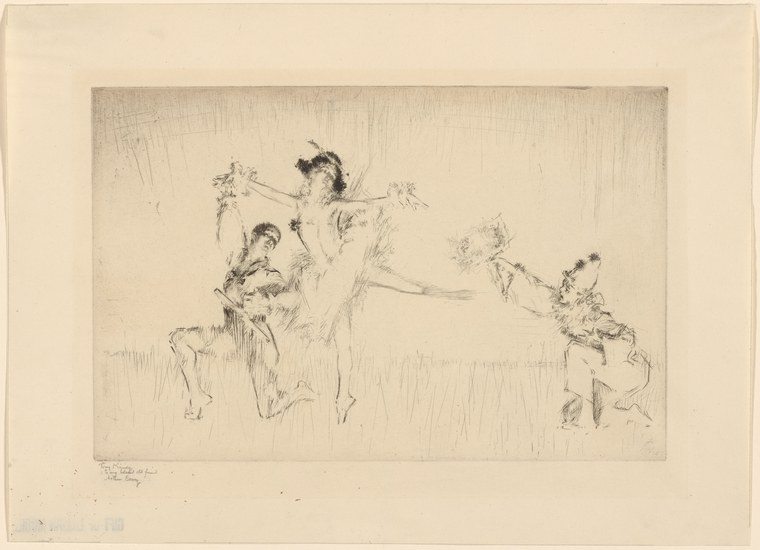
This etching depicts a moment of theatrical performance on a brightly lit stage. A central female figure in a classical pose dominates the composition, her body elongated and graceful, arms extended outward in a gesture of breadth and abandon. She is attended by smaller figures — possibly cherubs or child attendants — positioned at her sides and below, reaching toward her or holding flowering garlands. The setting suggests the interior of a theatre, with the background rendered in fine parallel lines that suggest both architectural depth and the shimmer of gaslight or footlights. The figures are rendered in delicate, nervous line work typical of etching technique, with minimal modeling; the eye reads the composition through silhouette and gesture rather than volume. The overall effect is one of lightness and theatrical artifice — a moment of apotheosis or unveiling under the gaze of an invisible audience.
The dancing
The principal dancer stands with her weight distributed evenly but with a slight lift through the torso; her arms spread wide in a neoclassical or romantic attitude of expansiveness, palms open and fingers extended. The smaller attendant figures cluster below and to either side in asymmetrical arrangement, their bodies bent and gestural, hands raised in devotional or celebratory poses. There is no closed hold or ballroom frame; the movement is vertical and radiating outward from the central figure. The artist has captured a moment of stillness rather than locomotion — this is a pose held for the audience rather than a step in motion.
The dance depicted
This appears to represent the apotheosis scene or final tableau of a romantic-era theatrical ballet, likely from the mid-nineteenth century. The central figure's elevated stance, the attendant figures, the theatrical lighting, and the classical drapery all point to ballet d'action conventions of the 1840s–1860s. The image may document or celebrate a moment from a well-known production, possibly one performed at a major European theatre. The absence of pointe shoes and the classical rather than romantic silhouette suggest this could be earlier — perhaps from the 1830s or even the neoclassical ballet tradition of the early 1800s. Without more documentation, it is difficult to identify the specific ballet or even the specific scene.
How it was made
This is an etching, a printmaking technique in which an image is incised into a metal plate (copper) with a needle, then inked and printed. The characteristic fine parallel lines visible throughout the image — especially in the background and in the definition of drapery — are hallmarks of etching. The delicate, expressive linework and the ability to capture subtle tonal gradation through varied line density made etching a favored medium for theatrical portraiture and documentation in the nineteenth century. As a print, this work was reproducible and could circulate widely among theatregoers, critics, and collectors, making it a form of popular theatrical documentation.
About this work
This etching captures a moment of theatrical spectacle at the height of romantic-era ballet, showing a soloist in a pose of classical elevation attended by allegorical figures. The work is both a record of performance and a celebration of the aesthetic ideals of its time — lightness, transcendence, and the fusion of classical form with theatrical narrative. It belongs in a collection of dance in art because it documents not a specific step or technique, but rather the visual language and staging conventions through which nineteenth-century audiences understood ballet as an art form. The image preserves the ephemeral moment of live performance in a medium designed for circulation and remembrance.
How to look at it
Observe how the artist has organized the composition around the central figure's extended arms and lifted torso — she is the apex toward which all other elements converge. Note the contrast between the solidity of the stage floor (suggested by the lower figures' weight and poses) and the ethereal, almost floating quality of the main figure's stance. The title 'Footlight' points directly to the source of illumination: the lights at the front edge of the stage that create both the visual drama and the distinction between performer and audience. This is not naturalistic movement but a pose held for presentation — the moment of being seen.
The period
This etching was made during or shortly after the golden age of romantic ballet in Europe (c. 1830–1870). The romantic era saw the rise of the ethereal, weightless female dancer as an ideal — epitomized by figures like Marie Taglioni — and a shift toward narrative ballets set in fantastical or exotic worlds. Theatres were increasingly well-lit by gas lamps, which made the stage a space of heightened visibility and artifice. The etching format was a standard way of documenting and celebrating theatrical performances for audiences who could not attend live; such prints were sold as souvenirs and hung in homes as mementos of celebrated dancers or ballets.
Where it lives
This work is held in the NYPL's collection of prints depicting dance, a curated assembly of theatrical and dance-related printwork spanning several centuries. The object is catalogued as 'Footlight' but the artist and date are not recorded in the available catalogue information.
Dance in this work
Questions about this work
Is this a record of an actual performance or an imaginative scene?
Almost certainly a record of a real performance or at least a celebrated dancer and ballet of the era. Theatrical etchings of this type were commissioned to document and commemorate successful productions and celebrated performers. However, without the artist's name and date, and without the title of the ballet, we cannot identify the specific production. The print may have been made during the run of the ballet or years afterward, based on dancers' recollections or earlier drawings.
Why is she not on pointe?
This suggests the work predates the era of Romantic pointe technique or documents a moment in which the dancer was meant to be grounded rather than elevated. Many romantic-era ballets included both supported and elevated moments. Alternatively, the etching technique may not have been capable of rendering the fine point of a foot en pointe with sufficient clarity, and the artist may have chosen a more legible pose.
What do the smaller figures represent?
In romantic ballet convention, such attendant figures typically represent sylphs, spirits, maids, or other allegorical beings. They are often rendered smaller than the principal to emphasize hierarchy and focus audience attention on the soloist. Their upturned faces and reaching gestures suggest devotion, support, or celebration of the principal dancer.
How would I find this ballet if I wanted to know its name?
The NYPL catalogue should list any known title or source ballet. If the title 'Footlight' is the only designation, you might search the library's online collection by date range (if estimated), search for other impressions or related prints, or consult histories of romantic-era ballet and celebrated dancers of the period. A print dealer or rare books specialist in theatrical history might also help identify the work.
More dance artwork





