49 works in this view — arrow keys or swipe to move between them.
Dance in Art
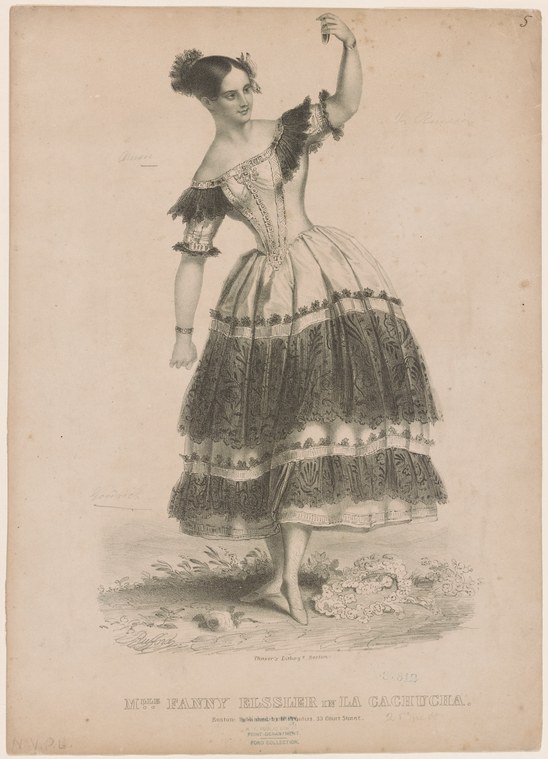
Mlle. Fanny Elssler in La cachucha
Unknown artist
- Collection:
- Prints depicting dance
- Source:
- New York Public Library
- Rights:
- Public domain — free to use, share and adapt.
- Recorded as:
- Public Domain
Fanny Elssler was one of the defining figures of Romantic ballet and a rival to Marie Taglioni; her performances and persona shaped ballet history in the 1830s–1840s. This image is a primary record of how she and her role were presented to the public, showing the gap between the trained classical technique visible in her posture and the exotic, 'national' character she was asked to embody. For historians of dance imagery and theater portraiture, it is a precise document of how celebrity performers were commodified and circulated.
What you are looking at
A young woman in Romantic-era theatrical dress stands alone against a bare ground, gazing upward and to the side with one arm raised in a graceful arc. She wears a white off-shoulder bodice with short puffed sleeves trimmed in lace, and a full skirt of layered white gauze beneath darker patterned silk panels arranged in horizontal tiers—a costume typical of the 1830s–1840s stage. Her dark hair is styled up with a decorative element, and she stands on the balls of her feet, almost en demi-pointe, suggesting the dancer's trained posture. The setting is minimal and nonspecific: a simple ground line with minimal scenery, focus entirely on the figure and her deportment. The engraving technique creates fine lines and careful tonal gradation, giving the image the character of a theatrical souvenir print.
The dancing
The dancer is captured in a single, lyrical pose rather than mid-motion: one arm raised overhead in a soft curve, the other at her side, torso upright and graceful. Her weight appears to be on the balls of her feet, suggesting trained elevation and the lightness valued in Romantic ballet. The pose is portrait-like—a moment of poise and presentation rather than vigorous action—which was characteristic of the promotional imagery of famous ballerinas of this era. The stillness and elegance of the frame emphasize line and epaulement over dynamic movement.
The dance depicted
This is a portrait of the Austrian ballerina Fanny Elssler performing or in the character of a cachucha dancer. The cachucha is a Spanish solo dance in triple meter, popular in European theaters from the 1830s onward, and Elssler's performance of this piece became one of her signature roles. The image does not show her mid-cachucha in its rapid footwork and hip action; instead it captures the composed, elegant presentation of a trained classical ballet dancer—which is what Elssler was. The costume is a stage adaptation, romanticized and etherealized with gauze: theatrical rather than authentically Spanish.
How it was made
This is a steel or copper engraving, a technique that allowed fine detail and mass reproduction. The linear hatching creates form and shadow, and the composition and printing quality suggest it was a commercial print, likely sold as a theatrical souvenir or artistic memento. The technique was standard for dance and theater portraiture of the 1830s–1840s, enabling wide distribution among theater-goers and collectors. The inscription at the base would have carried the dancer's name and role, making it a form of publicity and a record of a famous performance.
About this work
This is a engraved theatrical portrait of Fanny Elssler, one of the most celebrated ballerinas of the Romantic era, in her famous role as a cachucha dancer. The work is not a document of the dance itself in action, but rather a formal portrait of the dancer in character—a genre that dominated visual records of nineteenth-century performance. Elssler was known for her technical brilliance, her earthy and engaging presence (in contrast to the otherworldly Romantic ideal represented by her rival Marie Taglioni), and her ability to master diverse dance styles. The cachucha, a Spanish solo that became a European stage sensation through her performances, exemplified her appeal: technically demanding yet theatrically vivid.
How to look at it
Look at the precision of the pose: the raised arm in a soft overhead arc, the upright spine, the elevated heels. These are signs of rigorous classical training, not the free-spirited authenticity the role of cachucha dancer was meant to suggest. The costume—the white gauze, the lace, the layered silk—is theatrical fantasy, not Spanish reality. The engraver has rendered the dancer as an ideal figure, poised and statuesque, which tells you as much about how the 1830s public wanted to see ballerinas as it does about how Elssler actually danced.
The artist
The artist is not recorded. The print was produced commercially in Paris or London, likely by a reproductive engraver working from a drawing or painting. Such prints were typically unsigned or signed only with the engraver's name, and they were made to order for theatrical production companies and sold through print shops. The style and quality suggest a professional house specializing in theatrical and celebrity portraiture.
The period
This print dates to the height of the Romantic ballet era, when Fanny Elssler's career was at its peak (c. 1834–1844). The 1830s–1840s saw an explosion of theatrical portraiture and the mass production of prints commemorating famous performers. Lithography and engraving competed as the dominant media for such images, both allowing relatively inexpensive reproduction and wide circulation. The cachucha itself gained European popularity through the 1830s, partly due to Elssler's performances, as part of a broader Romantic fascination with 'national' and 'exotic' dance forms. The image reflects both the technical mastery of classical ballet training and the Romantic era's hunger for character, emotion, and theatrical spectacle.
Where it lives
This engraved print is part of the New York Public Library's collection of dance-related prints and theatrical imagery. It is a commercial theatrical souvenir, likely published in Paris or London during Elssler's active performance years (c. 1830s–1840s).
Dance in this work
Questions about this work
Who was Fanny Elssler?
Fanny Elssler (1810–1884) was an Austrian ballerina and one of the two greatest dancers of the Romantic era, the other being Marie Taglioni. She was known for her technical brilliance, her charisma, and her mastery of different dance styles—from classical ballet to character and national dances. She performed across Europe and America and was a celebrity of her time.
What is a cachucha?
The cachucha is a Spanish solo dance in triple meter, often performed with castanets or the heels and rhythm of footwork. It became a theatrical sensation in Europe in the 1830s, partly through Elssler's performances. The European version was romanticized and theatricalized; it was less about authentic Spanish tradition than about the Romantic appetite for exotic and national character.
Why is this portrait so formal and posed?
Theatrical portraits of the era were typically formal and composed, designed to be sold as souvenirs and to capture the ideal image of the dancer rather than the moment of performance. They were promotional tools, not action photographs. They showed the dancer's beauty and bearing rather than the visceral reality of the dance.
How do we know this is an engraving?
The linear hatching and tonal gradation, the fine detail, and the style of reproduction all point to a copper or steel engraving. Engravings were labor-intensive but produced durable plates and fine impressions, making them the premium choice for theatrical portraiture of this era.
More dance artwork





