49 works in this view — arrow keys or swipe to move between them.
Dance in Art
Holiday festivities in colonial times; dancing the Virginia reel
Unknown artist
- Collection:
- Prints depicting dance
- Source:
- New York Public Library
- Rights:
- Public domain — free to use, share and adapt.
- Recorded as:
- Public Domain
The Virginia reel is foundational to American social dance history, yet visual documentation from the period is sparse. This engraving shows how the dance was understood and represented in the 19th century, and serves as evidence of its persistence in American cultural memory long after the colonial era. For historians and dancers, it is a rare image of a specific dance formation and a reminder that dances like the Virginia reel were not solo performances but collective, orderly social practices that expressed the values of their time.
What you are looking at
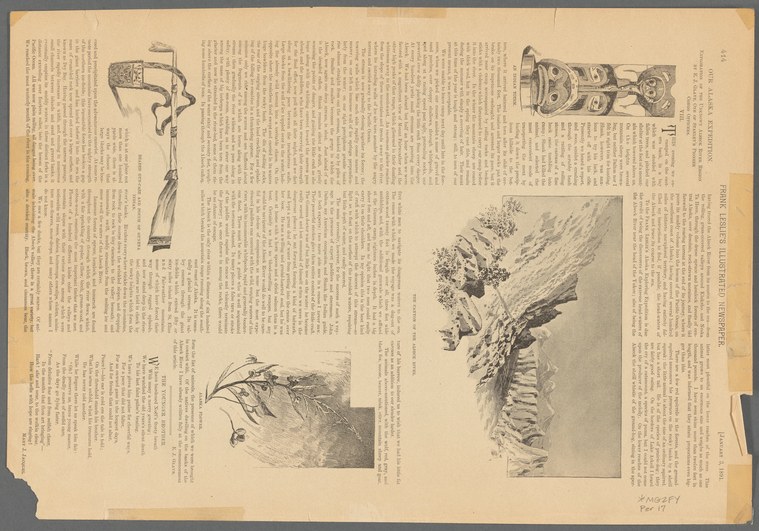
This is a densely printed page from a historical periodical or encyclopedic work, featuring three separate illustrations of colonial American social life. The central and largest image shows a Virginia reel in progress: couples in 18th-century dress stand in two facing lines, the men in breeches and coats, the women in full skirts. The composition captures the orderly, processional nature of the dance, with figures arranged along a clear spatial axis. To the upper left is a detailed drawing of what appears to be a decorative vessel or implement, possibly related to colonial festivities. The lower left shows a botanical illustration of flowering plants. The dense columns of printed text surrounding these images suggest this is a scholarly or educational article on colonial holiday customs and material culture. The paper is aged and yellowed, consistent with 19th-century printing.
The dancing
The Virginia reel dancers are positioned in two parallel lines facing each other—the classical formation for the dance. The figures are shown standing upright in formal posture, the women's full skirts clearly delineated, the men in period coat-and-breeches silhouettes. The spacing between the lines and the positioning of individual couples suggests the orderly, processional step-down of the reel, where couples take turns traveling the length of the line. There is no suggestion of wild or exuberant movement; instead, the composition conveys the structured, almost ceremonial character of colonial-era ballroom dancing.
The dance depicted
This is a Virginia reel, a couple dance that became a signature of colonial American social life in the 18th century, imported from Scotland and adapted to American custom. The Virginia reel was danced in two long lines of couples facing each other, with couples progressing down the line in a series of turns, chassés, and reels. It was primarily a social dance for mixed company at formal occasions—taverns, assemblies, and domestic celebrations. The image shows the formation and approximate spacing of such a reel, though the still image cannot convey the footwork or the specific turning mechanics that characterized the dance.
How it was made
This is a wood engraving or steel engraving, identified from the fine parallel-line hatching and the tonal quality achieved through dense, controlled mark-making. The image appears in a printed periodical or book alongside substantial text, indicating 19th-century mass production. The use of engraving rather than lithography or photographic reproduction suggests a work from the mid-to-late 19th century, when engraved illustrations remained the standard for educational and historical publications. The technique allowed for precise rendering of period costume and spatial relationships, and its circulation in a periodical format suggests a educated, general readership interested in colonial history and material culture.
About this work
This is an illustration from a 19th-century historical or encyclopedic work on colonial American holidays and social customs. It documents the Virginia reel, one of the most significant social dances of the colonial and early American period, and represents it in the formal, orderly manner that characterized such dances in polite society. The work belongs in a gallery of dance imagery because it is both a historical document—a record of how this dance was understood and taught—and a window into the role of dance in colonial social hierarchy and courtship. The Virginia reel was not merely entertainment; it was a ritualized practice that taught young people propriety, grace, and appropriate interaction across gender lines. This engraving preserves that understanding for later generations.
How to look at it
Attend first to the formation: the two facing lines are the essential spatial structure of the Virginia reel, and no other common social dance of the period uses this arrangement. Observe the spacing between the lines and the positioning of couples—this shows how the dance accommodated multiple couples in sequence. Notice the formal upright posture of all the figures and the absence of any suggestion of rapid or vigorous movement; the Virginia reel was danced with restraint and propriety, not exuberance. The detail of the women's skirts is historically significant, as the full skirts of the period required dancers to manage their garments while executing turns and chassés.
The period
The Virginia reel emerged in Scotland in the 17th century as a variant of the English country dance, and was brought to America by Scottish and English settlers. By the 18th century it had become the dance of choice at American assemblies and social gatherings, particularly in the South and Mid-Atlantic colonies. It remained popular into the 19th century, though its prominence had declined with the rise of the waltz and other couple dances. This illustration likely dates from the mid-to-late 19th century, when antiquarian interest in colonial life was strong; the framing of the Virginia reel as a quaint relic of 'colonial times' suggests that by the time this was printed, the dance had already begun to be associated with the past rather than the present.
Where it lives
This work is held by the New York Public Library as part of its collection of prints depicting dance. It appears to be extracted from a larger publication—likely a 19th-century periodical, encyclopedia, or historical monograph on colonial American life and customs. The original date of publication and the specific source work are not recorded.
Dance in this work
Questions about this work
What is the Virginia reel?
The Virginia reel is a couple dance in which two lines of dancers stand facing each other and progress through a series of coordinated figures—reels, turns, and chassés—down the length of the lines. Each couple takes a turn 'traveling' while the others stand still, creating an orderly, processional movement. It was a standard social dance in colonial America and remains part of American folk dance tradition today.
Why is this dance called the Virginia reel?
The dance has Scottish origins but became especially popular in colonial Virginia and other American colonies, where it was adapted and became a fixture of social life. The name reflects its association with Virginia, though it was danced throughout colonial America. By the 19th century, when this illustration was made, 'Virginia reel' had become the standard American name for the dance.
How do we know this is a Virginia reel and not another colonial dance?
The two facing parallel lines of couples are diagnostic of the Virginia reel and country dances of similar type. This formation distinguishes it from the minuet (which is danced by a single couple) or from the cotillion or quadrille (which typically involve four couples in a square formation). The title of the source work confirms the identification.
What does the formal posture of the dancers tell us?
The upright, restrained posture reflects the ballroom context and the class conventions of colonial and early American society. This was dance as courtship ritual and social discipline, not as physical play or expression. The formality of the image reveals that propriety and decorum were central to the meaning of such dances.
More dance artwork





