49 works in this view — arrow keys or swipe to move between them.
Dance in Art
Apache dancers
Unknown artist
- Collection:
- Prints depicting dance
- Source:
- New York Public Library
- Rights:
- Public domain — free to use, share and adapt.
- Recorded as:
- Public Domain
The Apache is rarely represented in visual art despite its historical significance as a flashpoint between working-class culture, theatrical spectacle, and middle-class anxiety. This print is evidence of how the dance was staged and promoted, and it captures the specific acrobatic vocabulary—the backward arch, the close hold, the asymmetrical energy—that made the Apache distinct. For historians of dance, performance, and urban culture, this image documents a brief but culturally resonant moment when street dance entered the theater.
What you are looking at
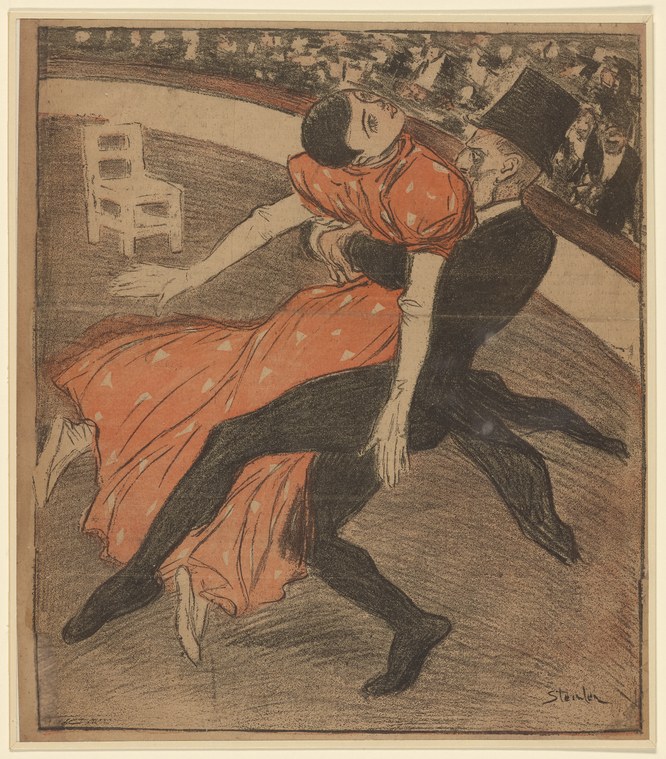
A man in formal evening dress—dark suit, white shirt, and top hat—dances with a woman in a striking red-orange gown. The woman's dress is high-waisted and draped dramatically across her body, with flowing fabric that sweeps across the composition. The couple occupies the center foreground, captured mid-movement against a background of onlookers; the man's posture is upright and animated, leaning slightly, while the woman's body arches back dynamically, her head tilted upward. The setting appears to be an indoor social venue, rendered in muted tones of brown and tan with dark shadows. A simple chair is visible in the background to the left. The overall mood conveys urgency and intensity—this is not a formal ballroom pose but a moment of vigorous, almost aggressive physical engagement.
The dancing
The man holds the woman in a close embrace with his right arm across her back; his left arm extends outward and slightly upward. The woman's body is arched dramatically backward, her torso extended, her left arm raised high. Both figures are in strong asymmetrical positions suggesting rapid weight shift and traveling movement. The composition emphasizes verticality and tension rather than the parallel symmetry typical of ballroom hold. The energy reads as combative or highly charged rather than graceful.
The dance depicted
The title 'Apache dancers' identifies this as depicting the Apache, a pair-dance of Parisian origin that emerged in the early 1900s and became associated with working-class nightclub culture. The Apache was performed by couples in close, often dramatic holds, characterized by sudden shifts, lifts, and a theatrical roughness that scandalized bourgeois observers. The physical aggression and backward arch of the woman's body shown here aligns with Apache vocabulary—a style that fetishized street toughness and danger. The formal dress of the male figure (not typical Apache street costume) suggests this may document stage or theatrical versions of the dance rather than its authentic nightclub origins.
How it was made
This is a color woodcut or lithograph, identifiable by the bold outlines, limited palette, and characteristic flattened modeling of form. The artist has used two tones of red-orange for the woman's dress, brown and black for the man and background, and cream for highlights and the skin. The simplification of shadow and the reliance on contour line are consistent with early 20th-century printmaking techniques used for posters and commercial illustration. This mass-production method implies the image was intended for wide circulation—as a poster, periodical illustration, or postcard—rather than as a unique work.
About this work
This print documents the Apache, a controversial pair-dance that emerged from Parisian nightlife around 1900–1910 and generated intense artistic and moral attention. The Apache scandalized respectable society through its close contact, dramatic lifts, and theatrical simulation of street violence. By depicting the dance in a formal medium with careful attention to costume and movement, the artist—likely a chronicler of contemporary urban entertainment—records both the physical vocabulary of the Apache and its commodification for theater and public consumption. The work belongs to a substantial archive of early modernist prints depicting newly visible forms of popular dance, from music-hall entertainment to street culture, at a moment when dance was becoming a subject worthy of artistic attention.
How to look at it
Observe the woman's arched back and the dynamic asymmetry of the pose—this is the signature gesture of the Apache, a moment of maximum dramatic tension and physical display. Notice the formal clothing, especially the top hat: this signals that what you are seeing is not street dancing but a theatrical rendering, likely from a music-hall or cabaret performance. The artist has frozen the moment of greatest visual impact rather than a balanced or static pose, emphasizing the dance's appeal as spectacle. The flat, bold printing technique and limited color palette are itself a kind of shorthand—the image is designed to circulate quickly and widely, as a poster or press image, capturing the public's hungry curiosity about this scandalous new entertainment.
The period
The Apache emerged in Paris around 1900 in cafés and music halls, performed by dancers who often drew on or were drawn from the city's working-class and criminal subcultures. The dance became an international phenomenon and was adapted for theatrical performance, revue, and even ballet. Early 20th-century visual artists, printmakers, and illustrators found the Apache compelling as a subject of modernity—it represented the raw, unpolished energy of contemporary urban life in contrast to classical dance. The formal evening dress of the male figure in this print suggests the image documents a theatrical or staged version, part of the Apache's transformation from street entertainment into commercial spectacle. This was an era of intense artistic interest in popular entertainment as subject matter, particularly by artists influenced by Japanese woodblock techniques and Art Nouveau design.
Where it lives
This print is held in the New York Public Library's collection of prints depicting dance. It is part of a broader archival effort to document entertainment, popular culture, and visual representations of movement in the modern period.
Dance in this work
Questions about this work
What is the Apache dance?
The Apache was a partner dance that originated in the working-class cafés and music halls of Paris around 1900. It was characterized by close physical contact, dramatic lifts, sudden shifts in weight, and theatrical roughness. The dance often involved stylized portrayals of street conflict and danger, and it became controversial among respectable society while remaining popular in cabarets and eventually in theatrical productions.
Why are they dressed so formally if this is Apache?
Street Apache dancers typically wore working-class or street clothing. This formal dress—the man's top hat and suit, the woman's elegant gown—indicates that this print documents a theatrical or music-hall version of the Apache, not the dance as performed in actual street culture. By the early 1900s, the Apache was being staged for paying audiences, which required adaptation and refinement of costume.
Why would this have been controversial?
The Apache's close body contact, physical aggression, and sexual charge violated norms of respectable dance and conduct. Bourgeois observers viewed it as vulgar, immoral, and linked to criminality and urban decay. Its association with working-class culture and the underworld made it fascinating to avant-garde artists but threatening to conservative society.
Who created this print?
The artist is not recorded in the catalogue. However, the style and technique suggest an early 20th-century printmaker, likely European, working in the mass-circulation markets of posters, periodicals, and postcards. The Apache was popular enough to have generated significant commercial imagery.
More dance artwork





