49 works in this view — arrow keys or swipe to move between them.
Dance in Art
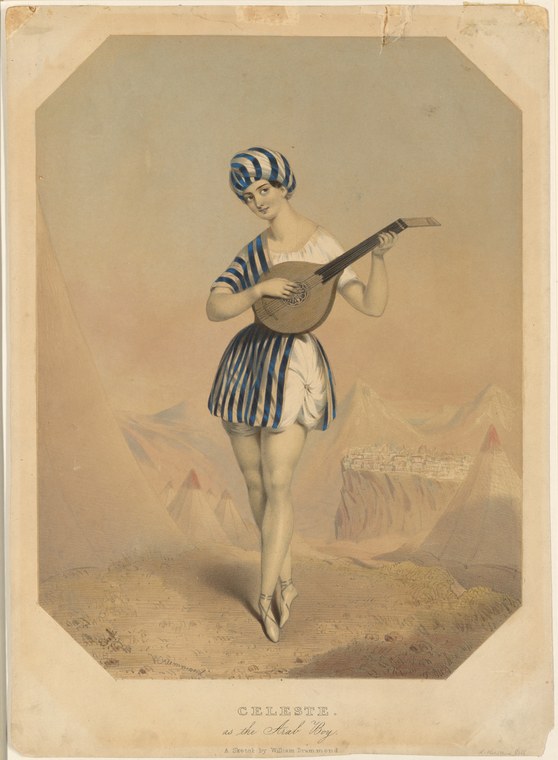
Celeste as the Arab boy
Unknown artist
- Collection:
- Prints depicting dance
- Source:
- New York Public Library
- Rights:
- Public domain — free to use, share and adapt.
- Recorded as:
- Public Domain
This print documents the theatrical dance and character performance of a significant but now-obscure performer whose work bridged dance, pantomime, and dramatic acting in the Romantic era. It is evidence of the centrality of Orientalist fantasy to early 19th-century popular entertainment and of the commercial circulation of celebrity performer images. For dance historians, it reveals the aesthetic values of the period: the emphasis on theatrical presence and costume over technical demonstration, and the role of individual charismatic performers in creating iconic theatrical moments.
What you are looking at
A young woman stands alone in the center of the composition, posed in a classical contrapposto stance against a warm, sandy background. She wears a short tunic with bold vertical stripes in dark blue and white, leaving her legs bare, and a matching striped headpiece or cap. She holds a long-necked lute or similar stringed instrument horizontally across her body, angled as though she is about to play or has just finished playing. Her posture is graceful and theatrical—weight shifted onto one leg, the other slightly relaxed—and her gaze is directed downward toward the instrument. Behind her, rendered in much lighter tones, are indistinct camp structures or tents, suggesting an exotic or foreign setting. The entire composition is framed within an octagonal border, and a caption reading "CELESTE as the Arab boy" appears below the image.
The dancing
The figure is a single dancer depicted in a moment of poised stillness rather than dynamic movement. She stands in an elegant S-curve or contrapposto, with her weight over her back leg and her front hip released forward, a posture common in theatrical dance training of the 19th century. Her arms frame the instrument, one extended and one flexed, creating an open, demonstrative upper body. The positioning suggests a performer addressing an audience or held in a moment of choreographic display rather than naturalistic action. Her bare legs and pointed foot position hint at a balletic vocabulary, though the costume and setting contradict classical ballet practice.
The dance depicted
This is a theatrical dance portrait, most likely depicting a scene from a Romantic-era theatrical production or pantomime in which the performer Celeste took a starring role. The title identifies the character as "the Arab boy," placing this in the context of Orientalist fascination characteristic of 19th-century European theater. The costume—striped tunic, bare legs, and decorative headpiece—signals exoticism rather than authentic ethnographic dress. The lute and camp setting reinforce the Near Eastern fantasy. Celeste was a celebrated dancer and actress of the 1830s–1840s, known for her versatility in character roles and acrobatic virtuosity. The image preserves a specific theatrical characterization rather than documenting a particular dance form or technique.
How it was made
This is a hand-colored lithograph or engraving, produced using the commercial theatrical print methods of the early-to-mid 19th century. The fine line work, subtle shading, and delicate color application suggest a skilled lithographic or engraved plate, hand-finished with watercolor or tinted pigment. The octagonal framing and formal composition follow the conventions of celebrity theatrical portraiture of the 1830s–1840s, a genre designed for mass circulation among theater-goers and collectors. The warm, muted palette and the precise delineation of the figure against a soft background are typical of this period's portrait technology, which could reproduce a likeness quickly and affordably for wide distribution.
About this work
This is a theatrical dance portrait of Celeste in the role of "the Arab boy," a character role from early 19th-century Romantic-era theater. The print captures not a dance form but a theatrical character and moment—a performer in exotic costume, poised with an instrument, embodying the era's fascination with Oriental fantasy and spectacle. Celeste was celebrated for her combination of dance, mime, and acrobatic skill across multiple theatrical genres, and this image documents one of her most memorable character turns. The work belongs in the history of theatrical dance not because it depicts a recognizable technique or tradition, but because it records how a major performer of the period inhabited dramatic roles through physical presence and costume.
How to look at it
Note the precise moment the artist chose: not mid-movement, but in a posed, statuesque stillness that allows the audience to take in both the character (through costume and setting) and the performer's physical presence and grace. The bare legs and pointed foot position reference the balletic training underlying theatrical performance of the era, while the exotic costume signals the fantasy or pantomime context. The downward gaze and the way the hands frame the instrument create an impression of focused artistry or vulnerable femininity, depending on how the viewer reads the character. The soft, indistinct background keeps the focus entirely on the figure and her costume, a compositional choice that emphasizes the performer's body as the central attraction.
The period
This print dates to the 1830s–1840s, the height of European Romanticism and the so-called 'Romantic ballet' era, though it documents a performer working largely outside classical ballet. Celeste's career coincided with the rise of the celebrity theater star and the commercial theater print as a form of fan culture. The Orientalist fantasy depicted here reflects the widespread European obsession with the Ottoman Empire, North Africa, and the Near East, an aesthetic that shaped music, visual art, theater, and dance throughout the period. Theatrical portraiture of this kind was produced in large numbers and distributed cheaply, making it a primary medium through which the public encountered and remembered major performers.
Where it lives
This print is held in the New York Public Library's collection of prints depicting dance, a genre collection formed to document theatrical and social dance across media and periods. Lithographic and engraved theatrical portraits of performers were produced in large editions and circulated through print sellers, theaters, and collectors; this example is typical of commercial dance portraiture from the 1830s–1840s.
Dance in this work
Questions about this work
Who was Celeste?
Celeste was a celebrated dancer, actress, and performer active in European and American theater from the 1820s through the 1840s, known for her versatility in character roles, acrobatic ability, and pantomimic skill. She was a major star of the Romantic era and performed across multiple genres, from ballet to melodrama to spectacular pantomime. While now largely forgotten, she was widely celebrated during her lifetime and her image was circulated widely through theatrical prints.
What is an 'Arab boy' in 1830s theater?
This is an Orientalist fantasy role, part of the widespread European fascination with the Near East during the Romantic period. The costume, setting, and title are theatrical inventions with no ethnographic basis, reflecting the aesthetic and commercial priorities of European theater rather than any actual cultural practice. Such roles were common in pantomime, melodrama, and mixed-genre spectacles of the era.
Is this a ballet?
Not in the classical sense. While the figure's training is evident in her posture and the balletic conventions visible in her leg position, this represents a broader theatrical dance idiom that combined ballet technique with pantomime, character acting, and acrobatics. Celeste was known for this hybrid approach, working across genres rather than within the rigid classical ballet tradition.
How should I interpret the bare legs?
In classical ballet of the 1830s, bare legs (or legs in flesh-colored tights) were standard; this was revolutionary and controversial when first introduced, but had become the norm by this period. Here, bare legs serve both to display the dancer's trained body and to signal the theatrical/acrobatic context of the performance, distinguishing this from the more formally costumed roles of classical ballet.
More dance artwork





