49 works in this view — arrow keys or swipe to move between them.
Dance in Art
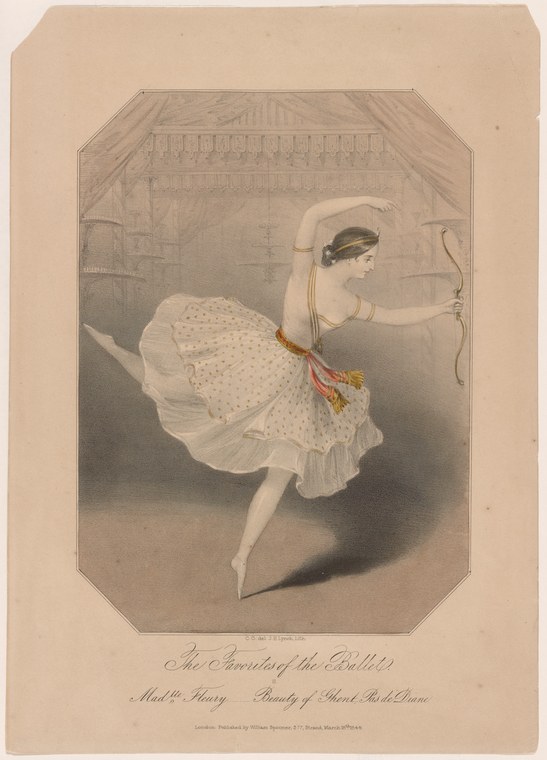
Madlle. Fleury, Beauty of Ghent, pas de Diane
Unknown artist
- Collection:
- Prints depicting dance
- Source:
- New York Public Library
- Rights:
- Public domain — free to use, share and adapt.
- Recorded as:
- Public Domain
This image is a crucial document of romantic ballet as it was actually danced and promoted in the 1840s, showing the exact costume, body line, and characterization an educated audience of the period would have recognized. The specificity of the credit—naming both dancer and choreographer's work—demonstrates that dancers were recognized as individual artists with distinct roles and reputations, not interchangeable performers. The survival of such prints, and their presence in archives like the New York Public Library, shows how dance history is preserved through theatrical ephemera.
What you are looking at
A young female dancer in a light, romantic costume is caught in mid-movement against a dark, shadowed interior space. She wears a pale dress with a fitted bodice decorated with small dots or sequins and a voluminous skirt of sheer, pleated fabric that billows around her legs. Her dark hair is pulled back smoothly, and she gazes upward and to the side with an ethereal expression. She holds what appears to be a bow and arrow or hunting prop in her raised right hand, the implement catching light against the dark background. The setting suggests a classical interior—possibly a temple or palace interior indicated by the architectural details visible at top—rendered in muted tones that emphasize the brightness of her figure and costume. The composition is vertical and intimate, focusing entirely on the solitary dancer poised in a moment of graceful suspension.
The dancing
The dancer stands in a pose of balletic elegance, her weight appearing to rest lightly on her legs while her torso twists gently upward. Her left arm is raised, hand near her head in a classical port de bras, while her right arm extends to hold the hunting implement. Her head is tilted back and turned, creating an S-curve through her spine typical of romantic-era ballet. The pose suggests she is either ascending into a jump or caught at the apex of one, with the musculature and line of the legs implying a trained classical technique. Her costume—a short, full skirt—is characteristic of mid-nineteenth-century theatrical dress and permits the visibility of the dancer's legs and footwork.
The dance depicted
This is unmistakably a romantic ballet of the mid-nineteenth century, most likely from the 1840s based on the costume, pose, and theatrical style. The catalogue identifies this as "Madlle. Fleury, Beauty of Ghent, pas de Diane"—a solo or group dance from a work that remains to be identified with certainty. The "pas de Diane" nomenclature indicates a dance in the style or character of the goddess Diana, the huntress, which explains the bow and arrow. The pose and ethereal quality are consistent with the sylph-like, otherworldly qualities that defined romantic ballet of this era. The technical vocabulary visible—the elongation, the port de bras, the weight distribution—reflects the classical ballet training codified in the Cecchetti and Vaganova methods that were being systematized during this period.
How it was made
This is a hand-colored engraving or lithograph, a reproductive print technique that allowed wide circulation of popular stage images during the nineteenth century. The subtle tonal gradations in the background—the deep shadows that frame the luminous figure—suggest the work of a skilled colorist working from a tonal base plate. The print technique permitted exact reproduction and distribution to audiences who had seen or wanted to see the dancer perform, making this both a souvenir and a promotional image. The quality and finish suggest this was a professional theatrical print, likely published in France or Belgium given the subject matter and the names invoked.
About this work
This is a theatrical print documenting a moment from romantic ballet during its golden age in the 1840s. It preserves the image of a specific dancer, Madlle. Fleury, performing a solo or featured role in a work centered on classical mythology. The print captures the aesthetic ideals of romantic ballet—weightlessness, ethereal beauty, technical precision combined with an impression of effortlessness—that made this era foundational to modern ballet. As a reproductive print, it is one of thousands of such images that circulated during the period, creating a shared visual culture around theatrical dance and allowing dancers to achieve fame and reputation beyond their own cities and stages.
How to look at it
Attend to the pose itself: the dancer is caught not in a fully grounded moment but in a state of suspension or ascent, with the body elongated and the weight lifted. The artist has chosen the apex of the movement, the moment of apparent weightlessness that was the whole goal of romantic ballet technique. Notice how the costume—transparent, short, pale—is used to display the dancer's legs and the line of her body. The bow and arrow are held lightly, as props that don't anchor her to the ground but rather float with her. The upturned face and the architectural setting behind her create a narrative moment—she is not simply dancing, she is enacting a mythological character, Diana the huntress, in a classical interior.
The period
This print dates to the height of romantic ballet in Europe, when works like La Sylphide (1832) and Giselle (1841) had established the aesthetic of ethereal, otherworldly female characters as the centerpiece of theatrical dance. Dancers like Marie Taglioni and Fanny Cerrito had achieved international celebrity, and prints of famous dancers in their celebrated roles were sold to audiences as both souvenirs and aspirational images. The mid-nineteenth century saw rapid technological advancement in printmaking, allowing colored theatrical prints to reach a broad middle-class audience. By the 1840s, the technical vocabulary of classical ballet had been largely standardized, and the corps de ballet and principal dancers were distinct categories with different training and roles.
Where it lives
This print is held in the New York Public Library's collection of prints depicting dance. It is a theatrical print of the kind distributed to audiences and collectors during the nineteenth century, both as a documentation of a celebrated performance and as a commercial entertainment souvenir.
Dance in this work
Questions about this work
Who was Madlle. Fleury?
The catalogue records her as a dancer known as "the Beauty of Ghent," performing in a pas de Diane. She was likely a principal or featured dancer of the 1840s, but further biographical information is not available in the current record. She would have been known to audiences in French and Belgian theaters of the period.
What is a 'pas'?
In ballet, a pas is a solo dance or a dance for a specific group of dancers within a larger work. A pas de Diane would be a solo or variation performed in the character or style of the goddess Diana. These were often showcases for individual dancers' technical skill and dramatic ability.
Why is she holding a bow and arrow?
In classical mythology, Diana (or Artemis) is the goddess of the hunt, associated with the bow and arrow. In romantic-era ballet, mythology provided ready-made narratives and character types. Costumes and properties like the bow instantly communicated the character and story to the audience.
How was this image made?
This is a hand-colored engraving or lithograph—a print made from a prepared plate or stone, then colored by hand. This technique allowed artists to create many copies of the same image, making theatrical prints affordable souvenirs and promotional images for audiences.
More dance artwork





