49 works in this view — arrow keys or swipe to move between them.
Dance in Art
Dance prints from L'Illustration
Unknown artist
- Collection:
- Prints depicting dance
- Source:
- New York Public Library
- Rights:
- Public domain — free to use, share and adapt.
- Recorded as:
- Public Domain
This work reveals what Romantic ballet looked like in practice and how it was perceived by educated satirists. It preserves the costumes, shoes, poses, and performance conditions of a lost ballet tradition in precise visual detail. For historians and dancers, it is a rare record of the gap between the idealized image of 19th-century ballet and its physical and social reality—essential context for understanding how the art form was both celebrated and critiqued in its moment.
What you are looking at
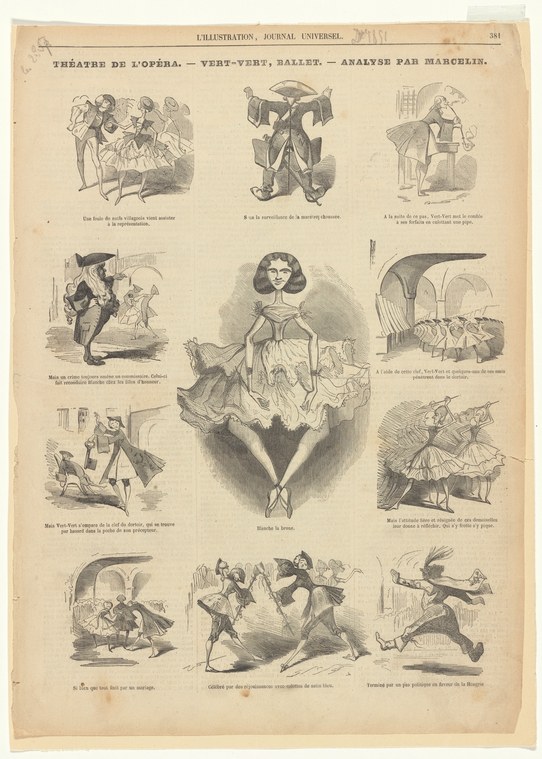
This is a page of satirical theatrical vignettes depicting scenes from the Opéra—specifically analyzing what the artist identifies as 'vert-vert, ballet' (a reference to a specific theatrical work). The composition arranges twelve separate illustrative scenes across the page in a grid format, each capturing a different moment or character from theatrical performance. The largest central image shows a woman in a voluminous tulle skirt, her body angled with one leg extended, embodying the exaggerated poses of mid-19th-century ballet theater. Surrounding her are smaller scenes: dancers in conversation, figures attempting acrobatic or contorted poses, stagehands and workers managing scenery, and performers in various states of theatrical preparation and performance. The drawing style is loose and caricatural, with heavy use of shadow and cross-hatching to define form. The figures are rendered in period dress—tailcoats, crinoline skirts, ballet pointe shoes visible in some figures—situating the work firmly in the 1840s–1860s. The overall tone is comic and demystifying: the artist exposes the labor, strain, and sometimes absurdity behind the polished illusion of operatic ballet.
The dancing
The ballet figures display the characteristic postures of Romantic-era dance: turned-out legs, raised arms in classical port de bras, and exaggerated extensions of the working leg. Several dancers are shown in the contrapposto balance typical of ballet, with weight shifted onto one leg and the supporting heel lifted—evident in the largest figure and in several smaller studies. The artist captures not virtuosic moments but transitional poses and moments of strain: dancers adjusting their costume, catching their breath, or supporting themselves against scenery. One figure appears mid-pirouette or mid-arabesque; others are in conversation or seated. The drawings suggest an artist familiar with ballet anatomy but deploying it for satirical effect, emphasizing the grotesque extremes of turned-out positions and the visible muscular effort required.
The dance depicted
This is a satirical commentary on Romantic ballet in the Paris Opéra, likely from the 1840s–1860s. The work analyzes 'Vert-Vert,' a ballet that played on operatic and balletic conventions. The scenes depict both the on-stage illusions (the graceful, ethereal poses and costumes) and the backstage reality (fatigue, awkward adjustments, physical strain, stagehands working). The artist demonstrates clear knowledge of ballet technique and performance conditions: the pointe shoes, the high extensions, the turned-out legs, and the elaborate tulle skirts characteristic of the ballet d'action of the period are all rendered with precision. The work belongs to a French tradition of theatrical satire that mocked the pretensions and physical demands of operatic ballet while remaining visually literate about its actual practice.
How it was made
This is a wood engraving or steel engraving, created as a page for *L'Illustration*, a French weekly newspaper of cultural and social satire. The fine parallel lines and cross-hatching are characteristic of engraving technique, which allowed for the precise reproduction of fine detail and the creation of multiple impressions from a single plate. The medium was ideal for mass-circulation journalism: pages like this would be printed in thousands and distributed to readers across France and Europe. The technique enabled the artist to achieve both delicate effects (the translucent tulle of the ballet skirt, the texture of fabric) and bold caricatural distortion in the same image. The page format—multiple scenes arranged in a grid—is typical of theatrical or social satire in 19th-century illustrated newspapers.
About this work
This is a page of engraved satirical commentary on Romantic ballet at the Paris Opéra, appearing in *L'Illustration* (likely 1840s–1860s). It analyzes a specific ballet production—*Vert-Vert*—by juxtaposing idealized theatrical poses with backstage realities. The work is a document of how mid-19th-century ballet actually functioned: the costumes, the physical demands, the labor of performance. But it is also a work of visual culture and satire, exposing the gap between the ethereal illusion sold to audiences and the sweat, effort, and sometimes grotesque strain of the dancers themselves. It sits at the intersection of art criticism, theatrical documentation, and social satire—a form pioneered by the French press in the 1830s–1860s.
How to look at it
Attend first to the largest central figure: the exaggerated extension of the leg, the voluminous tulle skirt, and the angled body express the aesthetic ideal of Romantic ballet in its most extreme form. Then look at the surrounding smaller scenes: notice how the artist repeats and varies the ballet pose in contexts of fatigue, humor, and physical strain. The grid format itself is significant—it fragments the illusion of unified theatrical performance into a collection of isolated moments and bodies. The heavy use of shadow and caricatural distortion signals the artist's skeptical, comic eye. The inclusion of stagehands and scenery emphasizes the theater as a machine, a place of labor and artifice, not transcendence.
The period
This engraving belongs to the tradition of French theatrical satire that flourished in *L'Illustration* and similar publications from the 1830s onward. The 1840s–1860s were the height of Romantic ballet in France, when works like *Giselle* (1841) and *La Sylphide* (1832) dominated the Paris Opéra. Simultaneously, a robust culture of illustrated journalism created a space for social and artistic criticism. Theatrical satire—especially commentary on ballet—was a staple of this press: artists mocked the pretensions of grand opera, the physical contortions demanded of dancers, the elaborate machinery of production, and the peculiar aesthetics of the Romantic ballet d'action. This page appears in that tradition, treating the ballet not as transcendent art but as a curious social spectacle worthy of exposure and satire. The work reflects a period of debate about art, labor, gender, and public entertainment in France.
Where it lives
This engraved page comes from *L'Illustration*, a major French weekly newspaper of cultural and social satire, held in the New York Public Library collection of theatrical prints. Such pages were mass-produced and distributed; they represent one of the primary means by which 19th-century theatrical culture was documented and critiqued for a broad reading public.
Dance in this work
Questions about this work
What ballet is this about?
The title indicates 'Vert-Vert, ballet,' a work performed at the Paris Opéra in the mid-19th century. Vert-Vert was a satire on operatic conventions, and this engraving extends that satire by exposing the physical and material realities of performance.
Why is the central dancer drawn so grotesquely?
The exaggeration is deliberate satire. The artist is mocking the extreme aesthetic demands of Romantic ballet—the turned-out legs, the artificially extended lines, the way the body was contorted to achieve ethereal effects on stage. By exaggerating these features, the artist reveals the gulf between the ideal and the physical strain required to achieve it.
What do the smaller scenes show?
They depict backstage moments: dancers adjusting costume, conversing, resting, or attempting difficult technical poses. Some show stagehands managing scenery. Together, they contrast the idealized moment of performance (the central figure) with the messy, laborious reality of theatrical production.
How was this image made and distributed?
It is a wood or steel engraving—a technique that allowed fine detail and mass reproduction. As a page in *L'Illustration*, a weekly newspaper, it would have been printed in thousands of copies and distributed to educated readers across France and Europe, making it a form of popular cultural criticism.
More dance artwork





