49 works in this view — arrow keys or swipe to move between them.
Dance in Art
Dancers in eighteenth-century garb
Unknown artist
- Collection:
- Prints depicting dance
- Source:
- New York Public Library
- Rights:
- Public domain — free to use, share and adapt.
- Recorded as:
- Public Domain
This image is a primary visual record of how 18th-century ballroom dance actually looked—the upright posture, the distance between partners, the formal arm positions—and of the social context that gave dance meaning. For historians of dance, costume, and manners, it provides concrete evidence of the embodied culture of the aristocratic salon.
What you are looking at
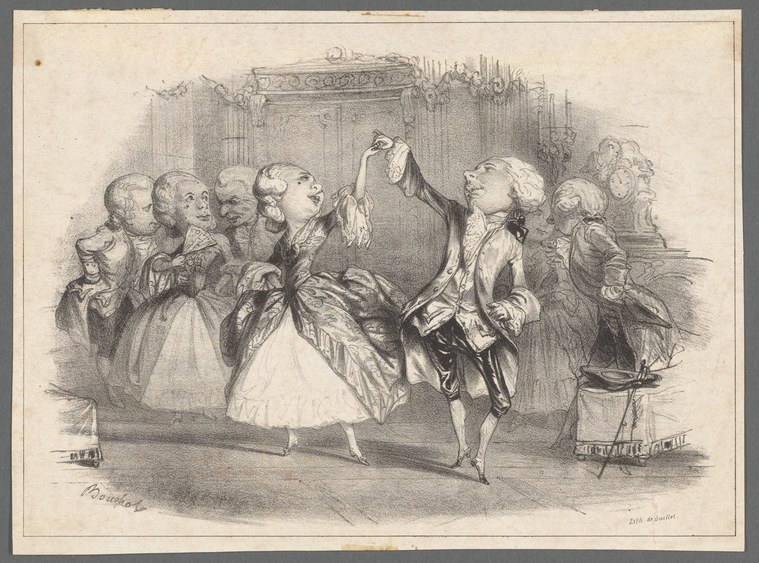
A formal dance scene in an interior space with classical architectural elements visible in the background—pilasters and a cornice suggest a ballroom or salon. A central couple commands the composition: a man in 18th-century court dress (breeches, coat, tricorn hat) faces a woman in an elaborate gown with a full skirt and fitted bodice, both poised in an attitude of formal courtship or dance. Around them stands a crowd of onlookers in period dress—other couples, single figures, attendants—some watching intently, others conversing or adjusting their appearance. The lighting is even and diffuse, typical of interior scenes rendered in this medium. The artist has captured a moment of social performance where the central couple's dance or gesture serves as entertainment and display for an assembled company of the aristocratic or wealthy merchant class.
The dancing
The central male dancer stands upright with one arm extended toward his partner in a gesture of presentation or invitation; his posture is formal and composed, weight evenly distributed. The female dancer faces him with her body in three-quarter view, her right arm extended toward his, her left arm held gracefully at her side. Both figures maintain the upright, vertical alignment characteristic of formal court dance. The surrounding figures are arranged in a loose semicircle, their poses varied—some lean forward with interest, others stand back with hands clasped or gesturing; none are in active dance positions, marking them as audience rather than dancers.
The dance depicted
This depicts a formal court or salon dance of the 18th century, most likely a minuet or another dance of the historic-baroque or historic-regency period given the dress, setting, and social context. The central couple's positioning—facing one another at a formal distance with extended arms—matches the opening attitude of a minuet or similar partner dance. The engraving captures not the movement itself but the moment of social presentation and courtship ritual that accompanied ballroom dancing in elite circles. The crowd of observers confirms this was performative social dance undertaken partly for its own pleasure and partly as a display of taste, rank, and accomplishment before an assembled company.
How it was made
This is a lithograph or engraving rendered in black ink on paper, made using a tonal technique to model form and suggest depth. The artist has used cross-hatching and varied line weight to create shadow and volume in the figures' clothing and in the architectural space. The medium allowed for fine detail in costume and facial expression while maintaining a sketch-like immediacy; the loose handling of the background and secondary figures contrasts with the sharper definition of the central pair, focusing attention. This technique and scale suggest the work was intended for circulation as a print—popular as illustration, satire, or documentary record of social custom.
About this work
This is a witness to the formal dance culture of 18th-century Europe, capturing a minuet or similar court dance at the moment of social performance. The lithograph or engraving documents both the movement vocabulary and the social ritual surrounding ballroom dance—the formal dress, the attentive audience, the careful positioning of the body. It belongs in a dance art gallery as evidence of how elite European society understood and displayed dance as a marker of refinement, rank, and courtship, and as a technical record of how dancers held and moved their bodies in the period.
How to look at it
Observe the distance maintained between the partners and the formal alignment of their bodies—this is not intimate modern ballroom but a dance of geometric precision and display. Notice how the artist has frozen not a moment of dynamic movement but a posed attitude, a moment of presentation. The crowd's attention—the turned heads, the leaning figures—confirms that dance was a social spectacle as much as a physical activity. The detail of costume—the embroidery, the lace, the arrangement of the skirts—shows that dress was integral to dance performance.
The period
The 18th century was the age of the minuet in European court and salon culture. The minuet had spread from the French court to become the universal marker of elite social dancing and good breeding. Prints documenting ballroom custom were popular across Europe, often satirical in intent but also serving as practical guides to etiquette and deportment. The formal, almost ceremonial quality of the dancing depicted here reflects the minuet's status as a learned accomplishment that required instruction and practice. By the later 18th century, such formal court dances were beginning to be displaced by livelier and more playful forms—cotillions, country dances, and quadrilles—but the minuet remained the foundation of ballroom training.
Where it lives
This print is held in the New York Public Library's collection of prints depicting dance. It belongs to a tradition of satirical or documentary lithographs and engravings produced throughout the 18th and 19th centuries documenting social custom and ballroom practice.
Dance in this work
Questions about this work
What dance is being performed here?
The formal posturing, distance between partners, and upright bearing suggest a minuet or a similar formal court dance of the 18th century. The artist has chosen to capture a moment of social presentation—the couple offering themselves to the assembled company—rather than a moment of active movement. The minuet was the universal dance of European elite society in this period.
Why are all these other people watching?
In 18th-century ballroom culture, dance was a social performance undertaken partly for pleasure but significantly for display and judgment. A couple dancing a minuet was expected to demonstrate good breeding, correct deportment, and skilled execution. The assembled company watched, assessed, and gossiped. Dance was a form of public self-presentation.
How do I know what period this is?
The dress is the clearest marker: the men wear tricorn hats, knee breeches, fitted coats, and long vests characteristic of the mid-to-late 18th century; the women wear full skirts with tight bodices and elaborate hair and headdresses. The formal interior architecture—the pilasters and cornice—places the scene in a grand salon or ballroom of the period.
Is this a specific event or a generic scene?
This appears to be a generic representation of fashionable ballroom custom rather than a record of a particular evening. The print was likely created to document or satirize contemporary social manners, making it a valuable source for understanding how ordinary elite people danced and dressed in the 18th century.
More dance artwork





