49 works in this view — arrow keys or swipe to move between them.
Dance in Art
Dance prints from L'Illustration
Unknown artist
- Collection:
- Prints depicting dance
- Source:
- New York Public Library
- Rights:
- Public domain — free to use, share and adapt.
- Recorded as:
- Public Domain
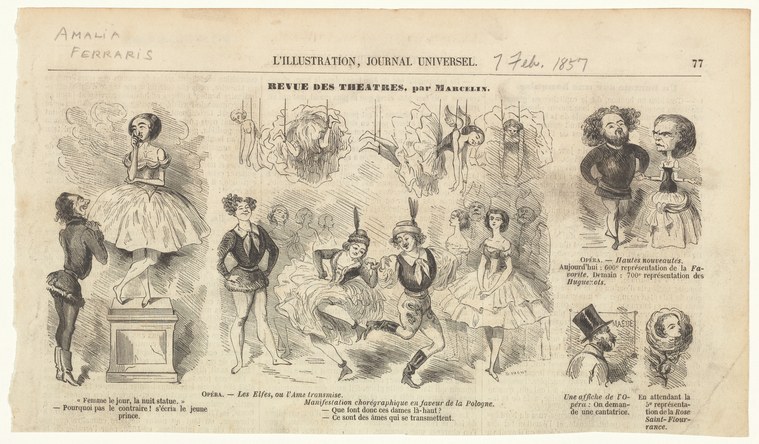
This work documents the Romantic ballet aesthetic in its native habitat—not as a formal stage photograph or a choreographer's design, but as a journalist's record of live performance, with all the energy, variety, and social commentary that entailed. It shows how ballet was integrated into the broader operatic and theatrical world of mid-nineteenth-century Paris, and how it was understood and critiqued by the educated public.
What you are looking at
A densely composed page from L'Illustration showing multiple theatrical vignettes and character studies in ink sketch, arranged across the page without a unified stage. The scenes depict operatic and ballet performance moments, with figures in mid-gesture and movement. Central to the composition is a group of dancers in tutus and tights, some en pointe or in classical ballet positions, their bodies arranged to suggest choreographed steps. Surrounding these are studies of individual performers and comic character interactions—a woman in a full skirt being admired by a man in tailcoat, exchanges between singers or actors, and figures in various states of theatrical emotion. The style is caricatural and journalistic, with quick, expressive line work capturing movement and personality rather than anatomical precision. Light washes and hatching suggest volume and costume texture. The page bears the publication date 7 Fév. 1857 and is titled 'REVUE DES THÉÂTRES, par Marcelin'—a theatre review column.
The dancing
The central ballet figures display the key positions of classical technique: several dancers stand en pointe in turned-out positions characteristic of Romantic-era ballet, with raised arms and extended legs. The poses show proper turnout and lifted carriage. One figure appears to be in an arabesque or attitude; others stand in port de bras with arms rounded or raised. The surrounding theatrical figures use exaggerated gesture and posture—wide arm extensions, bent knees, expressive spinal curves—typical of comic operatic performance. The sketches capture the distinction between the refined vertical line of ballet dancers and the broader, more gestural acting of the singing actors.
The dance depicted
This is almost certainly a record of Parisian operatic and ballet performance from 1857, likely depicting scenes from current productions at the Opéra or similar venues. The central figures perform classical ballet in the Romantic manner—likely from a scene in an opera-ballet or a standalone ballet production. The dominant dance style is theatrical ballet of the mid-nineteenth century, with the characteristic aesthetic of the Romantic period: tulle skirts, vertical extension, ethereal carriage, and a preference for weightless movement. The surrounding vignettes suggest this is a theatre review or critical commentary on multiple performances, capturing both the serious dance and the comic or dramatic moments that share the same venues.
How it was made
This is a pen and ink engraving or etching, published as a page in L'Illustration, the leading French illustrated newspaper of the period. The technique is rapid illustrative line work with selective wash and cross-hatching to suggest shadow and texture, suited to weekly reproduction and quick satirical commentary. The style and execution suggest a professional theatre critic's illustrator working from memory or quick notes, capturing gesture and character economically. As a printed page, this reached a broad educated audience in Paris and circulated widely; it represents how theatre and dance were documented and commented upon for the general public of the 1850s.
About this work
This page from the theatre review section of L'Illustration documents Parisian ballet and operatic performance in February 1857, capturing both the refined classical technique of contemporary ballet and the dramatic expression of the operatic stage. The central ballet figures are performing in the Romantic idiom—tulle, pointe work, verticality, weightless carriage—while the framing vignettes show the broader theatrical world these dancers inhabited: the interaction of drama, comedy, and spectacle that characterised mid-nineteenth-century lyric theatre. As a periodical illustration, it preserves not a single performance but a week's survey of the stage, offering insight into what critics and audiences saw as notable, amusing, or exemplary in dance and drama of the moment.
How to look at it
Examine the central cluster of ballet figures first: notice the uniformity of their silhouettes, the consistency of their positions, and the way the artist has rendered the upward lift and the turned-out legs. Then look at the surrounding theatrical figures: the contrast in their gestures—wider, more angular, more dramatically posed—shows the artist's awareness of the different physical language of operatic acting versus classical ballet. The caricatural style allows the artist to emphasise character and moment over anatomical detail, which paradoxically makes the conventions of 1850s ballet technique immediately legible. Notice too the variety of dress and role: the distinction between the dancing figures and the singers, between principals and supernumeraries, gives a sense of the hierarchy and complexity of operatic production.
The artist
The page is credited to Marcelin, the pseudonym of Émile Planat (1801–1887), a prolific French illustrator and caricaturist who was a principal contributor to L'Illustration from its founding in 1843. Marcelin specialised in theatrical, social, and political satire, and was known for his rapid, expressive line and his ability to capture character and movement with economy and wit. He produced hundreds of theatre reviews and social commentaries for the journal, making him one of the most visible documentarians of Parisian cultural life in the mid-nineteenth century.
The period
In 1857, French theatrical culture was at a high point of prestige and innovation. The Opéra was the grandest theatrical institution in Europe, and ballet was increasingly central to operatic production—the five-act opéra was expected to include a substantial ballet scene, typically in Act III, which could extend to twenty minutes or more. The Romantic era in ballet (roughly 1830–1870) was in full development: the emphasis on ethereal, supernatural, and feminine subjects, the dominance of the female dancer, and the technical innovations of pointe work and gas lighting were all at their height. L'Illustration itself, founded in 1843, had revolutionised the consumption of art and theatre by a broad audience; illustrated theatre reviews reached tens of thousands of Parisians weekly, making the journal a powerful arbiter of taste and commentary.
Where it lives
This page is part of the holdings of the New York Public Library, which collects L'Illustration as a primary source for the visual culture of nineteenth-century France. It is one page from the theatre review column that appeared weekly or bi-weekly, and is catalogued within the broader collection of dance prints and theatrical imagery.
Dance in this work
Questions about this work
Is this from a real ballet or opera?
The page is a review of performances that were happening in Paris in February 1857, but the specific works are not identified in the caption visible here. Marcelin would have been watching current productions at the Opéra or other major venues and sketching memorable moments. The style and technique of the ballet figures—the tutus, pointe work, and classical positions—are consistent with major Romantic-era ballets of the period, such as those choreographed by Jules Perrot or Arthur Saint-Léon.
Why is this style of ballet review important?
Illustrated theatre reviews in newspapers like L'Illustration are among our best records of what nineteenth-century ballet actually looked like in performance. Unlike formal stage photographs (which were rare and posed), or costume designs (which represent intention rather than execution), Marcelin's sketches capture movement, energy, and the lived experience of the stage. They also show how ballet was understood by educated audiences—not as an isolated art form, but as part of a broader theatrical world.
Who was Marcelin?
Marcelin was the stage name of Émile Planat, one of the most prolific French illustrators of the nineteenth century. He specialised in social and theatrical satire, and contributed thousands of drawings to L'Illustration from 1843 until his death in 1887. He was known for his ability to capture character and movement with remarkable economy of line, and his weekly theatre reviews made him one of the most influential commentators on Parisian culture of his era.
More dance artwork





