49 works in this view — arrow keys or swipe to move between them.
Dance in Art
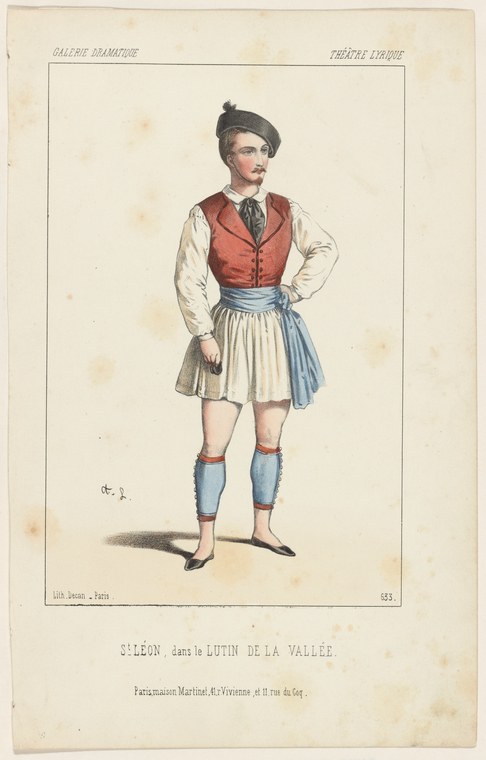
St. Léon, dans le Lutin de la vallée
Unknown artist
- Collection:
- Prints depicting dance
- Source:
- New York Public Library
- Rights:
- Public domain — free to use, share and adapt.
- Recorded as:
- Public Domain
Male dancers in Romantic ballet are often overlooked in dance history, which tends to focus on the tutu-clad female dancer; this print documents the parallel tradition of the character dancer and shows us exactly what a celebrated male performer in such a role actually wore and how he was publicly represented. The inscription suggests this portrait commemorates a specific artist and role, making it potentially identifiable as a document of a real performance or a record of how a particular ballet was staged.
What you are looking at
A single male dancer stands in three-quarter pose against a plain background, wearing the costume of a Romantic-era ballet peasant or character dancer. His outfit combines elements of European folk dress with theatrical refinement: a white linen shirt with full sleeves, a red wool or silk vest buttoned over it, a light blue or grey skirt of moderate length (knee-level), and blue stockings with red cuffs at the calf. He wears a soft cap or beret tilted slightly on his head. His posture is alert and poised—one hand rests at his hip while the other hangs naturally—and his weight appears lightly distributed, suggesting readiness for movement. The costume and stance together evoke the character dances that were central to mid-nineteenth-century ballet, where male dancers performed in folk-inspired dress as part of grand divertissements in longer works. The image is a hand-colored engraving or lithograph, rendered with careful attention to fabric texture and color graduation, against a cream-colored ground.
The dancing
The single figure occupies the center of the composition in a neutral standing position that nonetheless conveys alertness and potential. His stance is upright with a slight contrapposto quality—one leg bearing weight while the other is slightly relaxed—and his frame is open and frontal. The position of his hands and the set of his shoulders suggest neither strain nor tension, but rather the poised readiness of a trained dancer awaiting music or direction. His gaze is fixed slightly upward and to the side, away from the viewer, which lends the figure an introspective or focused quality rather than a performative one.
The dance depicted
This is a character dancer or danseur in the Romantic ballet tradition, most likely from a specific known work titled or associated with 'Le Lutin de la vallée' (The Spirit of the Valley or similar). The costume—a peasant or folk ensemble modified for theatrical presentation—was standard for male character roles in ballets of the 1830s–1850s. The image preserves a record of how such roles were costumed and how the male dancer was expected to present himself: not as a prima ballerina in pointe shoes and tutus would be posed, but as a character figure in everyday dress transformed by theatrical refinement. The name St. Léon suggests this may be a portrait of a celebrated dancer in a specific role, or a costume study documenting a particular production or repertoire piece.
How it was made
This is a hand-colored engraving or lithograph, identifiable by its crisp outlines, the precision of line work, and the application of color in flat or graduated tones over a printed base. The inscription at the foot indicates it was produced by a commercial theatrical print shop (likely Parisian, given the French text and artistic conventions). Such prints were mass-produced and distributed to document celebrated dancers and iconic roles, serving as souvenirs for audiences and as records for dancers and choreographers elsewhere. The quality of hand-coloring and the care taken with detail suggest this was a relatively high-end theatrical print, not a cheap broadside—evidence of a professional dance culture with an invested audience.
About this work
This is a theatrical costume portrait documenting the appearance of a male character dancer in mid-nineteenth-century Romantic ballet. It preserves both the visual record of a specific production or star performer and the conventions of male character costuming in an era when such roles—danced by men in folk dress or national costumes—were a crucial part of the ballet repertoire. The figure is posed not mid-leap or in a dramatic arabesque, but in a calm, composed stance that suggests the character dancer's role was understood as grounded and human-scaled, distinct from the weightless artificiality of the prima ballerina. The work belongs in a dance gallery as both a costume document and a window into how ballet companies of the 1840s–1850s imagined and presented male performers on stage.
How to look at it
Attend to the tension between the figure's calm, composed stance and the potential for movement that his trained body suggests. The artist has captured not a moment of action but a moment of readiness—a pause between movements. Notice how the theatrical costume combines historical or national accuracy (in the vest, skirt, and stockings) with stage refinement: this is not a real peasant's outfit, but a theatrical interpretation of one. The hand-coloring and the delicate rendering of fabric texture show the care taken to make the costume materially convincing while still clearly artificial. Compare the figure's presentation here—frontal, poised, serene—with contemporary prints of ballerinas, and you will see how differently the male and female dancer were positioned and imagined.
The artist
The artist is not recorded in the catalogue. The print bears the mark 'Lith. Joanh. à Paris' (Lithography by Joanh. in Paris), indicating it was produced by a Parisian lithographic shop, likely in the 1840s or 1850s. Such shops were central to the documentation and celebrity culture of Romantic ballet, reproducing likenesses of famous dancers for sale to audiences and for distribution across Europe. The skill of execution and hand-coloring suggests a reputable atelier rather than a hack operation.
The period
This print was produced during the height of the Romantic ballet era, when works like *La Sylphide*, *Giselle*, and *La Péri* dominated the European stage (1830s–1850s). During this period, male dancers occupied a subordinate position in ballet aesthetics—the emphasis was on the ballerina's ethereal weightlessness—but male character dancers remained essential to the full evening's entertainment, performing as peasants, soldiers, gypsies, and regional types in divertissements and act finales. The costume depicted here reflects contemporary European folk dress, updated and refined for theatrical presentation: the design suggests a Scandinavian, German, or Eastern European character, consistent with the Romantic era's fascination with distant, northern, or exotic locations. Prints like this one were collected by aficionados of dance and served as both souvenir and promotional tool.
Where it lives
The print is held in the New York Public Library's collection of prints depicting dance, indicating it was recognized as a document of theatrical history and preserved accordingly. The French inscription and Parisian production mark suggest it was created for a Parisian or European audience familiar with the ballet repertoire and celebrity system of the mid-nineteenth century.
Dance in this work
Questions about this work
Who was St. Léon and what was 'Le Lutin de la vallée'?
St. Léon was likely a professional dancer—possibly a member of the Paris Opéra or another major European ballet company—performing in a character role in a work titled or known as 'Le Lutin de la vallée' (possibly 'The Spirit of the Valley' or similar). Without further archival evidence, the specific premiere date and authorship cannot be confirmed from the image alone. The title suggests a supernatural or folkloric subject, consistent with Romantic ballet taste.
Is this a man in drag?
No. The skirt here is not a tutu or ballet skirt but a character costume—part of a peasant or folk ensemble. Male character dancers in nineteenth-century ballet regularly wore skirts as part of national or regional costume (Scotsmen in kilts, peasants in dirndls or similar garments). This reflects the costume conventions of the era, not gender presentation.
What was the role of male dancers in Romantic ballet?
While the Romantic era prioritized the ballerina and her ethereal qualities, male dancers were indispensable for character roles, dramatic duets, and the full evening's entertainment. They danced as peasants, soldiers, sailors, and regional types, often in folk or national costume. These roles required different training and presentation than the ballerina's classical vocabulary, emphasizing character, charm, and theatrical personality.
How do I know this is from the 1840s or 1850s?
The costume style, the theatrical print conventions (lithography, hand-coloring), the French inscription and production mark, and the Romantic-era character costuming all point to the mid-nineteenth century. The exact date cannot be determined from the image alone, but the NYPL likely has archival documentation.
More dance artwork





