49 works in this view — arrow keys or swipe to move between them.
Dance in Art
Dance prints from L'Illustration
Unknown artist
- Collection:
- Prints depicting dance
- Source:
- New York Public Library
- Rights:
- Public domain — free to use, share and adapt.
- Recorded as:
- Public Domain
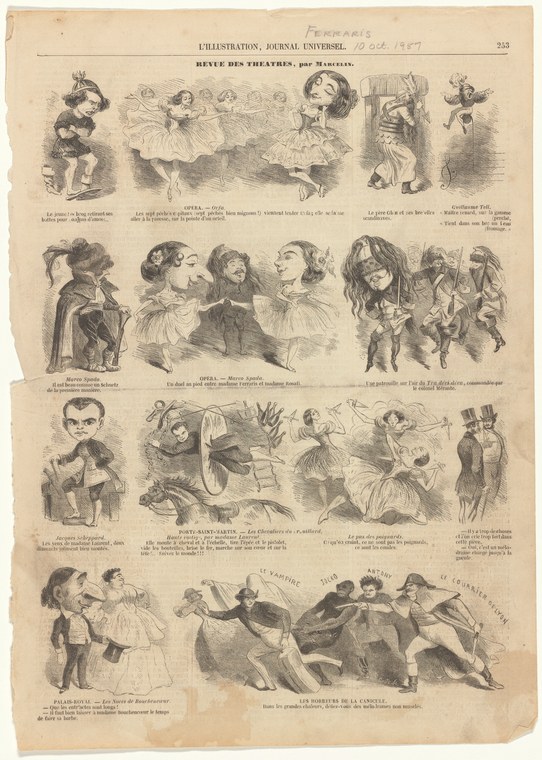
This page documents a crucial moment in the public life of ballet—the emergence of illustrated newspapers as a primary way urban audiences engaged with theatre between performances. The composition and style reveal what the 1860s audience cared about: not just the dancers' bodies but the machinery of theatre, the costume, the off-stage drama, and the whole spectacle. For historians of dance documentation and media, this shows how ballet became a subject for journalistic illustration and how the press shaped the public image of the Romantic ballet.
What you are looking at
This is a page of theatrical vignettes from L'Illustration, a French newspaper, showing scenes from Paris theatres in the mid-19th century. The page is divided into sixteen small framed scenes arranged in four rows. Each scene depicts a different moment—some showing dancers on stage in tutus and pointe shoes, others showing backstage interactions, costume adjustments, and moments of dramatic intensity. The figures are rendered in ink in a sketch-like style with cross-hatching for shadow. In the top row, dancers in romantic-length tutus perform in pairs and groups, with their bodies caught in mid-leap or mid-turn; to the right, a figure in theatrical dress strikes a dramatic pose. The middle sections show intimate moments between dancers and other theatre personnel—a woman being helped into costume, figures conversing or gesturing expressively. The lower sections shift to broader theatrical scenes with multiple figures in animated conversation or conflict, some in street dress, others in costume. Throughout, the dress is consistent with 1860s fashion for both civilians and performers, with crinolines, tight jackets, and elaborate hats visible in the street scenes.
The dancing
The dancers are depicted in the balletic vocabulary of the 1860s: extended legs, pointed feet, elevated positions, and the characteristic posture of romantic ballet. In the top register, women in tutus are shown en pointe and in mid-air, with partners supporting them in lifts and turns. The bodies are elongated and posed rather than capturing genuine weight or anatomical strain. Arms are raised in classical positions—overhead or extended to the side. The supporting figures (dressers, attendants, male dancers) stand in contrapposto or with exaggerated gestural poses typical of theatrical caricature. The artist captures moments of extreme physical extension and theatrical artifice rather than naturalistic movement.
The dance depicted
These are scenes from the Paris Opéra or similar legitimate theatres, depicting Romantic ballet as it was performed in France in the 1860s. The tutus, pointe work, and paired arrangements confirm classical ballet vocabulary. The focus on costume changes, backstage moments, and the performative apparatus surrounding the dance suggests these are illustrative sketches made for a newspaper audience—capturing not just the dancing but the entire theatrical spectacle and the labour that produced it. The presence of male partners and the scale of the productions shown suggest full-length ballets rather than divertissements.
How it was made
This is a wood engraving or steel engraving on the page of a newspaper or magazine, likely printed by intaglio. The technique allows for fine detail and the rapid reproduction necessary for weekly publication. The style—with its quick, economical line work and reliance on cross-hatching for tone—is characteristic of press illustration of the 1860s. The small scale and serial arrangement suggest this was designed as a visual column summarising the week's theatrical happenings for readers who might not attend in person.
About this work
This is a page of theatrical reportage from L'Illustration, one of the first illustrated newspapers, documenting Romantic ballet performances on the Paris stage circa 1860. It sits at the intersection of dance history and media history—these are not preparatory studies or artistic interpretations but working illustrations made for a mass-circulation audience, capturing the spectacle, the labour, and the personnel of the theatre as much as the dance itself. The page is evidence of how ballet was seen, consumed, and represented to the urban public in the mid-19th century: as a combination of technical display, costumery, social encounter, and dramatic narrative.
How to look at it
The reader should attend to the variety of moments the artist chose to show—not just the moment of maximum extension or elevation, but backstage bustle, costume adjustment, and dramatic gesture. This reflects the newspaper illustrator's mandate to show the whole event, not just its climax. The exaggeration of pose and the sketch-like technique also tell us that this is caricature or stylisation for public consumption, not documentary naturalism. The serial arrangement, with each scene captioned, suggests that the reader is meant to read these as a narrative or commentary on the week's theatrical happenings.
The artist
The attribution is not recorded. The style is consistent with the in-house illustrators of L'Illustration, which employed a large staff of engravers and draughtsmen to produce weekly illustrations. The hand is skilled but anonymous, which was standard practice for newspaper illustration of the period—the image served the publication, not the individual artist.
The period
The 1860s were the height of Romanticism in ballet, with the works of composers like Delibes and choreographers like Saint-Léon dominating the Paris Opéra. The illustrated press was still relatively new—L'Illustration was founded in 1843—and had become a major medium for documenting theatrical life. This was also a period when ballet, particularly the female dancer, had become a fixture of urban entertainment and a subject of intense social and artistic interest. The Romantic tutu and pointe work had become standardised, and the corps de ballet was an established element of the spectacle.
Where it lives
The work is held in the New York Public Library's prints collection and is catalogued as part of a series of dance-related illustrations from L'Illustration. It is one page of a recurring feature in the newspaper, evidence of the institutional commitment to theatrical reportage.
Dance in this work
Questions about this work
Is this a real ballet or a made-up illustration?
These are illustrations of actual performances, made for a weekly newspaper. The artist was documenting real ballets performed on Paris stages in the 1860s, though the scenes are reimagined and stylised for publication. The costumes, poses, and theatrical settings are authentic to Romantic ballet practice.
Why are there non-dancing scenes mixed in with the dance scenes?
This was a newspaper page designed to show readers the whole theatrical experience—not just the performance but the labour, costume, drama, and social dimensions of the theatre. This approach reflected how urban audiences actually experienced theatre: not just watching the stage but being part of a social spectacle.
Who danced in ballets like these?
By the 1860s, the Paris Opéra had an established hierarchy of dancers including étoiles (principal female dancers), danseurs (male soloists), and a large corps de ballet of women. The dancers were almost exclusively French or European, professionally trained from childhood, and performed full-length ballets with multiple acts.
More dance artwork





