49 works in this view — arrow keys or swipe to move between them.
Dance in Art
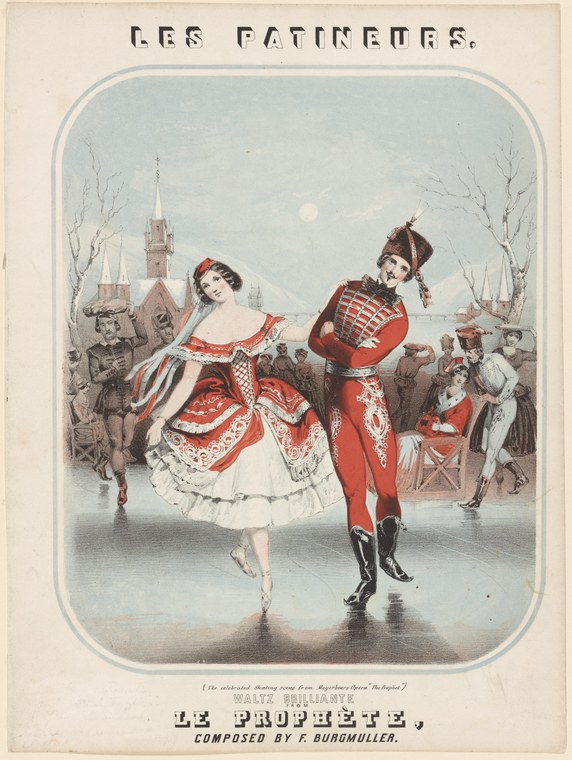
Les Patineurs, Waltz brilliante from Le Prophète, composed by F. Burgmuller
Unknown artist
- Collection:
- Prints depicting dance
- Source:
- New York Public Library
- Rights:
- Public domain — free to use, share and adapt.
- Recorded as:
- Public Domain
This work documents a specific theatrical moment when ballroom dance vocabulary was being translated into operatic spectacle, and when ice itself became a stage for choreographed performance. For dance historians, it shows how the waltz and its formal frame migrated from ballroom to concert stage and how costume and setting were used to market dance to audiences expecting narrative, glamour, and technical display.
What you are looking at
A pair of skaters performs on frozen water in a winter landscape, watched by an audience gathered at the shore. The woman wears a red and white costume with a full skirt caught mid-swirl, her body leaning into the motion; the man is dressed in a brilliant red military-style jacket with ornate frogging and black boots, his posture formal and upright. The setting includes bare trees framing the scene, a church spire visible in the distance, and spectators in period dress arranged informally along the ice's edge. The composition captures a moment of theatrical performance—the woman's skirt billows with movement while the man appears to be executing a turn or leap, their bodies creating a diagonal line across the frozen surface. The pale winter light and soft color palette emphasize the elegant artificiality of the scene.
The dancing
The dancers are in close proximity but not in a strict ballroom hold. The woman's body is actively rotating, her skirt and petticoats flaring outward in a way that reads as centrifugal movement; her posture is open and dynamic. The man stands more vertically, his weight appears centered, and his carriage suggests controlled precision rather than the abandon suggested by his partner's pose. Their relative positions and the woman's submissive tilt toward him suggest a partnership in which he is leading a spinning or rotational figure, though the exact technical frame cannot be determined from this angle. The print shows understanding of how layered skirts move on ice.
The dance depicted
This is a theatrical interpretation of ice skating as dance, performed as part of the ballet *Le Prophète* and titled *Les Patineurs* (The Skaters). The work belongs to the 19th-century tradition of bringing ballroom and character dances into the opera house. This is not a documentation of social ice-skating but a choreographed theatrical piece set on ice—a fantasy of elegance and control applied to a winter sport. The title credit to Burgmuller confirms this as a published composition, likely a waltz or similar ballroom form adapted for performance. The exaggerated swing of the woman's skirt and the formal costume suggest the piece was danced by professional ballet dancers in a spectacle scene.
How it was made
This is a hand-colored lithograph, identifiable from the soft tonal gradations, the characteristic line work, and the delicate color application typical of 19th-century theatrical publicity prints. The blue-gray stone tone forms the foundation; the reds, blacks, and flesh tones are applied as overlays. The technique allowed for rapid reproduction and wide distribution—this is plainly a published marketing image, not a unique work. The soft focus and romantic treatment of the winter landscape are characteristic of the aesthetic that lithography enabled for the illustration of narrative and theatrical scenes.
About this work
This is a theatrical advertisement for a musical number from the grand opera *Le Prophète*, presenting ice-skating as a ballroom dance set in a winter landscape. The image captures the 19th-century Romantic preoccupation with spectacle and with incorporating social and recreational dances into elite theatrical forms. The work demonstrates how waltz and other ballroom vocabularies were adapted and performed in operatic contexts, and how lithography served to promote and circulate these elaborate productions to paying audiences. The print conflates two distinct art forms—ice-skating and ballet—through costume, composition, and the assertion of ballroom structure, creating a fantasy of control and elegance in a naturally slippery environment.
How to look at it
Notice the precise moment the artist selected: the woman is caught mid-rotation, her skirt at maximum extension, while the man is poised in a moment of control. This convention—freezing the moment of greatest visual drama—was central to theatrical dance prints of the period. Observe how the formal military costume of the male dancer contrasts with the romantic, full-skirted gown of the female dancer; this sexual dimorphism in costume was standard in Romantic-era dance and opera. The winter setting and the spectators are subordinate to the dancers, framed to emphasize the pair as performers rather than as people engaged in authentic ice-skating.
The artist
The artist is not recorded. The print bears the credit only to the composer, F. Burgmuller. This work originates in the commercial printing infrastructure of 19th-century opera and theater publicity, likely produced by a Parisian or European lithographic house as standard promotional material for a popular production.
The period
This work dates to the era of grand opera, when composers like Meyerbeer (who wrote *Le Prophète*, 1849) were incorporating spectacular dance numbers into five-act operatic forms. The 1840s-1860s saw a flourishing of character dances and national dances within opera, and ice-skating was among the exotic or novelty settings applied to ballroom dance. The waltz itself was at peak popularity and prestige during this period, having moved from ballroom to concert and theatrical contexts. Lithographic printing allowed these scenes to be rapidly circulated as publicity and souvenirs, shaping audience expectations for spectacle.
Where it lives
This print is held in the NYPL dance prints collection, part of a body of theatrical and ballroom dance imagery that documents 19th-century performance and publicity practices. Such prints were produced in quantity and distributed to theaters, patrons, and the public as advertisements and mementos.
Dance in this work
Questions about this work
Was this an actual dance that people performed, or a theatrical invention?
This was a theatrical dance number created for performance in the opera *Le Prophète*. It adapted ballroom waltz movement to an ice setting, creating a spectacular fantasy rather than documenting how people actually skated recreationally. The elaborate costume, the controlled partnering, and the outdoor theatrical setting all mark this as a choreographed piece designed for a paying audience in a concert hall.
What is Burgmuller's role?
F. Burgmuller composed the music for this dance number. He was a 19th-century composer and musician whose work was performed in theatrical and concert contexts. The title credit to him, rather than to a choreographer or ballet master, was typical of the era; composers' names were more prominently advertised than choreographers'.
Is this a waltz?
The print is titled a 'Waltz brilliante,' which suggests it is a waltz or waltz-like form adapted for ice and theatrical costume. The formal partnering and the emphasis on turning and rotational movement are consistent with waltz technique, though the exact choreography is lost to us.
Why would an opera include ice-skating?
Grand opera of the 1840s-1860s incorporated spectacle and novelty as part of its appeal. Character dances, national dances, and fantasy sequences set in unusual environments were standard. Ice-skating represented romance, exoticism, and technical display all at once—exactly the combination audiences wanted.
More dance artwork





