49 works in this view — arrow keys or swipe to move between them.
Dance in Art
Louise Fairbrother
Unknown artist
- Collection:
- Prints depicting dance
- Source:
- New York Public Library
- Rights:
- Public domain — free to use, share and adapt.
- Recorded as:
- Public Domain
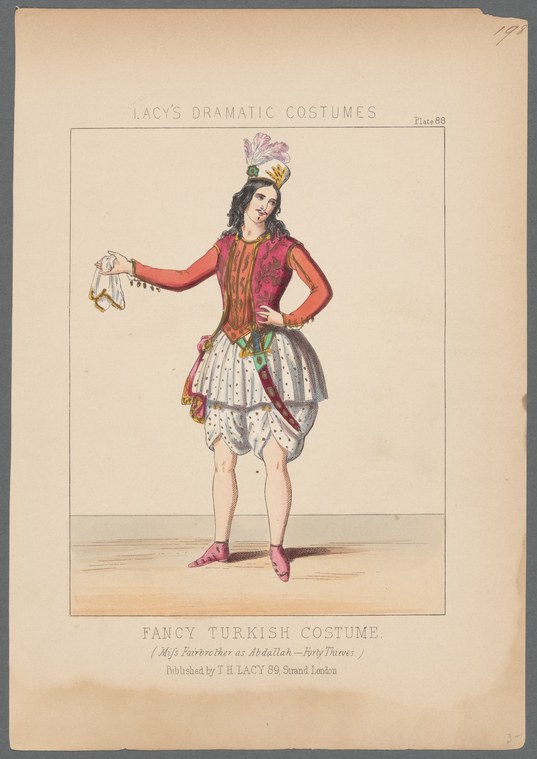
This print documents a professional dancer and a specific theatrical costume in an era when photography was not yet standard, making it invaluable evidence of how 19th-century performers dressed and how dance theatre created 'exotic' characters. It shows the intersection of theatrical dance, costume spectacle, and consumer culture—the print was a commodity as much as the performance itself. Understanding what Louise Fairbrother danced, how she moved, and what her public saw depends partly on documents like this one.
What you are looking at
A single female dancer stands in an elegant contrapposto pose against a plain beige background, her weight resting on one leg while the other extends lightly. She wears an elaborate costume combining European and Ottoman elements: a rich red long-sleeved tunic with gold embroidery, a deep purple-pink quilted or padded waistcoat worn open over it, and a full skirt made of white or cream fabric with gathered or pleated sections and a green underskirt visible at the hem. Her headdress is a tall ornamental turban or crown in purple and gold with an upright feather accent. Her dark hair is partially visible beneath the headdress. She holds aloft in her right hand a decorative object—possibly a prop or ornament. Pink or reddish slippers cover her feet. The figure is posed with one hand on her hip, projecting confidence and theatrical presence. The composition isolates her against the pale ground, emphasizing the costume's richness rather than suggesting narrative or interaction.
The dancing
The dancer stands in a relaxed, frontal stance with clear weight placement on her left leg and the right leg free. Her right arm extends upward at an angle, displaying an object, while her left arm rests at her hip in a gesture suggesting ease and authority. Her shoulders are relatively level, and her head is held upright with a frontal gaze. The pose suggests controlled, deliberate positioning rather than captured mid-movement; this is a presented or displayed attitude rather than a moment of dynamic action. The body frame is open and frontal, showing the full costume to advantage.
The dance depicted
The costume and title indicate this is a European theatrical fantasy of Ottoman or Turkish dress, part of the 'Turkish' or 'orientalist' repertory that was popular in 19th-century dance and theatre. The figure appears to be a character dancer rather than a classical ballet dancer, given the mixed influences and the theatrical styling. The pose and presentation suggest this is a solo character or divertissement number, likely designed for a professional performer (the title names Louise Fairbrother, a known Victorian dancer). Without pointe shoes, raised turnout, or classical ballet vocabulary, and without the setting or gesture of social dancing, this appears to document a theatrical costume piece rather than a specific named dance form—a character variation or solo turn from a larger work, probably from the mid-to-late 19th century theatre.
How it was made
This is a hand-coloured lithographic print, evidenced by the soft tonal background, the delicate outlines, and the translucent quality of the applied colour washes. The technique allowed for detailed costume documentation while maintaining the elegance of line work; colour was applied selectively to emphasize the richness of dress. Lithography made such prints relatively affordable and distributable, allowing theatregoers to own images of favourite performers and costumes. The printed credit line visible at the bottom confirms this is a commercial theatrical souvenir, likely sold in the lobby or by print sellers near the theatre.
About this work
This is a theatrical costume study of a 19th-century solo character dance, documented in the format of a commercially produced hand-coloured lithographic print. It captures a moment of theatrical display—the performer posed to show the full effect of an orientalist costume combining European and Ottoman elements. The work belongs to the tradition of theatrical souvenir prints that documented performers, roles, and spectacular costumes for an audience that could not always attend performances or wished to remember them. It documents not a codified dance tradition but a theatrical character piece, part of the commercial dance and theatre world of the Victorian era. Such prints are primary sources for understanding how theatre costumes appeared on stage and what theatrical exoticism meant to 19th-century audiences.
How to look at it
Look at how the costume is constructed and displayed: the print is organized to show the full effect of the dress from multiple sightlines at once—the front, side, and length are all visible. Notice the theatricality of the pose: this is not a moment from a narrative, but a display of decoration and authority. The feather in the headdress, the gold embroidery, the layered skirts, and the raised arms all serve the logic of theatrical visibility rather than natural stance. The artist (and publisher) were documenting a spectacle designed to be seen from a distance in a theatre—the costume had to read clearly and impressively from the back of the house.
The artist
The artist is not recorded. The print was published by T. H. Lacy of London, a major theatrical publisher and printer of the mid-19th century. Lacy's firm specialized in theatrical prints, playscripts, and illustrations, making them central to the documentary and commercial culture of Victorian theatre. The quality of the colouring and the detail of the costume suggest a professional theatrical print workshop rather than an amateur artist.
The period
The print dates to the mid-to-late 19th century, a period when European theatre was intensely engaged with 'orientalism'—imaginative and often inaccurate fantasy versions of Ottoman, Middle Eastern, and Asian dress and culture. This interest extended to dance: London theatres regularly staged spectacular productions featuring dancers in 'Turkish,' 'Persian,' or 'Indian' costumes. Louise Fairbrother was a well-known performer of such character dances. Simultaneously, commercial theatrical portraiture was flourishing: prints of performers became collectible souvenirs, distributed widely and helping to build celebrity culture around stage personalities. The hand-coloured lithographic process was the standard medium for such prints before photographic reproduction became common.
Where it lives
This print is held in the New York Public Library's collection of prints depicting dance. It is a commercial theatrical souvenir from the mid-19th century, published by T. H. Lacy of London, one of the major theatrical print houses of the Victorian era.
Dance in this work
Questions about this work
Who was Louise Fairbrother?
Louise Fairbrother was a 19th-century professional dancer known for theatrical character dances, particularly roles in pantomime and musical theatre. She was a celebrated performer of her era, and her costumes and roles were documented in commercial prints like this one. Beyond the fact that she danced such roles, detailed biographical information is sparse in accessible sources.
Is this a 'ballet' print?
Not in the strict sense of classical ballet vocabulary. This is a theatrical character dance or costume piece. The dancer is not on pointe, the costume is not a classical tutu, and the pose is theatrical display rather than ballet technique. It represents the broader 19th-century category of theatrical dance, which included pantomime, character roles, spectacular productions, and social dances—not only ballet.
What is the object in her raised hand?
The object is difficult to identify with certainty from the print. It appears to be a decorative prop or ornament—possibly a handkerchief, a small fan, or a jewelled accessory. In character dances of the period, such objects were often held to add to the visual effect and to give the performer something to do with her hands during a display pose.
Why is the costume a mixture of styles?
This reflects 19th-century European orientalism: theatre designers and costumers created imaginative fantasy versions of 'exotic' dress, combining elements freely and prioritizing visual spectacle and luxury over historical accuracy. The costume shows what European theatre audiences expected 'Turkish' dress to look like—layered, richly coloured, elaborately trimmed, and theatrical.
More dance artwork





