49 works in this view — arrow keys or swipe to move between them.
Dance in Art
Leon Schottisch
Unknown artist
- Collection:
- Prints depicting dance
- Source:
- New York Public Library
- Rights:
- Public domain — free to use, share and adapt.
- Recorded as:
- Public Domain
This print is evidence of how classical ballet technique was integrated into popular American entertainment in the 1840s–1850s, and how a single performer could span both Romantic ballet and the social dances that audiences knew from ballrooms. It also documents the costume and bearing of a working professional dancer during a pivotal moment in ballet history, when the Romantic tutu was establishing itself as the standard for theatrical femininity.
What you are looking at
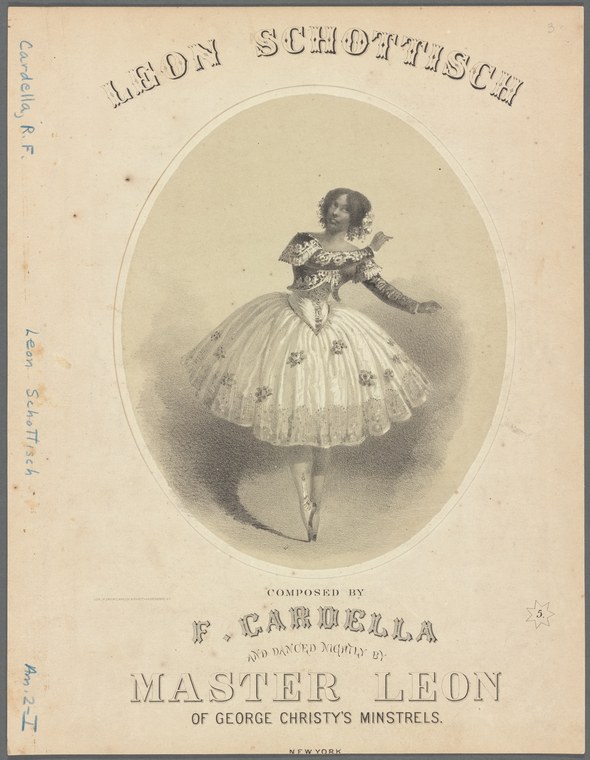
A single female dancer dominates the oval composition, posed in a balletic attitude against a plain background. She wears an ornate corseted bodice with short, puffed sleeves and a voluminous skirt of white tulle decorated with embroidered or applied floral motifs. Her dark hair is curled and styled fashionably; she gazes toward the viewer's right with an expression of composed grace. One leg is extended in a pointed position while the other supports her weight, her arms held in a soft, classical port de bras. The image is rendered as an engraving or lithograph in sepia tones with fine cross-hatching to suggest volume and shadow. The oval framing was a convention of theatrical publicity of the era.
The dancing
The dancer's weight rests on her left leg, which is straight and turned out; her right leg extends behind and to the side in an open position approximating a développé or attitude derrière, the foot pointed in classical ballet style. Her upper body remains upright and composed, with arms softly placed—the left arm extended gently forward, the right at her side—in a balletic frame that avoids the angular positions of character dance. The entire figure conveys the ethereal, weightless quality of mid-19th-century Romantic ballet technique.
The dance depicted
This is a portrait of a professional ballet dancer, almost certainly a prima ballerina of the 1840s–1850s. The title refers to the schottische (or scotch), a popular ballroom and theatrical dance of the period, but the image shows pure classical ballet vocabulary and costume. The schottische itself was a couple dance in moderate 2/4 time, popular in ballrooms, but theatrical dancers also performed solo versions. This image may depict a theatrical performer known for her ability to dance both classical ballet and popular social dances, or it may be a misattribution of the title.
How it was made
This is a hand-colored or tinted engraving or lithograph, most likely a commercial theatrical print from the 1840s–1850s. The technique allows fine detail in the costume and anatomy while the pale background emphasizes the figure. The oval frame and sepia tones are typical of celebrity portraiture in sheet music covers and theatrical publicity of this era. Such prints were produced in quantity and widely circulated, serving as both souvenir and advertisement.
About this work
This is a theatrical portrait of a professional female dancer, rendered as an engraved or lithographed print in the style of 19th-century celebrity publicity. The work documents the appearance and costume of a performer of the Romantic ballet period, when tutus had shortened from ankle-length to mid-calf and the technique demanded the pointed foot and lifted bearing evident here. The inscription credits the image to the printer and mentions that the dance was performed by 'Master Leon' of George Christy's Minstrels, a major American entertainment company of the era. The juxtaposition of classical ballet technique with the title 'Schottisch' suggests the flexibility and versatility demanded of professional dancers in mid-19th-century American theatrical culture, where ballet, pantomime, and popular social dance coexisted on the same stage.
How to look at it
Attend to the technical precision of the pose: the turned-out supporting leg, the fully pointed extended foot, and the composed upper body all signal training in the classical ballet vocabulary. The costume—the short tulle skirt, the corseted bodice, the soft upper arm—was the emerging Romantic ballet standard, distinct from both earlier court dress and the heavy costume of character dance. The artist has chosen a moment of stillness and balance rather than motion, which was standard in celebrity portraiture but also allowed viewers to appreciate the dancer's command of her body.
The artist
The artist is not recorded in the catalogue. The print bears the imprint of a New York publisher. The composition and execution are consistent with theatrical lithographic portraits of the period, a commercially important genre that recorded the appearance of celebrated performers for a paying public.
The period
The 1840s–1850s were the height of the Romantic ballet era in Europe, when dancers such as Marie Taglioni established the ethereal, weightless aesthetic visible here. In America, however, this European prestige coexisted with a thriving popular entertainment industry in which ballet dancers performed in shorter engagements, mixed bills, and social dances for audiences who encountered them primarily through prints, playbills, and live performances in theaters and music halls. George Christy's Minstrels were one of the most successful American entertainment enterprises of the era, and their employment of ballet-trained dancers suggests the porous boundary between 'art' dance and popular entertainment in 19th-century America.
Where it lives
This print is held in the New York Public Library's collection of prints depicting dance. It is part of the commercial theatrical print culture of mid-19th-century America and was designed for public circulation as a souvenir and promotional image.
Dance in this work
Questions about this work
Why is a schottische dancer posed in classical ballet positions?
The schottische was both a ballroom dance and a theatrical solo number. Professional dancers of this era trained in classical ballet but performed a wide range of material for popular audiences. The image may represent a solo theatrical adaptation of the schottische, or it may be a portrait of a dancer known for versatility. The title and the image are in some tension, which may reflect either the performer's range or a mislabeled or misremembered print.
What are George Christy's Minstrels?
George Christy's Minstrels were a leading American entertainment company of the 1840s–1850s, based in New York. They performed a mix of music, dance, comedy, and theatrical spectacle for popular audiences. The company employed singers, dancers, comedians, and specialty performers, and they toured extensively. The presence of a ballet-trained dancer in the company speaks to the diversity of entertainment offered.
Who was Master Leon?
The print credits 'Master Leon' as the dancer. 'Master' was a honorific used for male performers (as opposed to 'Signor' or 'Mr.'). Without additional records, it is not possible to identify this individual further or verify his biographical details.
What does 'Composed by P. Cardella' mean?
P. Cardella composed the music for this schottische. The print was likely the cover of sheet music or a theatrical arrangement. Cardella was a composer of popular and theatrical music in mid-19th-century America.
More dance artwork





