49 works in this view — arrow keys or swipe to move between them.
Dance in Art
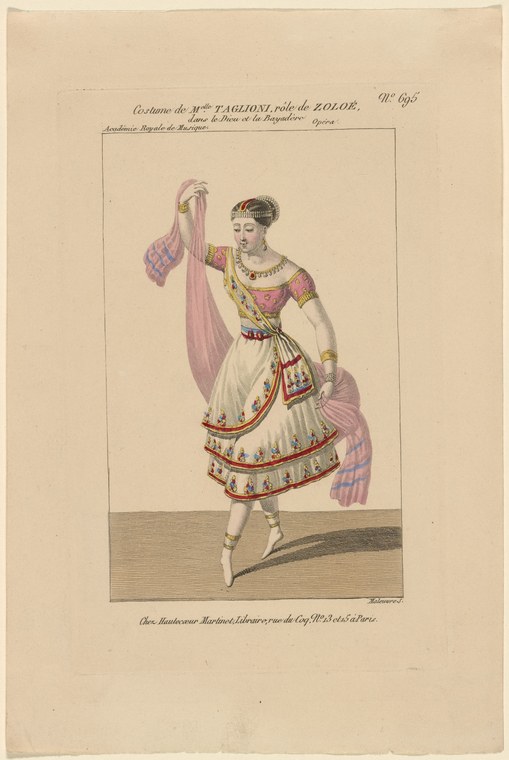
Costume de Melle. Taglioni, rôle de Zoloé, dans Le dieu et la bayadère, opéra, Académie royale de musique
Unknown artist
- Collection:
- Prints depicting dance
- Source:
- New York Public Library
- Rights:
- Public domain — free to use, share and adapt.
- Recorded as:
- Public Domain
Marie Taglioni was the defining dancer of romantic ballet, and images like this one are crucial evidence for how her body moved, how she was costumed, and what audiences saw when they went to the opera. The work shows the vocabulary of elevation and turned-out grace that Taglioni pioneered and that became the basis of classical ballet training as it exists today.
What you are looking at
A single female dancer in a light-filled studio or stage space, posed in a moment of arrested motion. She stands on the balls of her feet in a balletic attitude, her body angled in three-quarter view, weight forward, one leg extended behind her. Her costume is a romantic-era theatrical dress: a fitted bodice in deep rose or burgundy silk with short puffed sleeves and ornate embroidered trim, paired with a voluminous white skirt in multiple tiers, each layer decorated with small floral or jewelled motifs. A gossamer silk scarf in pale mauve or lavender—possibly part of the costume—floats upward from her hand as if caught mid-gesture or mid-turn. She wears her dark hair bound close to her head in the fashion of the 1830s–40s, with a jewelled circlet or crown. The figure casts a shadow on the ground plane, suggesting strong directional light from above and to the left. The background is a pale neutral wash, focusing all attention on the dancer and the geometry of her pose.
The dancing
The dancer's body is held in a balletic frame: torso upright, shoulders back, arms positioned with one raised gracefully near her head and the other extended at middle height, the floating scarf animating the composition. Her legs show the turned-out positioning and pointed foot of classical ballet. The weight is clearly forward and lifted, suggesting either a jump in flight or a moment of sustained elevation—the posture suggests an instant of weightlessness captured between movements. The gesture of the raised arm and the scarf implies a rotation or spiral motion, typical of the romantic ballet vocabulary of the period.
The dance depicted
This is a costume study for Taglioni in the role of Zoloé from Auber's opera *Le Dieu et la Bayadère*, a work that premiered at the Académie Royale de Musique in 1830 (or early 1830s). The costume and pose identify this as romantic-era ballet, specifically the style that emerged through Marie Taglioni's performances. The lightweight, ethereal costume and the emphasis on vertical lift and turn suggest a dance vocabulary centered on pointe work and sustained elevation—hallmarks of Taglioni's revolution in ballet technique. The image documents not the full narrative of the work but the visual codification of an exotic female character through dress and balletic pose, a central concern of romantic ballet.
How it was made
This is a hand-coloured engraving or aquatint, a reproductive print technique that allowed theatrical costume designs to circulate beyond the opera house in multiple copies. The fine linear work of the figure and the delicate watercolour application suggest skilled execution. The technique was standard for publishing theatrical documentation in Paris during the 1820s–40s, permitting rapid and relatively affordable circulation of images to an audience interested in operatic fashion, staging, and the celebrity of individual dancers. The survival of such prints in album form (as suggested by the holding) indicates they were collected systematically, likely by theatre-goers or professionals in the dance world.
About this work
This is a costume plate documenting a performance by the celebrated dancer Marie Taglioni in a leading role at the Paris Opéra during the early romantic ballet era. It belongs to the category of theatrical ephemera: a visual record made for circulation, documenting both the technical innovation of the dancer and the visual spectacle—costume, silhouette, bearing—that defined romantic ballet to its contemporary audience. The image is a primary source for understanding how romantic ballet dancers were costumed, how their bodies were positioned, and what the visual language of the dance was at a formative moment in European theatrical dance. It demonstrates the deep integration of ballet into operatic spectacle and the star system that made individual dancers into fashion icons whose likenesses were commodified and circulated.
How to look at it
Notice the moment the artist chose: not mid-leap, but suspended, with the body gathered and the scarf still in flight. This is a pose of potential energy, of readiness, rather than a narrative moment. Observe how the costume—the layers of skirt, the fitted bodice, the jewelled trim—frames and emphasises the dancer's verticality and turned-out lines. The lightness of the white fabric and the delicacy of the pose work together to convey the romantic ideal of the female dancer as ethereal and otherworldly. The positioning of the feet (on the balls, not flat) and the lift of the torso are technical markers of the balletic vocabulary Taglioni pioneered.
The artist
The artist is not recorded in the catalogue. The print is a typical product of the Parisian theatrical print industry of the 1830s–40s, an industry that employed skilled engravers and colourists to document costume and stage spectacle for a market of affluent theatre-goers. Such prints were often based on sketches made during or after performances, or supplied by the Opéra itself, and were published by the major Parisian print sellers associated with theatrical trade.
The period
The 1830s witnessed the full flowering of romantic ballet in Paris. Taglioni's performances in works like *La Sylphide* (1832) and the operatic ballets in which she appeared established new standards for female dancers: weightlessness, ethereal costuming, and a vocabulary of motion that emphasised vertical lift and sustained port de bras. Simultaneously, the print industry was at its height as a medium for theatrical documentation and celebrity promotion. Dancers' images were collected, traded, and displayed as tokens of beauty and artistic achievement. The romantic ballet aesthetic—the white tulle skirt, the pointe work, the emphasis on the female body as both technical instrument and ethereal vision—was being consolidated visually and commercially through images like this one.
Where it lives
The work is held in the New York Public Library's collection of prints depicting dance, part of a larger archive of theatrical and dance-related ephemera. This holding suggests it was preserved as a historical document of theatrical practice and design.
Dance in this work
Questions about this work
Who was Taglioni and why does she matter?
Marie Taglioni (1804–1884) was a Swedish-Italian dancer who became the most celebrated ballerina of the 1830s–40s. She pioneered the techniques and aesthetic of romantic ballet—weightlessness, pointe work, ethereal costume—and her performances in works like *La Sylphide* (1832) defined what European audiences understood ballet to be. She was also the first major star of the operatic ballet tradition in Paris, appearing in hybrid opera-ballet works like this one.
What was *Le Dieu et la Bayadère*?
An opera with ballet interludes by Auber, premiered at the Académie Royale de Musique (the Paris Opéra) in the early 1830s. The work combined operatic singing with extensive ballet sequences, following the French grand opéra convention. Taglioni performed in the ballet sections, dancing the role of Zoloé, an exotic character whose costume is documented in this print.
How do I tell this is ballet from the image alone?
The turned-out legs, the pointed foot, the lifted and weightless bearing, and the emphasis on vertical extension are unmistakable markers of the ballet vocabulary. The romantic costume—the white tulle skirt, the jewelled bodice, the lightness of the fabric—also codifies this as romantic-era ballet rather than other theatrical dance forms of the period.
What was the role of costume in romantic ballet?
Costume was central to the romantic ballet aesthetic. The ethereal white tulle skirt, the fitted bodice, and the jewelled accessories created a visual language of femininity, otherworldliness, and technical sophistication. Exotic roles (like this bayadère, or Indian dancer) were costumed in a Europeanised romantic idiom rather than with ethnographic accuracy, using rich fabrics and ornaments to signify both femininity and otherness.
More dance artwork





