49 works in this view — arrow keys or swipe to move between them.
Dance in Art
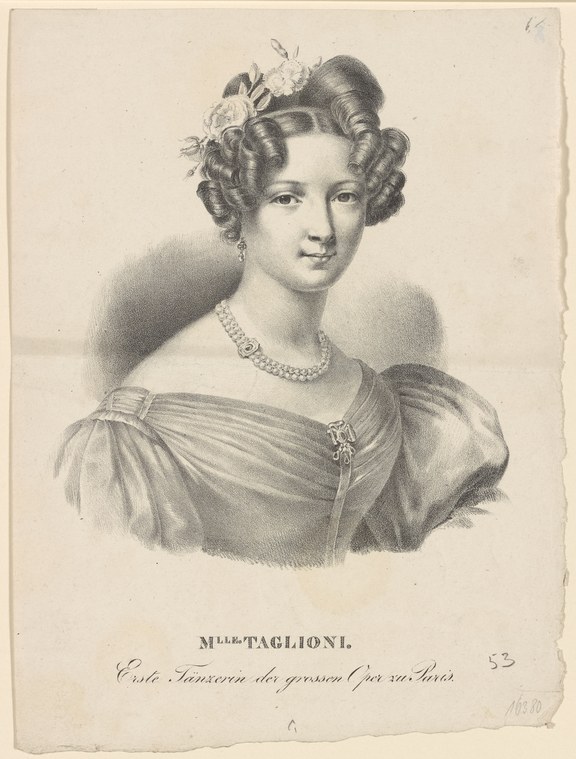
Mlle. Taglioni, erste Tänzerin der grossen Oper zu Paris
Unknown artist
- Collection:
- Prints depicting dance
- Source:
- New York Public Library
- Rights:
- Public domain — free to use, share and adapt.
- Recorded as:
- Public Domain
Marie Taglioni defined Romantic ballet and was the first dancer to achieve the kind of international celebrity that persists in dance history. Prints like this one shaped public understanding of what a ballerina was—ethereal, fashionable, and distant. Understanding how her image was constructed and circulated tells us as much about 19th-century dance culture as watching film of her would.
What you are looking at
A half-length portrait of a young woman in early 19th-century dress, rendered in fine stippled engraving. She faces three-quarters toward the right, her head tilted slightly with a serene expression. Her dark hair is arranged in the fashion of the 1830s–1840s, with loops of curls pinned at the crown and a small decorative comb or ornament nestled among them. She wears a off-shoulder dress with voluminous puffed sleeves gathered at the upper arm, the neckline edged in what appears to be lace or gathered fabric. A pearl necklace encircles her throat. The dress itself is rendered in fine parallel lines suggesting silk or fine muslin, with careful attention to the fall and drape of the fabric across the shoulders and upper chest. The background is plain, allowing the figure to dominate, with subtle shading that suggests depth behind her. The engraver has lavished particular care on the modeling of her face and neck, using fine hatching to create volume and the soft play of light.
The dancing
The sitter is shown in repose, her body angled slightly, her posture upright and composed. There is no active movement or dance gesture visible—this is a formal portrait, not a scene of performance. Her arms are not visible below the shoulders; the composition shows only the upper torso and head. The overall bearing is one of stillness and dignity, appropriate to the conventions of early 19th-century portraiture of theatrical celebrities.
The dance depicted
The inscription identifies this as Marie Taglioni, première danseuse of the Paris Opera. Taglioni (1804–1884) was the defining figure of Romantic ballet and the dancer most closely associated with La Sylphide (1832). She revolutionized technique and aesthetics—introducing the pointe shoe as a standard tool, raising the arms and elongating the line, and establishing the ethereal, weightless quality that became the hallmark of Romantic ballet. This portrait does not depict her dancing; it is a celebrity portrait in the tradition of prints distributed to the public and collectors. However, the dress—particularly the off-shoulder neckline and puffed sleeves—reflects the fashionable silhouette of the 1830s, the era of her greatest fame and the apex of Romantic ballet.
How it was made
This is a lithograph or steel engraving executed in fine stipple and parallel hatching, a technique that allowed precise gradation of tone and was particularly suited to the reproduction of portraiture for mass distribution. The fineness of the line work and the subtle modeling suggest this is a professional work, likely created for commercial sale as a celebrity portrait—a form of popular print that circulated widely among theater-goers and ballet enthusiasts. The technique was common for theatrical portraiture in the 1830s–1840s and would have been affordable enough to reach a broad audience, making it an important vehicle for the dissemination of the dancer's image.
About this work
This is a formal portrait engraving of Marie Taglioni, the most celebrated dancer of the Romantic ballet era, in the costume and fashion of her prime. While the print shows her not in performance but in repose—a convention of celebrity portraiture—it is inseparable from her identity as a dancer and from the visual language of early 19th-century ballet. The work belongs in a gallery of dance in art because it documents the public face of one of dance history's transformative figures and because it reveals how dancers were marketed and memorialized to the public through prints. Taglioni's image was among the most reproduced and sought-after of her time, and this portrait is part of that archive of celebrity and spectacle.
How to look at it
Attend to the hair and the arrangement of the head: Taglioni's curls are styled in the Romantic fashion, with loops and ornament that suggest movement and lightness even in stillness. The engraver has rendered the fabric of her dress with particular delicacy, using line to suggest the shimmer and weight of silk. Note how the off-shoulder neckline and the puffed sleeves were not dance costume but high fashion of the era—this portrait shows Taglioni as a society figure, not as a stage character. The face itself is idealized but not abstracted; the engraver sought to capture her likeness while conforming to the conventions of beauty of the age. This is a work about celebrity and recognition: it was meant to be recognized as Taglioni by those who had seen her perform or who knew her reputation.
The artist
The artist is not recorded in the catalogue. However, the quality and style of the engraving suggest a professional theatrical printmaker working in Paris or another major European center in the 1830s–1840s. Celebrity portraits of performers were a significant commercial genre, and many engravers specialized in theater and dance subjects. The inscription in French and German indicates this print was intended for circulation across European markets.
The period
This portrait dates to the height of Romanticism in ballet and the visual arts. The 1830s–1840s saw an explosion of lithographic and engraved celebrity portraiture, particularly of performers. Taglioni's debut in La Sylphide in 1832 created an international sensation; she was the first dancer to achieve truly global stardom, and her image was reproduced on prints, ceramics, and fan covers across Europe. The ethereal, weightless aesthetic she embodied—achieved through new technique, particularly dancing on pointe—became the visual ideal of the age. At the same time, Romantic painting and printmaking were increasingly concerned with capturing the ephemeral and the spiritual; Taglioni's image, with its emphasis on grace and otherworldliness, was perfectly aligned with these artistic values.
Where it lives
The work is held in the New York Public Library's Prints collection under the title 'Mlle. Taglioni, erste Tänzerin der grossen Oper zu Paris' (Miss Taglioni, first dancer of the great Opera in Paris), a designation in German suggesting circulation among German-speaking audiences. The print is part of a broader archive of 19th-century theatrical portraiture.
Dance in this work
Questions about this work
Was this print made during Taglioni's lifetime?
Very likely. The style and inscription date it to the 1830s–1840s, when Taglioni was at the height of her fame in Paris. She lived until 1884, so this is a contemporary portrait, probably made to capitalize on her celebrity following the success of La Sylphide and her subsequent performances across Europe.
Is this a portrait of Taglioni in costume?
No. This shows her in fashionable dress of the period, not in theatrical costume. However, the fashions of the era—the off-shoulder neckline, the puffed sleeves—were influenced by and associated with Romantic ballet aesthetics. This is a society portrait of a celebrity, not a record of her stage appearance.
Why does the inscription include German?
The bilingual inscription (French and German) indicates that this print was produced for international sale, circulating across French and German-speaking markets in Europe. Taglioni's fame was genuinely cosmopolitan, and her image was in demand from London to Berlin.
What technique was used to make this print?
This is a steel engraving or lithograph executed in fine stipple and parallel lines. The technique allowed for precise gradation of tone and was ideal for theatrical portraiture. It was a commercial print, likely produced in quantity and sold to the public, making it an affordable way for admirers to own an image of the dancer.
More dance artwork





