49 works in this view — arrow keys or swipe to move between them.
Dance in Art
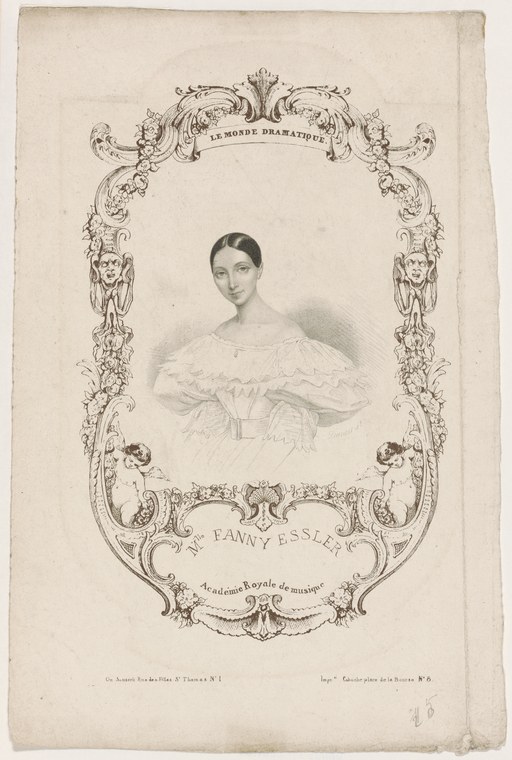
Mlle. Fanny Elssler [sic].: Académie Royale de Musique
Unknown artist
- Collection:
- Prints depicting dance
- Source:
- New York Public Library
- Rights:
- Public domain — free to use, share and adapt.
- Recorded as:
- Public Domain
Fanny Elssler was one of the two most celebrated dancers of her era, and this engraving is a primary document of how she was presented to her public and how Romantic ballet costume was understood and portrayed. For dancers and historians, the image provides concrete evidence of the dress, bearing, and aesthetic conventions of Romantic ballet in its mature phase, and of the ways that theatrical fame was mediated through prints before photography.
What you are looking at
A three-quarter-length portrait of a young woman, presented within an ornate rococo frame of scrollwork, cartouches, and decorative figural elements. She faces the viewer directly, her dark hair parted and pulled back smoothly in the fashion of the 1830s–40s. She wears a white or pale silk dress with a wide, off-shoulder neckline and billowing sleeves that fall to reveal her bare shoulders and upper arms—the signature silhouette of Romantic-era ballet costume. The dress is gathered at the waist and falls in soft folds to an unseen hem. Her posture is upright and composed, with one arm held across her body in a graceful gesture. The background is plain and neutral, allowing the figure and the elaborate frame to dominate. At the base of the frame, a nameplate reads "FANNY ESSLER" (note the spelling variant in the engraving). Above the frame, a banner inscribed "LE MONDE DRAMATIQUE" identifies this as a theatrical portrait from a publication. The entire composition is rendered as an engraving, with fine cross-hatching used to model the face, neck, and fabric, creating delicate tonal gradations.
The dancing
The dancer is shown in a calm, nearly stationary pose rather than mid-movement—a common convention in theatrical portraiture of this era. Her shoulders are relaxed and level, her frame upright without tension. The bare shoulders and off-shoulder cut are essential to the Romantic ballet aesthetic; they expose the line of the neck and upper body, which were thought to convey grace and ethereality. Her arms are positioned with one resting gently, the other lightly raised—a composed, almost parlor-pose rather than a dynamic dance position. This is portraiture that asserts her status as a celebrated dancer through costume and bearing rather than through captured motion.
The dance depicted
Fanny Elssler was the most famous dancer of the Romantic ballet era, a Viennese-born performer who dominated European and American stages from the late 1820s until her retirement in 1851. This engraving, published in *Le Monde Dramatique*, a Parisian theatrical periodical, captures her at the height of her fame in the 1830s–40s. Elssler was celebrated for her technical brilliance, speed, and earthy, sensual style—a marked contrast to the ethereal otherworldliness associated with her great rival Marie Taglioni. The dress shown here—the white gathered skirt, off-shoulder neckline, and bare arms—is characteristic of the tutu and bodice worn in Romantic ballets of the period, though this is a formal portrait pose rather than a depiction of her dancing. Her fame rested on roles in works like *La Sylphide*, *Giselle*, and Spanish character dances that showcased both technical virtuosity and dramatic presence.
How it was made
This is an engraving, executed with fine burin work and cross-hatching to create tone and volume, particularly in the modeling of the face and the rendering of fabric textures. The technique allows for fine linear detail in the ornamental frame and precise definition of the facial features. As a print published in a theatrical magazine, this engraving was produced in multiple impressions for wide distribution among the theater-going public and dance enthusiasts. The quality of execution and the prestigious publication venue indicate this was a significant promotional image, aimed at a literate, urban audience interested in following the careers of celebrated performers. Engravings of this kind were the primary means by which dancers' images circulated before photography became standard in the 1860s.
About this work
This is a formal theatrical portrait engraving of Fanny Elssler, the dominant dancer of the Romantic ballet era, published in the Parisian periodical *Le Monde Dramatique* in the 1830s or 1840s. It presents her in the costume of Romantic ballet—the iconic off-shoulder white dress—and asserts her status as a celebrated performer through the ornate rococo frame and prestigious publication. The engraving is not a depiction of her dancing but rather a document of her fame and the visual language by which star dancers were presented to the public.
Elssler's reputation rested on her technical command, dramatic power, and sensual presence—qualities quite distinct from the otherworldly ethereality associated with Marie Taglioni and the *ballet blanc*. This portrait captures her at a moment when Romantic ballet had become the dominant theatrical form in Europe, and when the dancer's body and persona had become central to the appeal of the art form. The work belongs in a gallery of dance art both as a historical record of Romantic ballet costume and as evidence of how performers were marketed and remembered.
How to look at it
The portrait presents Elssler not in action but in formal repose—a convention of theatrical portraiture that asserts her status and allows close examination of the costume and bearing. Attend to the off-shoulder neckline and the bare arm and shoulder, which were considered both technically necessary (to allow freedom of movement) and aesthetically crucial to the Romantic ballet ideal. The fine cross-hatching in the face and neck creates a delicate, idealized likeness that conveys both beauty and nobility. The ornate rococo frame, with its theatrical and rocaille vocabulary, asserts that this is not merely a portrait but a celebration of a celebrated performer. The nameplate and publication title anchor the image firmly in the world of Parisian theatrical culture.
The artist
The engraving is not signed by the artist in the visible portion of the image, and the catalogue record does not identify the engraver. *Le Monde Dramatique* was a French theatrical periodical that published such portraits regularly. Engravings of celebrated performers were typically executed by professional theatrical print-makers and distributed as loose prints or bound in the journal. The quality and finish of this work suggest it was produced by a skilled professional familiar with the conventions of theatrical portraiture and the demands of fine engraving.
The period
This engraving dates to the 1830s or 1840s, the peak of European Romantic ballet. The period saw the emergence of the Romantic aesthetic in dance: the elevation of the female dancer, the emphasis on otherworldly and ethereal themes, the development of pointe-work technique, and the iconic costume of the white gathered skirt and off-shoulder bodice. Fanny Elssler and Marie Taglioni dominated this era as rival stars, each representing a different aesthetic—Taglioni the ethereal and otherworldly, Elssler the earthly, sensual, and technically brilliant. The publication of theatrical portraits in periodicals was a central means of building and sustaining a dancer's fame and public image. This engraving sits within a broader culture of theatrical celebrity that was just emerging in this period.
Where it lives
The work is held in the New York Public Library's prints collection depicting dance. It was published in *Le Monde Dramatique*, a Parisian theatrical periodical, and circulated as a loose print or as part of the bound journal. This engraving is one of many such theatrical portraits produced and distributed during Elssler's career to capitalize on her fame.
Dance in this work
Questions about this work
Who was Fanny Elssler?
Fanny Elssler (1810–1884) was an Austrian dancer and the most celebrated performer of the Romantic ballet era alongside Marie Taglioni. She was famous for her technical brilliance, speed, and earthy sensuality, and for her roles in works like *La Sylphide* and *Giselle*. She performed throughout Europe and America and retired in 1851 at the height of her fame.
What is the white dress in the portrait?
The dress is the costume of Romantic ballet—a white or pale silk skirt gathered at the waist and falling in soft folds, paired with an off-shoulder neckline and billowing sleeves. This became the iconic tutu silhouette of the era. The off-shoulder cut exposed the dancer's neck and upper body, which were considered essential to conveying the grace and ethereality valued in Romantic ballet.
Why is this engraving important?
It is a primary document of Romantic ballet costume, bearing, and aesthetic at the height of the movement's dominance in the 1830s–40s. It also illustrates how theatrical fame was created and sustained through mass-produced prints before photography. For dancers and historians, it provides concrete visual evidence of how a star performer was presented and remembered.
What is *Le Monde Dramatique*?
*Le Monde Dramatique* was a Parisian theatrical periodical that published illustrations, reviews, and portraits of celebrated performers. Engravings of famous dancers were a regular feature, and such prints were an important means of promoting performers and circulating their images to the theater-going public.
More dance artwork





