49 works in this view — arrow keys or swipe to move between them.
Dance in Art
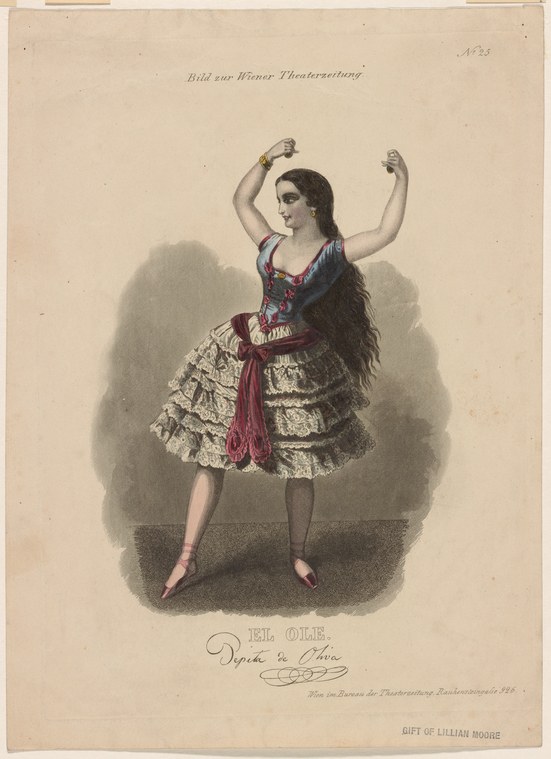
El ole. Pepita de Oliva
Unknown artist
- Collection:
- Prints depicting dance
- Source:
- New York Public Library
- Rights:
- Public domain — free to use, share and adapt.
- Recorded as:
- Public Domain
This print provides direct visual evidence of how Romantic ballet was performed and presented in the mid-1800s, showing the actual costume, silhouette, and pose conventions of the era. For historians and dancers, it is a primary source for understanding the evolution of ballet costume, the ideal of the Romantic ballerina, and the commercial circulation of dance imagery. The identification of a specific named dancer grounds the work historically and reminds us that Romantic ballet, though now known primarily through re-stagings and notation, was a living practice performed by individuals whose names and images were celebrated in their own time.
What you are looking at
A young female dancer stands alone against a neutral grey background in a three-quarter pose facing left. She wears a dark bodice with burgundy trim and a voluminous skirt of gathered white lace or gauze layered over darker underpinnings, caught mid-swirl to show the construction and movement of the skirt. Her long dark hair falls loosely down her back. Both arms are raised above her head with bent elbows, wrists and hands delicately positioned as if executing a gesture or preparing for movement. She balances on one leg with the supporting knee slightly bent; the other leg extends lightly behind or to the side. She wears pink tights and is posed en demi-pointe or flat. The lighting is even and focuses attention entirely on the figure; the background shadow suggests a studio or theatrical setting. The overall composition emphasizes the dancer's line, the movement of the skirt, and an attitude of graceful, controlled motion.
The dancing
A single female figure in a standing pose with arms raised symmetrically above her head, elbows bent, creating an open frame. Her weight appears centered but lightly distributed, with one leg supporting and the other leg extended or lifted with ease. The posture is upright and the frame is open and expansive. The raised arms and the tilt of her head suggest a moment of balanced poise rather than rapid motion. The position is characteristic of ballet vocabulary—a preparation or a sustained attitude—showing understanding of female classical dance form. The hands are delicate and properly positioned, indicating trained execution.
The dance depicted
This is a portrait of a Romantic-era ballet dancer, most likely a principal dancer of the mid-19th century. The title 'Pepita de Oliva' appears to identify a specific dancer, and the style of dress, pose, and artistic rendering are consistent with theatrical ballet portraiture from that period. The raised arms and extended leg suggest a moment from classical ballet technique, presented as a formal studio or theatrical portrait rather than narrative action. The emphasis on the decorative skirt—shown with theatrical exaggeration of its movement and structure—was a signature of Romantic ballet, which celebrated the ethereal, weightless quality of the female dancer. The print appears to document a celebrated performer of the era in her theatrical costume.
How it was made
This is a hand-colored lithograph or engraving, recognizable by its linear framework, the tonal shading achieved through controlled mark-making, and the delicate hand-coloring in the bodice (deep red and dark tones), skirt (white with subtle grey shading), and the figure's complexion and hair. The technique allowed for wide circulation and relatively affordable reproduction—this would have been a popular souvenir or promotional image of the dancer, distributed to theaters and sold to admirers. The inscription at the base indicates a French publisher and connection to Parisian theatrical production, suggesting this was part of the commercial apparatus of 19th-century ballet promotion.
About this work
This is a mid-19th-century hand-colored print of Pepita de Oliva, a Romantic-era ballet dancer, rendered in a formal pose that shows her in her stage costume. The work captures the visual language of Romantic ballet—the ethereal skirt, the open arm frame, the delicate line—and functions as both a performance record and a promotional portrait. Such prints were central to how ballet dancers of this period were known to the public, circulated as playbills, lobby cards, and collectibles. The image documents not just a dancer but an entire visual and theatrical tradition: how Romantic ballet presented the female body, how dancers were celebrated and commodified, and what audiences understood as the essence of classical dance technique.
How to look at it
Note the moment the artist chose: not mid-leap or in the depth of a turn, but a sustained, posed moment that showcases the dancer's line and her costume simultaneously. The raised arms and extended line are presented as a statuary ideal, emphasizing balance and control rather than velocity or narrative. The exaggerated volume and detail of the skirt—shown as if caught in motion—reflects the theatrical convention of depicting the skirt not as it would appear in a still photograph, but as the eye would remember it in performance. The delicate hand-coloring emphasizes the precision of the pose and the theatrical glamour of the figure.
The artist
The artist is not recorded, which is typical for commercial theatrical prints of this period. The print bears a publisher's mark and French theatrical credits, indicating it was produced as part of the professional theatrical apparatus in Paris, likely by a commercial print shop specializing in dance and opera imagery. Such prints were often unsigned or credited only to the publisher; the skill evident in the work—the accurate rendering of pose, the delicate hand-coloring, the theatrical understanding—suggests a trained artist working within a commercial tradition.
The period
This print dates to the heyday of Romantic ballet (circa 1830s–1860s), when ballet was the dominant form of theatrical dance in Europe and particularly in Paris. The Romantic era in ballet celebrated the female dancer as a weightless, ethereal figure—costumes grew fuller and lighter, pointe work became standard, and the ballerina was idealized as a supernatural or otherworldly being. Simultaneously, the theatrical print business was booming; colored lithographs of famous dancers were mass-produced, sold as souvenirs, and displayed in theaters and shops. This image sits at the intersection of artistic documentation and commercial promotion, a characteristic product of 19th-century theatrical culture.
Where it lives
The work is held in the New York Public Library's collection of prints depicting dance. The inscription indicates connection to Parisian theatrical publication and distribution. Such prints were typically produced in editions and widely circulated; this copy represents what was a common format for the promotion and documentation of 19th-century ballet performance.
Dance in this work
Questions about this work
Was Pepita de Oliva a famous dancer?
The title identifies her as such, and the quality of the print and its theatrical context suggest she was a recognized performer of her era. However, without additional archival documentation, specific details of her career and fame cannot be established from the image alone. Romantic-era dancers who were celebrated enough to be reproduced in colored prints like this were typically principal dancers at major opera houses or touring performers.
What is she doing in this pose?
She is not performing a specific choreographic moment but rather presenting herself in a formal studio or portrait pose that showcases her technique and costume. The raised arms and extended line are characteristic of ballet vocabulary—this might be described as a preparation, an attitude, or a moment of suspension. The pose is designed to display her line, training, and the theatrical appeal of her costume.
Why is so much detail shown in the skirt?
The Romantic era valued the female dancer's ethereal quality, and the voluminous skirt was central to that ideal. The print exaggerates the movement and construction of the skirt—showing its gathering, layering, and dynamic quality—to emphasize both the theatrical artistry and the technical skill required to move in such a costume. This was a signature visual convention of Romantic ballet imagery.
More dance artwork





