49 works in this view — arrow keys or swipe to move between them.
Dance in Art
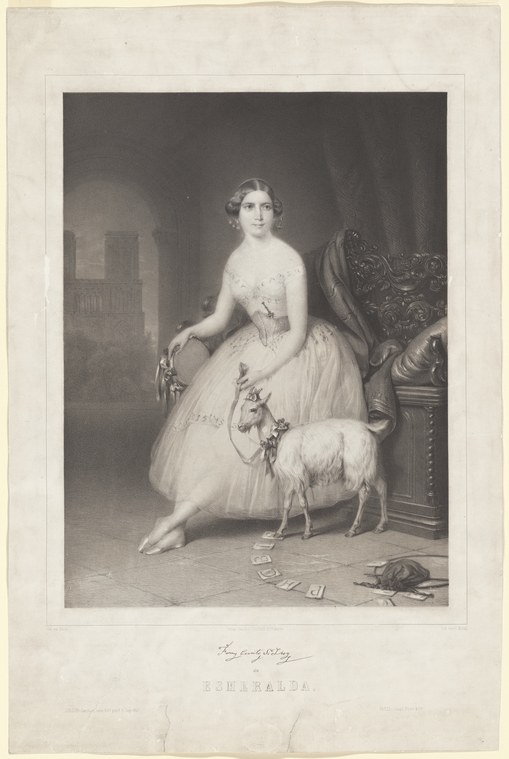
Fanny Cerrito St. Leon [fac. sig.] als Esmeralda
Unknown artist
- Collection:
- Prints depicting dance
- Source:
- New York Public Library
- Rights:
- Public domain — free to use, share and adapt.
- Recorded as:
- Public Domain
This image shows how romantic-ballet dancers were publicly presented and commodified as cultural icons, and how prints rather than live performance shaped public memory and desire. It is also evidence of Fanny Cerrito's international stardom: the fact that her likeness was reproduced as a commercial print testifies to her rank among the handful of dancers whose names and faces commanded commercial circulation.
What you are looking at
A young woman sits gracefully in three-quarter profile on an ornate chair with carved wooden back, positioned stage-right. She wears a pale, diaphanous tulle skirt of romantic length, bare shoulders and décolletage, and her hair is styled in the fashion of the 1840s with ringlets and a center part. Her posture is relaxed and contemplative, one arm resting across her lap while the other hangs naturally. A small white dog sits at her feet to the left, gazing upward; scattered playing cards and what appears to be a tortoiseshell fan lie on the floor before them. The background is rendered in deep shadow with a suggestion of architectural detail—a doorway—creating theatrical depth. The lighting is dramatic, concentrating illumination on the pale figure against the dark ground, typical of romantic-era theatrical portraiture.
The dancing
The dancer is seated rather than in active motion, her body aligned in a graceful S-curve typical of romantic ballet portraiture. Her weight is settled into the chair; her arms are soft and gently placed rather than extended in dynamic line. There is no visible footwork, and no partner or ensemble. The pose emphasizes repose and elegance rather than the virtuosic extension or technical vocabulary of ballet vocabulary. The inclusion of the dog and scattered objects suggests a narrative or character moment rather than a pure dance position.
The dance depicted
This is a portrait of a performer in costume as a character rather than a depiction of active choreography. The inscription identifies her as Fanny Cerrito (the celebrated Swiss-Italian prima ballerina of the 1840s–1850s) in the role of Esmeralda from the ballet *La Esmeralda*, created by Jean Coralli in 1841. The work captures the dancer in character dress but in a moment of rest or pantomime rather than in the execution of steps. The theatrical softness of the image—the romantic lighting, the repose, the narrative objects—suggests this is a *carte de visite* or theatrical portrait celebrating the performer's fame rather than documenting her technique.
How it was made
This is an engraving or steel engraving, a reproductive print medium that allowed mass circulation of theatrical celebrity imagery in the mid-19th century. The fine parallel lines building shadow and the delicate modeling of fabric and skin are characteristic of steel-engraving technique. The relatively large scale and careful finish suggest this was a commercial theatrical print, likely produced for sale to the public as both artistic memento and advertisement of the performer. Such prints were the dominant medium for disseminating images of celebrated dancers to audiences who could not attend performances.
About this work
This is a celebrity portrait print of Fanny Cerrito, one of the great ballerinas of the romantic era, captured in the costume of Esmeralda from Coralli's 1841 ballet. Rather than showing her dancing, it presents her in a moment of repose, in full theatrical dress, gazing into middle distance with an air of melancholy or introspection befitting the character. The work belongs to the tradition of mid-19th-century theatrical prints that created and circulated the public image of dancers as romantic heroines—ethereal, contemplative, and associated with otherworldly grace. It is as much a portrait of celebrity as a document of dance, and reveals how romantic ballet and its performers were marketed and imagined by the era.
How to look at it
Attend to the stillness and introspection: romantic ballet was as much about the *idea* of movement—grace, lightness, dreamlike beauty—as about technical display, and this print captures that aesthetic perfectly by showing the dancer at rest. Notice how the dog and scattered cards (symbols of play, randomness, domestic life) anchor her in narrative rather than in pure abstraction. Observe the careful gradation of light from her pale skin and dress to the engulfing darkness, a technique that emphasizes her as the sole point of illumination and meaning. The engraving style—fine lines and careful cross-hatching—was considered the most refined and prestigious form of theatrical reproduction, appropriate to celebrating a prima ballerina of the first rank.
The artist
The artist is not recorded in the catalogue. The engraving style and theatrical subject suggest a professional print workshop producing commercial theatrical portraits for the mid-19th-century dance audience, likely in a major European center such as Paris, London, or Milan. Such prints were typically unsigned or attributed only to the publishing house.
The period
This print dates to the height of the romantic ballet (approximately 1840s–1850s), when works like *Giselle*, *La Sylphide*, *La Esmeralda*, and *Pas de Quatre* defined the era. Fanny Cerrito was one of the four dancers (alongside Marie Taglioni, Carlotta Grisi, and Lucile Grahn) celebrated in Perrot's *Pas de Quatre* (1845), an epochal event in ballet history. The 1840s were also the era of the lithograph and engraved theatrical print as the primary visual technology for celebrity creation; photography existed but was too new and slow to compete with engraving for mass theatrical portraiture. By the 1850s, this print technology would begin to give way to photography.
Where it lives
This print is held in the New York Public Library's collection of prints depicting dance. It is a reproductive engraving, likely commercially published, and would have circulated as an affordable theatrical souvenir available for purchase to audiences and admirers.
Dance in this work
Questions about this work
Is Fanny Cerrito dancing in this image?
No, she is seated in repose. This is a portrait of the performer in character costume rather than a depiction of choreography. It captures a moment of theatrical presence and character rather than the execution of steps. Such portraits were extremely common and were often based on poses from the choreography or famous gestures associated with the role.
What is Esmeralda?
Esmeralda is a character from Victor Hugo's novel *The Hunchback of Notre-Dame*, and Jean Coralli created a ballet around her in 1841. The role became a showpiece for romantic ballerinas throughout the 19th century. It typically showcases the ballerina's technique, expressiveness, and ability to embody both the earthy sensuality and the ethereal pathos associated with the character.
Who was Fanny Cerrito?
Fanny Cerrito (1817–1909) was a Swiss-Italian prima ballerina who enjoyed international stardom in the 1840s and 1850s. She was known for her technical facility, her dramatic presence, and her collaboration with the choreographer Jules Perrot. She was one of four dancers featured in the legendary *Pas de Quatre* of 1845.
Why are there playing cards and a dog?
These objects create a narrative context, suggesting the character's moment outside of pure dance. The cards may allude to fate or chance, while the small dog adds an element of tender domesticity. Such still-life objects were common in romantic theatrical portraiture as a way of humanizing the idealized ballerina and anchoring her in a story.
More dance artwork





