49 works in this view — arrow keys or swipe to move between them.
Dance in Art
Le rêve
Unknown artist
- Collection:
- Prints depicting dance
- Source:
- New York Public Library
- Rights:
- Public domain — free to use, share and adapt.
- Recorded as:
- Public Domain
This image documents a pivotal moment in ballet history when the medium of theatrical illustration was itself becoming an art form of sophistication and beauty. The spare composition and dreamlike quality show how ballet imagery was used not simply to document technique, but to evoke mood and to align dance with the romantic and symbolist aesthetics of early modernism. For historians of ballet costume and aesthetic ideology, the hybrid classical-modern dress and the ethereal staging offer evidence of how early 20th-century companies reimagined the classical ballet tradition.
What you are looking at
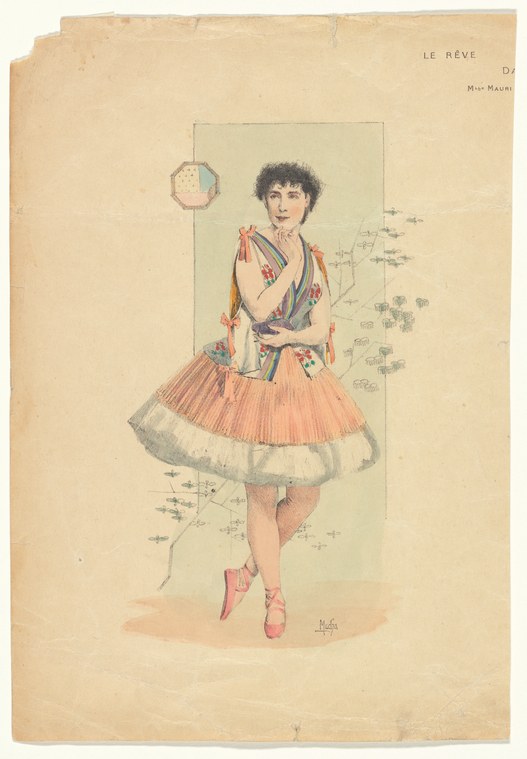
A young woman in theatrical dress stands in a posed attitude against a pale, minimalist background. She wears a short pleated skirt in coral or salmon pink with a grey underskirt, paired with a draped upper garment in multicolored fabric (coral, yellow, blue) that falls asymmetrically across one shoulder, leaving the other bare in a classical style. Her dark hair is styled close to her head in an early 20th-century bob. She stands on pointe in coral or pink ballet slippers, her body in a three-quarter turn, one leg supporting her weight while the other is lifted slightly behind. Her right arm is raised and bent, the left arm lowered; her gaze is directed away from the viewer with a dreamy, distant expression. The composition is spare and elegant: a circular form (perhaps a moon or celestial body) floats in the upper left, while delicate botanical or floral motifs—rendered in pale watercolor—scatter across the right side of the composition, adding an ethereal, nocturnal quality that echoes the title *Le rêve* (The Dream).
The dancing
A single female dancer is depicted in a classical ballet pose. She stands on pointe in both feet, though her weight is clearly on one leg while the other leg is raised in a gentle développé or attitude position behind her. Her torso is held upright with a slight forward inclination. Her arms are posed in a soft, expressive frame—the raised arm curves gracefully, the lowered arm hangs naturally—a vocabulary more consistent with romantic or classical ballet than strict academic formality. The dancer's body is slender and elongated, and her overall carriage suggests trained technique, though the pose is held with a lyrical rather than geometric precision.
The dance depicted
This is almost certainly a theatrical ballet image, most likely depicting a romantic or classical ballet solo, given the pointe work, the ethereal costume, and the solo female figure. The dreamy quality of the title, the nocturnal setting suggested by the moon motif, and the soft, expressive arm positions point toward romantic-era ballet vocabulary and aesthetic—the tradition of works like *La Sylphide* or *Giselle*. The artist has captured a moment of reverie or vision rather than technical display, which was a hallmark of 19th-century romantic ballet. The costume—a draped classical chiton worn with a modern pleated skirt—suggests either a stylized classical setting or a hybrid romantic-classical aesthetic popular in early 20th-century ballet.
How it was made
This appears to be a watercolor and possibly pencil or graphite work on paper, executed with delicate washes and fine linear detail. The technique is characteristic of theatrical design or illustration from the late 19th or early 20th century—the kind of preliminary study, costume design, or promotional image that would circulate in the world of theater and dance. The pale, luminous background and soft color palette are achieved through transparent watercolor glazes, while finer details (the hair, the face, the delicate botanical ornaments) are rendered in graphite or ink. This was a standard medium for dance and theater illustration of the period, allowing rapid execution and easy reproduction in theatrical publications and programs.
About this work
This is a single-figure study of a female ballet dancer in a classical or romantic pose, rendered in watercolor in the style of late 19th or early 20th-century theatrical illustration. The image captures the vocabulary of romantic ballet—pointe work, expressive port de bras, a lyrical rather than austere physicality—and places it in a dreamlike nocturnal setting. The title *Le rêve* (The Dream) and the sparse, ethereal composition suggest a moment of vision or reverie, rather than a narrative scene or technical display. The work belongs to a rich tradition of dance imagery created for theatrical promotion, costume design, and the illustrated press of the period, when ballet was being reimagined as an art form of fantasy, poetry, and visual elegance.
How to look at it
Look first at the pose itself: the dancer is not caught mid-movement but held in a moment of stillness and introspection. The weight distribution, the raised arm, and the lifted leg suggest potential energy rather than explosive action. Note how the artist has used the sparse background and the floating celestial motifs to create a sense of weightlessness and dream-logic—this is not a stage set but a poetic space. The costume, too, deserves attention: the asymmetrical draping and the mixture of classical and modern elements suggest an artist thinking carefully about how to costume a romantic subject for a modern audience. Finally, observe the dancer's face and gaze: turned away and downward, lost in thought. This is an image about interiority and reverie, not spectacle.
The artist
The artist is not recorded in the catalogue. However, the style, technique, and aesthetic are consistent with the work of theatrical illustrators and costume designers active in Paris and Western Europe in the 1890s–1920s. The signature visible in the lower right corner (appearing to read 'Pud' or similar) may point to a specific artist, but without further research, attribution cannot be confirmed. The work sits within a broader tradition of fin-de-siècle and early modernist dance illustration, a practice that was flourishing in the theater world and in journals and periodicals devoted to the arts.
The period
This work dates most likely to the 1900s–1920s, a period of extraordinary innovation in ballet and theatrical design. Sergei Diaghilev's Ballets Russes (founded 1909) was revolutionizing ballet through collaboration with modernist artists and designers; simultaneously, traditional opera-ballet companies in Paris and Europe were undergoing aesthetic renewal. The Romantic ballet tradition of the 19th century—with its emphasis on ethereal, pointe-dancing heroines, supernatural themes, and pastoral or nocturnal settings—remained a powerful cultural reference even as modernism was reshaping dance and visual art. This illustration reflects that tension: it draws on romantic vocabulary and sentiment while employing the graphic sophistication and spare composition of early modernism.
Where it lives
The work is held in the New York Public Library's collection of prints depicting dance. It was likely created as a theatrical design, costume study, or illustration for a program or theatrical publication, and entered the library's collection as part of its effort to document dance history and the performing arts.
Dance in this work
Questions about this work
Is this a real ballet or a generic dance image?
It is most likely a generic or stylized image representing the aesthetic of romantic ballet rather than a scene from a specific ballet. The title *Le rêve* is poetic and evocative but does not correspond to a well-known ballet of the period. The image was probably created as a promotional, illustrative, or costume-design work, not as a record of a particular performance.
Why is the dancer on pointe if this is a dream?
Pointe work became a fundamental marker of the ethereal, weightless quality that romantic ballet aimed to achieve. By the early 20th century, pointe was inseparable from the visual language of ballet elegance and fantasy, even in images meant to evoke dreams or supernatural worlds. The pointe shoes announce 'this is ballet' to the viewer.
What is the dress? It doesn't look like a standard ballet tutu.
The costume is a hybrid: the pleated skirt and classical draped chiton suggest either an ancient or pastoral setting, or an early 20th-century designer's reinterpretation of classical themes. This kind of costume experimentation was common in the 1900s–1920s as ballet companies sought to modernize the 19th-century tutu while retaining its visual poetry.
Who was the artist?
The artist is not identified in the catalogue record. A signature appears in the lower right corner of the work, but it has not been conclusively identified. The style and technique suggest a professional theatrical illustrator or designer working in Paris or Western Europe in the early 20th century.
More dance artwork





