49 works in this view — arrow keys or swipe to move between them.
Dance in Art
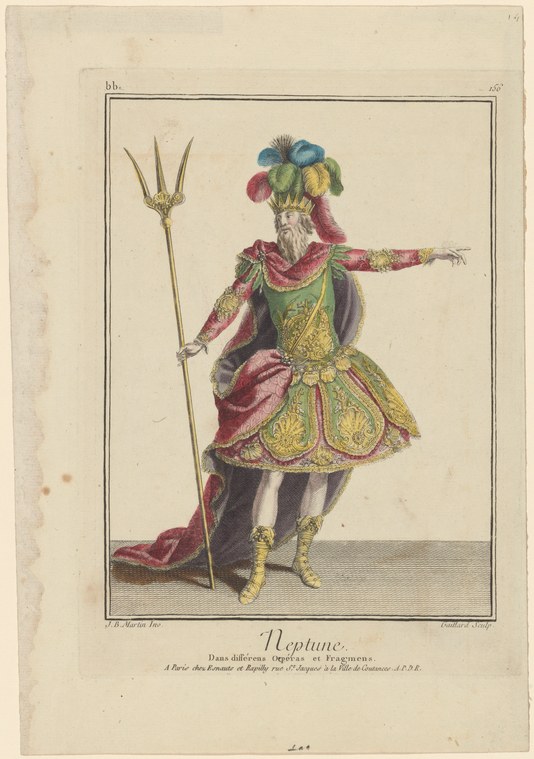
Neptune. Dans différens opéras et fragmens
Unknown artist
- Collection:
- Prints depicting dance
- Source:
- New York Public Library
- Rights:
- Public domain — free to use, share and adapt.
- Recorded as:
- Public Domain
For a dance historian, this plate documents the visual and sartorial framework within which baroque opera dancers moved and were seen. Neptune was a dancing role, not merely a speaking one, and understanding his costume, attributes, and formal bearing is essential to reconstructing the kinetic and visual logic of 17th- and 18th-century theatrical dance. The plate preserves a moment of theater history when dance, music, visual spectacle, and mythology were inseparable, and the costume itself was a primary vehicle of meaning.
What you are looking at
A single male figure in elaborate theatrical costume dominates the composition against a plain cream background. He wears a richly decorated short skirt in yellow with ornamental patterns, a burgundy draped upper garment, and a tall headdress with radiating blue and multicolored plumes. His pale legs are visible, clad in yellow stockings. He holds a three-pronged trident in his left hand and extends his right arm in an open, expansive gesture—the pose of address or dominion. The figure is rendered in hand-colored engraving with fine detail, the gold leaf visible on the skirt and the careful articulation of the textile patterns. The formal frame and sparse setting are typical of costume plate conventions from operatic documentation.
The dancing
The single dancer stands in a frontal, presentational stance rather than mid-movement. His weight appears evenly distributed; the pose is stationary and heraldic, displaying costume rather than capturing kinetic action. The extended right arm is open and gestural—a classical rhetorical pose of command or declamation. The left arm holds the trident as an attribute. There is no indication of partnering, footwork, or dynamic engagement with space; this is costume documentation designed to convey character and rank through dress and symbolic object.
The dance depicted
This is Neptune, the Roman god of the sea, as depicted in operatic or theatrical costume. The figure is clearly identified by the French inscription below the image. Neptune was a stock character in baroque opera and court entertainment, often appearing in elaborate spectacles and ballet de cour. The image documents not a moment of actual dance but rather the costume and attributes of the role—the trident, the sea-god headdress, the rich drapery. Neptune roles in 17th- and early 18th-century opera would have involved movement, but this plate freezes the character in a static, iconic pose suited to costume documentation rather than choreography.
How it was made
This is a hand-colored engraving, identifiable by the fine line-work, the formal frame border, and the evidence of watercolor or gouache applied to a printed base. The technique allowed for wide circulation of costume designs and character documentation among performers, designers, and literate audiences across Europe. Costume plates of this type were essential practical tools for understanding the visual conventions of operatic roles and served as record and reference for theatrical production. The careful reproduction of textile ornament and the subtle modeling of the figure suggest this was made from a drawing or painting, likely by an artist attached to a theater or opera house.
About this work
This is a costume plate documenting the character of Neptune as performed in 17th- or early 18th-century French opera or court spectacle. It belongs to a large body of theatrical documentation that visualized the mythological and allegorical repertory of baroque theater. The inscription indicates this is one of several versions of Neptune 'dans différens opéras et fragmens'—Neptune as he appeared in different operas and theatrical fragments—suggesting the print was part of a series cataloging the character across multiple productions. Such plates are invaluable records of how baroque spectacle made myth and divinity visible on stage, combining costume, symbolism, and the conventions of theatrical display.
How to look at it
Look first at the pose: this is not a captured moment of movement but a formal display of character. The extended arm, the frontal facing, the still weight—these are conventions of costume documentation meant to show the figure clearly from front. The ornament is dense and deliberate; note how the pattern on the skirt, the texture of the draped upper garment, and the construction of the headdress create a profile of divine authority and aquatic association. The trident is not incidental; it is Neptune's primary emblem and would have been recognized instantly by a theater audience. The color and patterning convey rank, gender, and mythological identity all at once.
The artist
The artist is not recorded in the catalogue. The print bears no signature visible in the image. Hand-colored costume plates of this type were produced by print workshops throughout Europe, many associated directly with opera houses or court theaters. They were often created by theater designers, engravers, or anonymous workshop hands whose names do not survive. The inscription indicates this is one of a series, suggesting it was part of a larger publication documenting theatrical costumes and characters.
The period
Neptune was a standard character in baroque opera and court ballet throughout the 17th and 18th centuries, appearing in countless French, Italian, and German productions. The costume and pose here reflect the high baroque aesthetic—elaborate decoration, mythological iconography, and the formal, heraldic presentation of character through dress. The trident and the radiating headdress are consistent with neptunian imagery across European theater of the period. The engraving technique and hand-coloring place this squarely in the early-to-mid 18th century, when such plates became widespread tools for documenting and disseminating theatrical fashion and design.
Where it lives
The work comes from the New York Public Library's collection of prints depicting dance. It is catalogued only as 'Neptune. Dans différens opéras et fragmens,' with no artist, date, or medium recorded in the NYPL record. The inscription and style suggest a French or Italian source from the early-to-mid 18th century.
Dance in this work
Questions about this work
Is this a document of actual choreography or just a costume plate?
It is primarily a costume plate—a frozen, formal presentation of the character rather than a record of how Neptune actually danced. However, the pose and gesture do reflect stage conventions of the period, and the costume itself was inseparable from the movement and bearing of the dancer who wore it. To reconstruct the choreography, this plate would need to be read alongside scores, librettos, and other dance documentation.
Why does the inscription say 'différens opéras et fragmens'?
This suggests the print was part of a series documenting Neptune as he appeared across multiple operatic productions—different versions, adaptations, or excerpts. The character had a standard costume and attributes, but specific tailoring and ornament might vary by production. The series would have served as a reference showing how the role was typically realized across the repertory.
What is the significance of the trident and headdress?
Both are explicit iconographic markers of Neptune's divinity and dominion over the sea. The trident is his standard attribute in classical mythology; the radiating headdress suggests both the crown of a god and the association with water and light. For an 18th-century theater audience, these objects would have conveyed character identity immediately, and the dancer would have moved with and through them as part of the performance.
More dance artwork





