49 works in this view — arrow keys or swipe to move between them.
Dance in Art
Le rêve
Unknown artist
- Collection:
- Prints depicting dance
- Source:
- New York Public Library
- Rights:
- Public domain — free to use, share and adapt.
- Recorded as:
- Public Domain
This work documents the physical and sartorial conventions of early twentieth-century European ballet, at a moment when the tutu, pointe shoe, and sleek silhouette were being codified as the norm for the female classical dancer. It also preserves the name and image of a performer—Mlle Lobstein—who would otherwise be anonymous to modern viewers, making it a small but vivid record of the performer ecosystem that sustained dance outside the famous imperial theaters.
What you are looking at
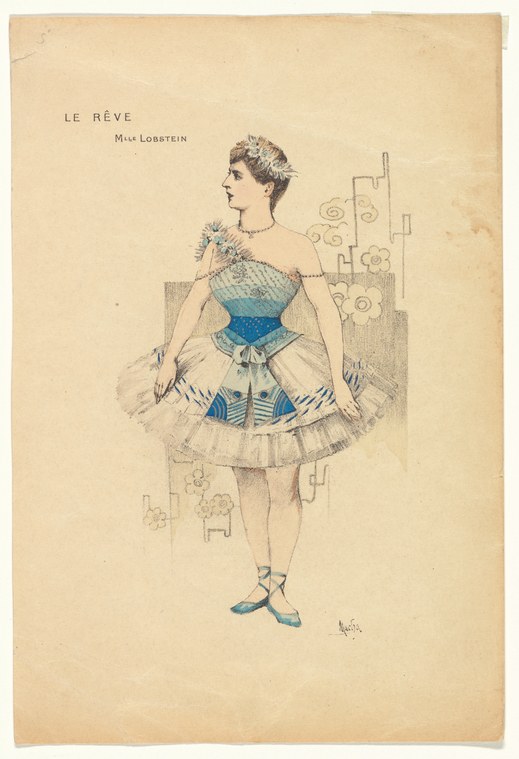
A young woman in theatrical dress stands in profile against a spare, geometric background suggesting an urban or architectural setting. She wears a pale corset with blue banding at the waist, a short tulle skirt with blue striped detail at the hem, and blue heeled shoes. Her hair is styled in an upswept Edwardian fashion, and she wears a choker necklace. Her pose is balletic and self-aware: she stands with weight on one leg, the other slightly extended, one arm raised with hand near her head in a gesture of reverie or self-regard. Her expression is dreamy, her gaze directed away from the viewer. The figure occupies the left two-thirds of the composition; to her right, light linear sketches indicate buildings or decorative forms, creating a sense of theatrical artifice. The title "Le rêve" (The Dream) appears in the upper left, with the name Mlle Lobstein below it.
The dancing
A single female dancer is depicted from the front, standing on one leg with the other extended lightly. Her carriage is upright and elegant, with one arm raised and the other held gracefully at her side; the pose suggests the training of classical ballet. Her weight appears centered and controlled. The gesture reads as introspective rather than dynamic—a moment of pause within movement. The artist has rendered the figure with careful attention to the silhouette and the articulation of the body in a stance familiar from late nineteenth-century ballet iconography.
The dance depicted
This appears to represent a romantic-era or early twentieth-century theatrical ballet, most likely a solo or variation from a ballet of the period. The title "Le rêve" and the dreamy quality of the pose suggest a lyrical, character-driven moment rather than display technique. The costume—light tulle skirt, fitted bodice with corset, heeled shoes—is consistent with ballet of the 1890s–1910s. Mlle Lobstein was likely a Parisian dancer of the period. The image captures not a moment of vigorous dancing but rather a poised, introspective attitude, a mood more than a step—exactly the kind of transitional moment that late romantic and early modern ballet prized.
How it was made
This is a color print, likely a lithograph or chromolithograph produced by commercial theatrical costume or publicity printing methods of the early 1900s. The subtle handling of the blue tones, the delicate cross-hatching in the skirt, and the minimal background sketch are characteristic of hand-drawn lithographic plates. The technique allowed for wide distribution as a souvenir or advertisement of the performer and her role, and the careful rendering of fabric and color speaks to its intended audience of theater-goers and collectors of theatrical imagery.
About this work
This is a portrait of theatrical aspiration and the machinery of celebrity in the Belle Époque theater world. It documents both a moment in a specific performance or role and the culture of performer promotion that surrounded Parisian stages in the early 1900s. The work belongs in a dance archive as evidence of how dancers were marketed and remembered, and what the early twentieth-century ballet body—and particularly the female ballet body—was understood to be: graceful, introspective, fashionable, and available to the male gaze even in repose. The image is part of a broader visual archive of theatrical dance, one of thousands of such prints made to memorialize dancers and roles that are now largely forgotten.
How to look at it
Attend to the stillness of the pose and the inward quality of the gaze. The artist has chosen a moment of contemplation rather than motion, suggesting that the drama of the role lay not in spectacle but in the dancer's capacity to embody a mood. Notice also the careful rendering of the fabric and the corset: the body is on display, yes, but it is also constructed and controlled, engineered for the stage. The geometric background, sketched lightly, indicates that this is a theatrical image—a record not of real space but of the dancer as a work of art.
The artist
The work is signed but the artist's name is not recorded in the catalogue. The signature on the lower right appears to read 'Wallis' or similar. The style is consistent with early twentieth-century Parisian theatrical illustrators and lithographic printers who specialized in portraits of performers. These artists were often skilled draftspeople working in service of the theater industry, producing images for programs, posters, and promotional sale.
The period
This print dates to approximately 1900–1920, a period of enormous energy in Parisian theater and a moment when ballet was undergoing transformation under the influence of the Russian Imperial Ballet and the Ballets Russes (founded 1909). The image shows a dancer still working in the lighter, more decorative idiom of late nineteenth-century French ballet—the tutus, the modest point work, the theatrical maquillage. Within a few years, Fokine, Nijinsky, and the Ballets Russes would introduce more dramatic, expressive movement vocabularies and more daring designs. This image thus captures a vanishing world of European ballet, one increasingly regarded as provincial by the artistic avant-garde.
Where it lives
This print is held in the New York Public Library's Prints collection, which includes theatrical imagery and dance-related graphic materials. It is catalogued as a single-sheet color print from the performing arts collection.
Dance in this work
Questions about this work
Who was Mlle Lobstein?
Mlle Lobstein was a Parisian dancer active in the early twentieth century, likely performing in commercial or operatic theaters. Beyond her appearance in this print and the information it carries, little is known. The image itself—elegant, professional, and produced as a lithograph for distribution—suggests she was a dancer of sufficient renown to merit promotional materials.
What is "Le rêve" the dream of?
The title refers to the internal state of the figure—a moment of reverie or introspection. In the romantic ballet tradition, such a moment would often precede a variation or solo in which the character's fantasies or desires would be dramatized. The image captures the dreaming moment itself, the pause before action.
Is she on pointe?
No. She appears to be standing flat, or possibly demi-pointe. Her shoe has a modest heel, not a reinforced pointe shoe. This is consistent with early twentieth-century French ballet, which made less use of full pointe work than later classical ballet would demand.
What does the corset tell us?
The corset was standard theatrical wear for ballet dancers until well into the twentieth century. It shaped the body into a specific silhouette—long, narrow waist, lifted bust—that was considered elegant and desirable. The visible boning and lacing remind us that the ballet body was, and is, a constructed object.
More dance artwork





