49 works in this view — arrow keys or swipe to move between them.
Dance in Art
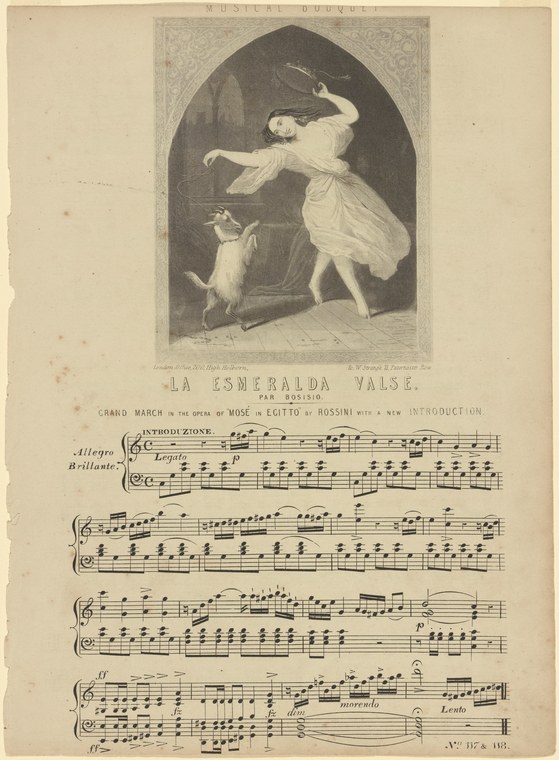
La Esmeralda valse, par Bosisio
Unknown artist
- Collection:
- Prints depicting dance
- Source:
- New York Public Library
- Rights:
- Public domain — free to use, share and adapt.
- Recorded as:
- Public Domain
This work preserves the visual vocabulary of Romantic ballet performance at the moment of its international success, showing how the dancer's body and the theatrical animal were staged and framed for effect. For historians of ballet, it offers concrete evidence of costume, proportion, and the spatial relationship between dancer and supporting elements on the 1840s stage. The combination of engraving and musical score shows how dance and music were marketed and consumed as integrated commercial products.
What you are looking at
A young female dancer in a white classical tutu and pointe shoes is captured mid-leap or arabesque within a darkened interior setting, her body angled dynamically against a deep shadow background. Her hair is styled up, and she wears the characteristic costume of 19th-century ballet. A small dog—possibly a spaniel or similar breed—stands on the stage floor below her, looking upward at the dancer with apparent attention. The composition is vertical and framed within an arched vignette, giving it the appearance of a stage proscenium. The background suggests a theatrical interior with architectural detail barely visible in the murk behind her. The lighting emphasizes the dancer's pale costume and figure while the surrounding darkness creates a dramatic spotlight effect typical of theatrical documentation.
The dancing
The dancer's body is extended in a classical line, with one leg raised high in a lifted position (likely an arabesque or attitude devant), her torso leaning forward slightly into the movement, and her arms positioned to frame the extended leg. Her weight appears to be supported on a single pointe foot, demonstrating the technical demand of the pose. The small dog below, rendered in profile, sits alert with front paws on the stage, creating a figure-ground relationship that is unusual and deliberately composed—the dog is not incidental but a deliberate narrative element. The scale between the upright dog and the dancer's height emphasizes the verticality of the classical ballet aesthetic.
The dance depicted
This is a Romantic-era ballet scene, almost certainly depicting a moment from *La Esmeralda* (also known as *Esmeralda*), the ballet created by Jules Perrot to music by Adolphe Adam, which premiered in 1844. The inclusion of the small dog refers to Djali, the celebrated goat character from Victor Hugo's *Notre-Dame de Paris* (the literary source), which was famously translated into animal form on the ballet stage. This print documents a specific theatrical moment—the dancer alone in the spotlight—rather than a full ensemble scene, which was a common format for promotional ballet imagery. The Romantic ballet's interest in supernatural or heightened emotion is suggested by the isolation and dramatic lighting.
How it was made
This is a hand-colored engraving, as evidenced by the fine line-work, the tonal gradations achieved through parallel hatching and cross-hatching, and the careful modeling of shadow. The vignette effect (the soft oval framing) is characteristic of mid-19th-century theatrical prints. The musical score printed below the image—marked 'INTRODUZIONE, Allegro Brillante'—establishes this as a multi-purpose theatrical document combining visual and musical content, likely intended as both a memento of the performance and a score for amateur pianists. The delicate hand-coloring of the dancer's costume in white, with touches of tone in the background, was the standard method of producing colored prints before chromolithography became dominant. Such prints circulated widely among theater-goers and music enthusiasts.
About this work
This is a theatrical memorial engraving of a celebrated moment from *La Esmeralda*, the 1844 Romantic ballet by Jules Perrot. It combines a stage image with the opening musical theme, making it both a visual record of the dancer's costume and movement and a musical artifact for domestic performance. The print captures the essential grammar of Romantic ballet—the solitary female figure in a spotlight, weightless and elongated, achieving an impossible verticality—while the presence of the small dog anchors the image in the specific narrative and stagecraft of this widely-performed work. The engraving is typical of the commercial theatrical prints that were a major form of dance documentation and circulation in the mid-19th century.
How to look at it
The viewer should notice the dancer's complete extension and the technical vulnerability of the single-point support, which communicates both the physical demand and the aesthetic goal of Romantic ballet. The dramatic darkness surrounding her emphasizes the artificial isolation of the stage light and the performer's status as a featured spectacle. Look at how the small dog below creates narrative depth—it is not merely decoration but references the plot and demonstrates that the artist understood this as a theatrical work with a story, not an abstract study of movement. The musical score below the image recalls that this was also a commercial object for music consumption.
The artist
The artist is not identified in the catalogue record. However, the quality of the engraving and the inclusion of musical notation suggest a professional theatrical print-maker working within the commercial apparatus of 1840s European opera and ballet publication. The style is consistent with prints produced by the Paris-based houses that dominated the Romantic-era theatrical print market.
The period
The 1840s saw the consolidation of Romantic ballet as the dominant European ballet aesthetic, with Jules Perrot as one of its leading choreographers. *La Esmeralda*, based on Hugo's gothic novel, was a flagship work of the period, performed repeatedly across Europe and featuring the era's greatest dancers. This was also the period in which the pointe shoe and the tutu became standardized costume elements and the ballerina became the central figure of the ballet. The theatrical print industry flourished in parallel, with Paris as the publishing center; such prints were affordable, portable, and were primary documents through which most people experienced ballet. Music publishers included opening themes or popular numbers to drive sales.
Where it lives
This engraving is held in the New York Public Library's prints collection documenting dance. It belongs to the category of 19th-century theatrical prints—mass-produced, hand-colored commercial objects that were sold to theater audiences, collected by dance enthusiasts, and circulated among musicians and music students. Such prints were rarely individually catalogued in their own time and often survive in albums or collections.
Dance in this work
Questions about this work
Is the small dog really part of the ballet?
Yes. Djali the goat (or a dog substituted for theatrical practicality) is a character in *La Esmeralda*, derived from Victor Hugo's novel. The animal was a celebrated feature of the ballet and a draw for audiences. Many productions featured a trained animal; it was standard practice in Romantic-era ballet.
Who was the dancer?
The print does not name the dancer. *La Esmeralda* was performed by many of the era's great ballerinas, including Carlotta Grisi (for whom Perrot created the original), Lucile Grahn, and others. Without a signature or inscription, the identity cannot be established from the image alone.
What is the music printed at the bottom?
It is the opening theme ('Introduzione, Allegro Brillante') of the ballet, engraved so that amateur pianists could perform it at home. This was a standard marketing practice—the print sold both as a souvenir of the performance and as sheet music, making it a dual-purpose object.
How was this image made?
It is a hand-colored engraving, made by incising lines into a metal plate and then hand-painting each print individually. The technique allowed fine detail and wide circulation, and was the primary method of distributing images of performers before photography became cheap and fast.
More dance artwork





