49 works in this view — arrow keys or swipe to move between them.
Dance in Art
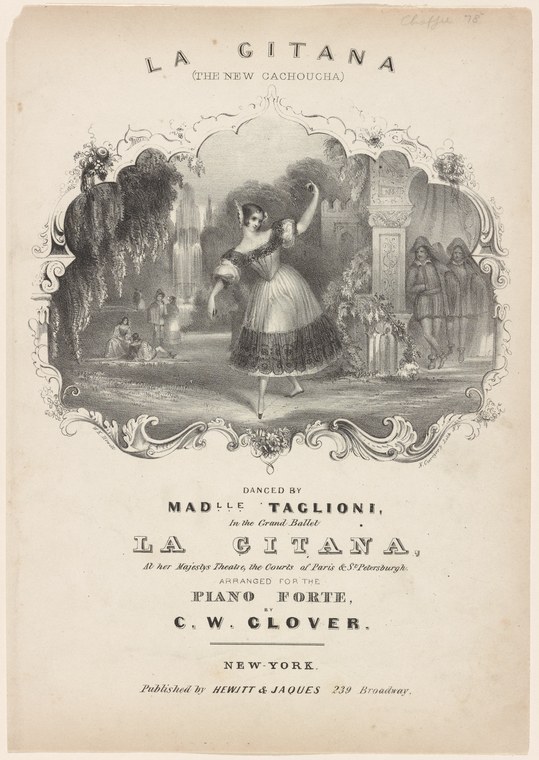
La gitana, (the new cachoucha) danced by Madlle. Taglioni, in the grand ballet La gitana, at her Majestys Theatre, the courts of Paris & St. Petersburgh.: Arranged for the piano forte, by C. W. Glover
Unknown artist
- Collection:
- Prints depicting dance
- Source:
- New York Public Library
- Rights:
- Public domain — free to use, share and adapt.
- Recorded as:
- Public Domain
This engraving is evidence of how Romantic-era ballets circulated beyond the theater—through published music, prints, and narrative imagery that shaped public memory and desire. For historians of dance, it shows how a single role (Taglioni in the cachucha) could become iconic enough to be commodified and distributed, and how the visual conventions of ballet—the lifted body, the exotic setting, the dramatic turn—were standardized and made reproducible. For musicologists, it documents the intersection of concert and theatrical music in the 19th century.
What you are looking at
A theatrical dance scene set in what appears to be a Spanish or Mediterranean street or courtyard, framed by ornamental rococo scrollwork. The central figure is a female dancer in mid-movement, wearing a full skirt with horizontal stripes or flounces and a fitted bodice, her body angled in a dynamic pose with one arm raised. She faces a male figure in dark clothing positioned to her left. The background shows architectural elements—arches and doorways—with additional figures visible in shadow, suggesting an ensemble or onlooking crowd. The composition emphasizes the soloist's commanding presence at the center. The engraving technique has rendered the scene with fine cross-hatching to suggest fabric texture and depth, creating strong contrasts between the dancer's illuminated form and the shadowed surroundings.
The dancing
The primary dancer's weight appears shifted onto one leg in a turning or weight-transfer moment, with the free leg extended or about to move. Her arms show the characteristic port de bras of early 19th-century ballet, raised and framing her torso expressively. The male figure beside her is in a supporting or partnering stance, rendered smaller and darker, suggesting either a partner, musician, or narrative interlocutor. The posture and arm carriage are consistent with trained theatrical dance of the Romantic era, not folk movement.
The dance depicted
This is a piano reduction of the cachucha—a Spanish-inflected theatrical dance that became fashionable in European ballet during the 1830s-1840s, here performed as part of the full ballet *La Gitana* (The Gypsy). The cachucha was a solo showpiece for prima ballerinas, combining balletic technique with Spanish rhythmic and gestural elements. Taglioni's performance of this choreography at Her Majesty's Theatre in London and in the courts of Paris and St. Petersburg established it as a signature vehicle. The image captures the soloist in a moment of touring or pivoting, a hallmark moment in the dance's vocabulary—the kind of dramatic turn that would have showcased technical brilliance and the spectacular effect of the full skirt.
How it was made
This is a steel or wood engraving, a medium suited to mass reproduction and circulation as sheet music cover or advertisement. The ornamental frame and fine detail suggest it was professionally executed, likely for a London music publisher. As a piano score cover, it served both to advertise the ballet and to distribute the music to drawing rooms and music teachers, making this a document of how theatrical dance entered domestic musical culture. The engraving allowed for consistent reproduction across multiple copies, standard practice for published music of the period.
About this work
This engraving documents a moment from the Romantic ballet *La Gitana*, a popular theatrical work performed by the era's most celebrated ballerina, Marie Taglioni, across the major courts of Europe. It is both a record of Taglioni's stage presence and a commercial artifact—the cover of a piano arrangement that brought the ballet's music and visual appeal to amateur musicians and the fashionable public. The work captures a pivotal moment in 19th-century dance history: the cachucha craze, when Spanish or pseudo-Spanish dances entered the vocabulary of classical ballet, blending technical virtuosity with exotic theatrical costume and setting. The image preserves not only a dance but the visual and commercial apparatus that made celebrity dancers accessible to a wide, literate audience.
How to look at it
Look at the dancer's silhouette and the moment captured: she is in a turn or pivoting movement, a moment of virtuosic display rather than narrative repose. The engraver has emphasized the full skirt's volume and movement, spreading it around her body to suggest speed and rotation. The framing—the ornamental scrolls, the architectural setting, the smaller male figure—directs attention to the soloist as the spectacle. Notice how the cross-hatching creates a halo of light around her form, isolating her from the shadowy background. This is the visual language of celebrity performance: the dancer as a brilliant, isolated figure commanding the gaze of onlookers, both in the scene and in the imagined audience reading the printed score.
The artist
The engraver is not recorded. The publisher, Hewitt & Jaques of New York, was a music publishing house active in the mid-19th century. The work was arranged for piano by C. W. Glover, a composer and conductor active in London theater in this period. The quality of the engraving and the prominence of the publication suggest professional commercial practice.
The period
The 1830s-1840s saw the height of the Romantic ballet, with Marie Taglioni at its center. The cachucha became fashionable after Taglioni danced it in Paris in 1836, spawning imitations, parodies, and publications. Simultaneously, the music publishing industry in London and New York was booming, with orchestral works, operas, and ballets being rapidly transcribed and sold as piano reductions for domestic consumption. This engraving sits at the intersection: a theatrical phenomenon (a prima ballerina's role) rendered as a domestic musical commodity. The appeal of 'Spanish' or 'exotic' dances in European ballet reflected broader Romantic fascination with the picturesque and the Other, while the cachucha's rhythmic character—its dotted figures and repeated phrasing—made it ideal for popular transcription.
Where it lives
This engraving is held by the New York Public Library as part of its collection of prints depicting dance. It was published in New York by Hewitt & Jaques, suggesting it was intended for the American market, where interest in European ballet and ballerinas was high. The print's status as a music cover—a hybrid object between theatrical advertisement and domestic musical score—places it at the boundary between performance ephemera and published music.
Dance in this work
Questions about this work
Who was Marie Taglioni and why does her name appear on this object?
Marie Taglioni (1804–1884) was the most celebrated ballerina of the Romantic era, renowned for her ethereal technique and her roles in works like *La Sylphide*. This engraving advertises her performance of the cachucha in the ballet *La Gitana*, which was one of her signature roles. Publishing her name and the titles of theaters where she performed was a marketing strategy that linked the music to her fame.
What is the cachucha and why was it important?
The cachucha is a Spanish or Spanish-influenced solo dance that entered European ballet in the 1830s. It blended balletic technique with Spanish-style rhythmic footwork and arm gestures, and became a showpiece for virtuoso dancers. Its popularity reflected Romantic-era fascination with exoticism and color while also offering choreographers a vehicle for technical display.
Why is this a piano score if it shows a dance?
This is the cover or title page of a piano reduction—a simplified orchestral score arranged for piano. Music publishers created these versions so that amateur musicians at home could play and study the melodies from popular operas and ballets. The engraving serves as both advertisement (showing who danced the role and where) and illustration, making the music more appealing and memorable to buyers.
What can we learn about Romantic ballet from this image?
The image shows several key features of Romantic ballet: the elevation and lightness of the dancer's pose, the exotic or picturesque setting (the Spanish courtyard), the emphasis on the female soloist, and the integration of non-balletic gesture (the Spanish arm and body carriage). It also demonstrates how ballet reached the public—not only through live performance but through prints, illustrations, and music that kept celebrated dancers and roles in cultural circulation.
More dance artwork





