49 works in this view — arrow keys or swipe to move between them.
Dance in Art
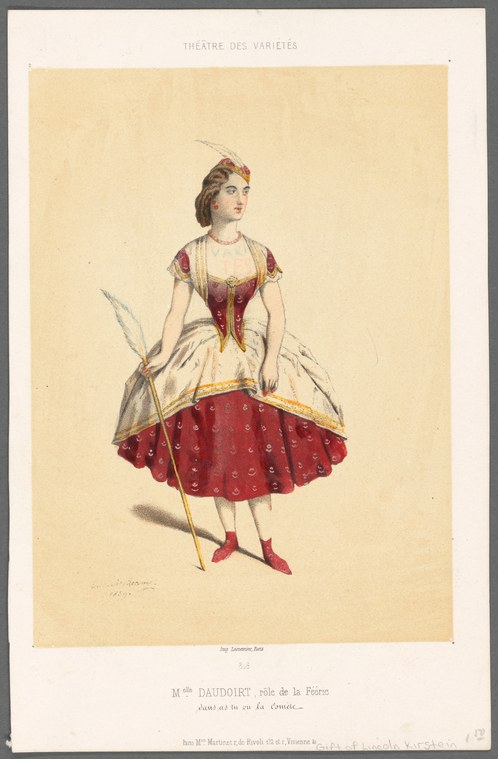
868. Melle. Daudoirt [Daudoird?], rôle de la Féerie, dans As tu vu la comête, Théâtre des Variétés
Unknown artist
- Collection:
- Prints depicting dance
- Source:
- New York Public Library
- Rights:
- Public domain — free to use, share and adapt.
- Recorded as:
- Public Domain
This print reveals how ballet vocabulary and the image of the ballerina infiltrated commercial theatre and how costume itself—not movement notation or choreography—was the primary means by which theatrical dance was recorded and circulated in the nineteenth century. For historians of dance on the popular stage, this is primary evidence of what audiences actually saw.
What you are looking at
A young woman in theatrical costume stands against a pale yellow background, posed in a graceful contrapposto stance. She wears a short classical tutu of deep crimson silk with gold embroidered details, a fitted bodice in burgundy velvet with short puffed sleeves, and a cream-colored chemise visible at the neckline and beneath the skirt. Her dark hair is arranged up with what appears to be a jeweled ornament or small crown. She holds long feathered wings—likely representing a fairy or sprite—in both hands, angled to frame her body. Her feet are clad in pointed red slippers, and she gazes upward and to the side with a dreamy expression. The pose is graceful and weightless, suggesting flight or ethereal movement rather than earthbound action.
The dancing
A single figure stands in a relaxed but elegant vertical alignment, her weight evenly distributed, with one leg slightly forward in an attitude of gentle repose rather than dynamic engagement. Her arms are raised to hold the feathered wings at shoulder height, creating an open, expansive frame. The pose reads as presentational and statuesque rather than caught mid-movement—this is a portrait of a character rather than a captured action. The overall impression is one of grace and delicacy, with the body held in the upright, balletic carriage expected of a Romantic-era stage dancer.
The dance depicted
This is a costume design or portrait of a dancer in the role of a fairy or magical creature in a theatrical féerie—a popular fantastical genre on the nineteenth-century stage. The play *As tu vu la comète* (Did You See the Comet?) was performed at the Théâtre des Variétés, a music-hall and vaudeville venue in Paris. Féeries featured elaborate visual spectacle, supernatural beings, and often dancing or balletic movement, though the precise choreographic content is unknown. Mlle. Daudoirt's costume—the pointed slippers, the tutus, the ethereal pose—suggests that classical ballet technique and aesthetics informed the role, even if this was popular theatre rather than the Opéra. The wings and the upward gaze belong to the visual vocabulary of Romantic ballet.
How it was made
This is a hand-colored lithograph or engraving printed on pale buff paper, a standard format for French theatrical costume plates of the mid-nineteenth century. The technique allowed fine detail in the faces and costumes while economical in production, making these prints affordable for theatre-going audiences and performers. The color is delicate and applied by hand to a tonal print base, with particular attention to the rich reds and golds of the costume. Such prints were typically sold as individual sheets at the theatre or through print publishers, serving as both souvenirs and a record of recent productions.
About this work
This is a hand-colored theatrical print documenting a performer and costume from a Paris music-hall production, likely from the 1840s–1860s. It belongs to a substantial nineteenth-century tradition of costume documentation, particularly for the féerie genre, which blended pantomime, ballet, acrobatics, and spectacular scenic effect. The work is valuable as evidence of how classical ballet aesthetic—tutus, pointe work, ethereal carriage—permeated popular and commercial theatre beyond the Opéra, and how female performers in féeries were marketed and remembered. The print captures not a moment of choreography but the character itself: the costume, the bearing, the fantasy identity that the dancer embodied on stage.
How to look at it
Observe the dancer's stillness and verticality—the pose is not mid-movement but a formal presentation. The wings and the upward gaze are the storytelling elements; the costume, the pointe shoes, and the balletic posture are what signal 'this is a dancer of some training.' The hand coloring emphasizes the richness of the textile—the jeweled embroidery on the bodice, the sheen of the silk skirt, the deep red of the slippers—suggesting that costume was as much the draw as the performer's technique. The print is designed to be read as a theatrical souvenir and a record of fashion.
The period
The mid-nineteenth century saw the golden age of the féerie, a genre that combined narrative, fantasy, spectacle, and dance. These productions relied on elaborate machinery, scenic transformation, and costuming to create worlds of magic and wonder. The Romantic ballet had established the white tutus and ethereal bearing visible here; féeries on the boulevard theatres adopted similar aesthetics to signal elegance and otherworldliness. Female performers in féeries occupied an ambiguous social position: more respectable than can-can dancers, but less elite than Opéra ballerinas, they were nonetheless celebrated for their grace and their legs. Costume plates like this one were primary cultural documents, circulating the image of these performers to a wide audience and establishing the visual identity of recent hit shows.
Where it lives
This print comes from the New York Public Library's collection of theatrical prints and ephemera. It is one of a substantial body of French theatrical costume documentation from the nineteenth century, many produced for sale at or near the theatres themselves. The accession information indicates it is part of a broader collection of dance-related prints.
Dance in this work
Questions about this work
What is a féerie and why does this matter to dance history?
A féerie was a spectacular theatrical genre that flourished on nineteenth-century Parisian boulevard stages. It combined pantomime, dance, acrobatics, and elaborate scenic machinery to tell stories of magic and transformation. Féeries were where ballet technique entered popular theatre: dancers wore tutus and pointe shoes, and the movement vocabulary drew on classical ballet even when the narrative was comedic or fantastic. Understanding féeries is crucial because they were where most Parisians actually encountered dancing, not the Opéra.
Was Mlle. Daudoirt a trained ballet dancer?
The record does not confirm her training or career beyond this single documented role. However, the pointe shoes and the balletic posture of the figure suggest she had classical training or at least that the role expected it. Boulevard theatre in Paris by the mid-nineteenth century employed dancers of varied backgrounds and training levels, many of whom had studied ballet alongside other forms of entertainment dancing.
How were theatrical prints like this one used?
These prints served multiple functions: souvenirs for audiences, publicity for the production, records for the theatre company, and fashion documents for other performers and designers. They were sold individually or in series at the theatre, and collected in albums by enthusiasts. For performers, they were a form of professional portraiture and a way to circulate their image and reputation.
What do the wings and the pose tell us about the choreography?
The wings and the upward gaze are part of the costume and character rather than evidence of specific steps. However, the vertical alignment, the upright carriage, and the pointe shoes all indicate that the movement was based on classical ballet technique. The stillness of the pose suggests the print captures a character moment rather than a step; the actual choreography is unknown.
More dance artwork





