49 works in this view — arrow keys or swipe to move between them.
Dance in Art
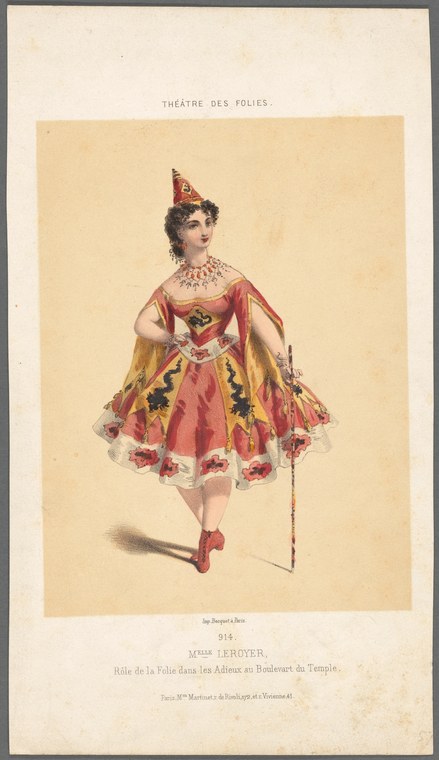
914. Melle. Leroyer, rôle de la Folie dans Les adieux au [sic] Boulevart [sic] du Temple, Théâtre des Folies
Unknown artist
- Collection:
- Prints depicting dance
- Source:
- New York Public Library
- Rights:
- Public domain — free to use, share and adapt.
- Recorded as:
- Public Domain
This print documents a now-lost theatrical production and the performance practices of mid-to-late 19th-century Parisian popular theatre. For historians of dance, costume, and theatrical design, it provides concrete evidence of how comic and character roles were visualized, dressed, and staged—information largely absent from written records. The print also shows how dance and theatrical costume were commercialized and circulated to the public through the market for souvenir prints.
What you are looking at
A single female dancer is shown in a three-quarter frontal pose against a pale yellow ground. She wears an ornate costume in shades of red and gold: a pointed crimson headdress with jeweled decoration, a short-sleeved red dress with a gold underskirt visible at the hem, and a draped gold cape or overskirt with red appliqué details and scalloped edges. The skirt is short and full, ending above the knee. She holds a decorative prop—apparently a cane or baton—in her right hand, angled downward. Her left arm hangs at her side. The figure is rendered with fine hand-coloring over what appears to be a lithographic base, with careful attention to the texture and sheen of the fabrics. A faint shadow cast by the figure grounds her on the page. The composition is formal and frontal, presenting the costume and pose for theatrical viewing rather than capturing a moment of dynamic movement.
The dancing
The dancer stands upright with weight evenly distributed, her body aligned in an open, presentational stance. Her gaze is directed downward and to one side, away from the viewer. Her arms are relaxed and asymmetrical: the right arm extended forward with the prop held at an angle, the left at rest. The posture is static and stately rather than dynamic, suggesting a moment of pause or presentation within a theatrical scene. Her feet appear to point forward, the stance grounded rather than lifted.
The dance depicted
This is a costume study for a theatrical character role—specifically the character of 'la Folie' (Madness) in a piece titled 'Les adieux au Boulevart du Temple' performed at the Théâtre des Folies. This identifies a Parisian theatrical dance or opéra comique, likely from the late 19th century. The character 'Folie' was a stock comic figure in French theatre, traditionally given an extravagant, ornamental costume. The prop and costume suggest a lighthearted, burlesque or comic theatrical performance rather than classical ballet or serious dance drama. The presentation is purely illustrative—a record of the costume and stage appearance rather than a document of actual movement or technique.
How it was made
This is a hand-colored lithograph, a print technique that allowed rapid mass production of costume designs and theatrical illustrations. The artist worked from a lithographic stone, then hand-applied watercolor or gouache to each print, resulting in the delicate gradations and jeweled details visible here. This technique was standard for theatrical documentation and publicity in the 19th century, and such prints circulated widely among theatre-goers, costume makers, and fans. The finish—flat graphic shapes enhanced by careful hand-coloring—prioritizes clarity and decorative effect over naturalistic representation.
About this work
This is a theatrical costume study for a character in a French opéra comique or féerie, documenting the appearance of a dancer playing 'Madness' on stage. The print preserves the exact silhouette, color scheme, and stage props of the role, presented as a frontal, undynamic pose suitable for documentation rather than artistic interpretation. It belongs to a large body of 19th-century theatrical ephemera that documented popular stage performances and the costumes that made them memorable. The Théâtre des Folies was a venue for comic and burlesque theatre in Paris, and such costume prints were sold to audiences as souvenirs and aids to memory.
How to look at it
Look first at the costume: the careful hand-coloring of the gold and red fabrics, the jeweled headdress, the scalloped edges of the overskirt. These details record exactly what a theatre-goer would have seen on stage. The pose is deliberately still and frontal—not a naturalistic moment of motion, but a presentation of the costume in idealized clarity. Notice how the prop (the cane or wand) and the costume together define the character: ornament, fantasy, and mockery signaled through dress. The downward gaze and asymmetrical arm position add a touch of character and personality without breaking the static, presentational mode.
The artist
The artist is not recorded in the catalogue. The print was produced in the style and format standard for Parisian theatrical costume documentation of the 1870s–1890s, a period when such prints were a commercial product marketed to theatre audiences. The hand-coloring technique and the careful, decorative rendering suggest a professional atelier rather than individual artistic invention.
The period
This work dates to the era of French opéra comique and féerie theatre, when comic, spectral, and fantastical characters were stock roles in Parisian popular theatre. The Théâtre des Folies (Folies-Bergère and similar venues) specialized in spectacular, music-driven comedies with elaborate costumes and scenic effects. This period coincides with the rise of theatrical tourism and souvenir culture—audiences wanted to take home images of the performers and costumes they had seen. In fine art, meanwhile, Impressionism and later movements were exploring movement and costume in very different registers; this theatrical print represents the commercial, popular culture of visual documentation.
Where it lives
This print is held in the New York Public Library's collection of dance-related prints. It is one of a large body of 19th-century theatrical costume prints, many of which document now-forgotten productions and performers. The collection preserves these ephemeral images as historical records of theatrical practice and popular culture.
Dance in this work
Questions about this work
What was the Théâtre des Folies?
The Théâtre des Folies (including the famous Folies-Bergère) was a Parisian entertainment venue specializing in opéra comique, féerie, revue, and other spectacular, music-driven comedy shows. These theatres were sites of popular entertainment and innovation in staging, costume, and choreography, aimed at broad paying audiences rather than elite patrons of high opera or ballet.
What role did costume prints play in 19th-century theatre?
Theatrical costume prints were sold as souvenirs to audiences after performances, functioning as both mementos and promotional images. They documented the visual spectacle of the stage, allowing people to remember and discuss the performances they had seen, and they circulated images of popular performers. For costume designers and theatres, they also served as records of designs that might be reused or adapted.
Is this a document of actual dance, or just costume design?
It is primarily a costume study and presentation rather than a dance document. The pose is static and illustrative, chosen to display the costume clearly rather than capture movement or technique. However, it does record the visual and material conditions under which a dance or theatrical character appeared on stage, which is historically valuable for understanding how performers were costumed and presented.
Who was Mlle. Leroyer?
Mlle. Leroyer is identified in the print as the performer who played this role. Beyond the name and this single role, no information about her career or biography is provided in the record. She was likely a dancer or actress in the Parisian theatre of her time, but like most popular performers of the period, her fuller history is not documented here.
More dance artwork





