Musical Theatre Character Dance
Also known as: Stage Character Dance, Period Musical Theatre Dance, Character Shoe Work
History & Cultural Context
Musical Theatre Character Dance is period and social styling: the choreography that tells an audience within eight bars what year it is, what class the characters are, and what the room's rules are. Its technique descends from classical character dance, which emerged in early nineteenth-century Moscow and was codified by Aleksandr Shirayev, assistant to Marius Petipa, as stylized national dance for the ballet stage, csardas, mazurka and tarantella danced in heeled suede-soled character shoes rather than pointe or jazz shoes. Broadway inherited the method and applied it to its own settings. Jerome Robbins staged 'The Small House of Uncle Thomas' in The King and I (1951) as a play-within-a-play in a Siamese-derived idiom, and for Fiddler on the Roof (1964) he attended Orthodox Jewish weddings and festivals, saw a man tottering with a bottle on his head pretending to be drunk, and elaborated that image into the four-man bottle dance, a Broadway invention rather than a traditional rite. Susan Stroman researched the Charleston's origins for Show Boat (1994) and used the staging to credit the Black dancers who created steps later taken up by white performers. The discipline is a research job as much as a movement one.
Cultural Significance
Character dance is how a musical signals a world the audience is not from, which makes it the genre's most ethically loaded material. Contemporary productions increasingly bring in culture-specific consultants and choreographers rather than relying on inherited stage conventions.
Characteristic Movement & Technique
Weighted footwork in heeled character shoes, grounded stamps and heel beats, circle and line formations, linked-arm group figures, torso and arm carriage borrowed from the source culture, and period social-dance holds and etiquette.
Partnering Dynamics
Partnering follows the social rules being depicted: closed ballroom holds for waltz and polka, segregated lines for religious ritual dances, and group rather than couple structures for wedding and festival numbers.
Competitive Context
Not a competitive form. It surfaces in ballet-school character syllabi, in Vaganova, Royal Ballet School and Australian Ballet School training, and as an audition requirement for revivals of Fiddler on the Roof, The King and I and Hello, Dolly!.
Regional Variations
Every licensed production adapts to the local ensemble's training, and revivals in the source culture's own country often re-research the material, replacing decades-old Broadway stage conventions with better-documented movement.
Common Misconceptions
Stage character dance is theatrical stylization, not ethnographic reproduction. The Fiddler bottle dance is Robbins's invention rather than an authentic Jewish wedding rite, and much older Broadway character material flattens or appropriates the cultures it depicts, which is why attribution and consultation now matter.
Signature Figures
- Jerome Robbins
- Agnes de Mille
- Michael Kidd
- Gower Champion
- Susan Stroman
Musical Theatre Character Dance Music & Tempo
Drawn from 35 Musical Theatre Character Dance tracks in the LODance music library.
Example tracks at practice tempo
- If I Were a Rich Man — Zero Mostel102 BPM
- Sit Down, You're Rockin' the Boat — Walter Bobbie and Guys and Dolls Ensemble129 BPM
- Game of Thrones Medley — Lindsey Stirling feat. Peter Hollens174 BPM
- The Spanish Panic — New Broadway Cast of Once Upon a Mattress
- Phantom of the Opera Medley — Lindsey Stirling
- With a Little Bit of Luck — Stanley Holloway and My Fair Lady Ensemble
Legends of Musical Theatre Character Dance
Dancers, choreographers and teachers whose work shaped this style.
Musical Theatre Character Dance on screen
Films and television where Musical Theatre Character Dance appears, with the sequences worth watching for.
 Every Little Step (2008)5 sequences indexedOpen-call dance combination · chor. Baayork LeeDance: Ten; Looks: Three — Val audition strand · chor. Michael Bennett; Bob AvianAt the Ballet — Maggie auditions · chor. Michael Bennett; Bob Avian; Baayork Lee
 The Band Wagon (1953)4 sequences indexedThat's Entertainment! · 00:27:32 · chor. Michael KiddI Love Louisa · 01:16:35 · chor. Michael KiddLouisiana Hayride · 01:26:10 · chor. Michael Kidd
 An American in Paris (1951)2 sequences indexedLise's Portrait — Dance in the Mirror / Embraceable You · 00:09:55 · chor. Gene KellyBy Strauss · 00:14:16 · chor. Gene KellyBad (1987)2 sequences indexedColour-change ensemble reveal · chor. Michael Jackson; Gregg Burge; Jeffrey DanielWind-grate fight-dance interlude · chor. Michael Jackson; Gregg Burge; Jeffrey Daniel
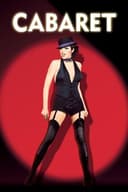 Cabaret (1972)2 sequences indexedTwo Ladies · 01:05:35 · chor. Bob FosseIf You Could See Her · 01:41:24 · chor. Bob Fosse
 Chicago (2002)2 sequences indexedWe Both Reached for the Gun / Press Conference Rag · 00:46:04 · chor. Rob Marshall; John DeLuca (choreographic supervisor)We Both Reached for the Gun · chor. Rob MarshallOklahoma! (1955)2 sequences indexedKansas City · chor. Agnes de MilleThe Farmer and the Cowman · chor. Agnes de Mille
 West Side Story (2021)2 sequences indexedGee, Officer Krupke · 01:15:25 · chor. Justin PeckI Feel Pretty · 01:48:20 · chor. Justin Peck
 Singin' in the Rain (1952)1 sequence indexedMake 'Em Laugh · 00:27:39 · chor. Gene Kelly; Stanley Donen
 The Gay Divorcee (1934)1 sequence indexedLet's K-nock K-nees · 00:35:20 · chor. Hermes Pan (dance director); Dave Gould (dance ensembles staged by)The Swan Princess (1994)1 sequence indexedPrincesses on Parade royal-ball pageantThe Swan Princess III: The Mystery of the Enchanted Treasure (1998)1 sequence indexedFestival Days opening: “It Doesn't Get Any Better Than This”
 West Side Story (1961)1 sequence indexedGee Officer Krupke · 01:06:32 · chor. Jerome Robbins
Poster artwork from TMDB.
 This site uses TMDB and the TMDB APIs but is not endorsed, certified, or otherwise approved by TMDB.
Musical Theatre Character Dance in performance
3 staged works in the Limelight catalogue contain Musical Theatre Character Dance, 1943–1978 — 1 of them in a named act or number.
- West Side Story1957Musical theatre · Jerome RobbinsAct II · Gee, Officer Krupke
Act II, 'Gee, Officer Krupke' — Comic, character-driven musical-theatre movement in which the Jets mimic and mock adult authority figures. Source: "To cheer themselves up, they lampoon Krupke and the other adults who don't understand them ("Gee, Officer Kru…
- Oklahoma!1943Musical theatre · Agnes de Mille · defining style
Throughout the show, across the individual dance numbers de Mille built into the score — Dance was built to advance character and plot rather than stand apart as specialty numbers; critics of the day identified specific danced sequences, including 'Out of M…
- Dancin'1978Musical theatre · Bob Fosse
The number 'Big City Mime' — A narrative, pantomimic number in which a tourist encounters prostitutes, massage-parlor workers and dance-hall figures in Times Square — story-driven character dance rather than the abstract revue vocabulary used elsewhere in t…
Every claim above is quoted from a cited source and names where in the work the style appears. Claims we could not place or could not quote are held back from this list and shown on the work’s own page instead. Browse the full performance catalogue →
What to Wear
Attire guidance for Musical Theatre Character Dance and other Musical Theatre Dance dances. Each card below is sized to the moment — class, practice, social, or competition — because the wardrobe shifts as the stakes do.
Reading the cards
In Class
Fitted enough that the teacher can see your line, because this style is judged on shape and storytelling from the neck down: leggings or jazz pants, a fitted top or leotard, hair pinned off the face so it doesn't break the focus of a head snap. Jazz shoes cover most classes; bring character shoes when the class works in heels, and expect Fosse-derived material to ask for turned-in, isolated positions your shoes must let you pivot in. Add knee pads or thicker leggings for classes with floorwork or knee slides.
Social Dancing
There is no social floor for musical theatre — the public-facing equivalent is the audition room, and it has its own conventions. Wear something solid-coloured and form-fitting that shows your body clearly and hints at the show you're auditioning for without being a costume; carry both jazz shoes and character shoes in your bag and change to whatever the choreographer calls. Keep jewellery minimal, avoid logos, and never wear brand-new shoes to an audition.
Competition
Musical Theatre is a scored category on the studio competition circuits (as opposed to a separate governing body), judged on character and storytelling as much as technique, so costume is expected to read the number from the back row. Whatever the design, it has to survive the choreography: straps secured, nothing that can slip during lifts or floorwork, and shoes broken in and taped well before the event. In professional work the costume is assigned by the production and your job is to arrive with your own well-fitted shoes and dance belt.
Shoes
Leather character shoes with a secure strap and a leather or suede sole. Around 2–2.5" is the workhorse height for anything with turns and leaps; 3" only when the number is mostly walking and kick lines, since a higher heel puts you in relevé before you start and raises the odds of rolling an ankle. Soft soles let you point the foot and land jumps; hard soles give support under a heavy costume. Jazz shoes cover most class work, with tap and ballet shoes as the show demands — Capezio, Só Dança and Bloch at the affordable end, LaDuca and Miller & Ben as the Broadway premium tier.
In Practice
Rehearsal wear is fitted so the choreographer can see shape and alignment: leggings or jazz pants, a fitted top, hair fully secured. Rehearse in the shoe you will perform in, from as early as possible — heel height changes your balance point, and tech week is the wrong time to discover it. Period shows call for a rehearsal skirt in roughly the weight of the costume, and anything with floorwork or knee slides calls for pads under the leggings.
Common Pitfalls
- ✗Wearing brand-new character shoes to an audition or performance — they need breaking in and a broken-in shoe is a safer shoe.
- ✗Jumping to 3" heels before the ankles are conditioned; rolled ankles come from height, not from choreography.
- ✗Baggy layers that hide the line — this style is scored on shape, so the shape has to be visible.
- ✗Arriving at an audition with only one type of shoe when the choreographer may call for either jazz or character.
- ✗Dancing in socks on marley, which is genuinely slippery, rather than in proper shoes or bare feet.
Price Range
- Budget: Capezio or Só Dança character shoes roughly $40–80, jazz shoes $30–60, leggings and fitted tops you already own.
- Mid: Bloch character shoes roughly $70–120, a dance belt $25–40, knee pads $20–40, a rehearsal skirt $40–80.
- Premium: LaDuca or Miller & Ben, made in Italy and often custom-fitted, at several hundred dollars a pair — the professional standard for eight shows a week, and worth it only once you are dancing that much.
Key Terms
- Character shoe
- Strapped leather heel built for dancing rather than walking — flexible shank, suede or leather sole, heights typically 1.5–3".
- Dance belt
- Supportive undergarment worn under tights or fitted trousers; standard, expected, and not optional in professional rehearsal rooms.
- Rehearsal skirt
- Weighted practice skirt approximating the costume, so the choreography is learned with the fabric rather than against it.
- Sole tape / rosin
- Tape or rosin applied to soles to adjust grip on an unfamiliar stage — too slick and you skid, too tacky and you catch.
- Look like the show
- Audition convention: solid colour, form-fitting, a hint of the era or character — suggestion rather than costume.
Quick Tips
- •Suede-soled shoes allow controlled sliding and pivoting — essential for most partner dances.
- •Avoid rubber soles on dance floors; they grip too much and can cause knee injuries.
- •Bring a separate pair of clean shoes for the dance floor to keep it in good condition.
Sources & Further Reading
Cultural & Historical Context
Musical Theatre Character Dance emerged from New York City and London, with technique inherited from Russian ballet during 1943—present day. Understanding the cultural roots, musical traditions, and social circumstances of this era enriches appreciation for the dance's characteristics and significance.
Formative Influences
Signature Movement Vocabulary:
Jerome Robbins, Agnes de Mille, Michael Kidd, Gower Champion, Susan Stroman
Primary Source Documents
The Library of Dance contains public-domain primary sources for dance history. Copyrighted modern syllabi are indexed with purchase links to their respective copyright owners. Search by dance name or codifier to discover primary source documents.
Last reviewed: September 2026 — This dance profile synthesizes historical research, cultural documentation, and contemporary practice knowledge to provide authoritative context.
More in Musical Theatre Dance
Golden Age Broadway Jazz
The show-dance idiom of the integrated book musical from Oklahoma! to Fiddler on the Roof, in which jazz, ballet and character steps were welded directly to plot and score.
Fosse Style
Bob Fosse's codified stage vocabulary of turned-in knees, rolled shoulders, isolated hips, splayed hands and hat-and-cane props, built into numbers of tightly controlled, sardonic movement.
Dream Ballet
The extended wordless narrative ballet inside a musical, entered from a character's mind, revealing desire or dread that the script and lyrics cannot state aloud.
Precision Kickline
Precision chorus dancing in which a long line executes identical steps and eye-high kicks in exact unison, descended from Russell Markert's Rockettes at Radio City Music Hall.
Contemporary Broadway
The Broadway idiom from the 1990s onward, fusing ballet, hip-hop, street and contemporary technique into character-specific storytelling, usually authored by a choreographer who also directs.
Musical Theatre Character Dance in art
Browse the gallery →Works our catalogue identifies as depicting musical theatre character dance.
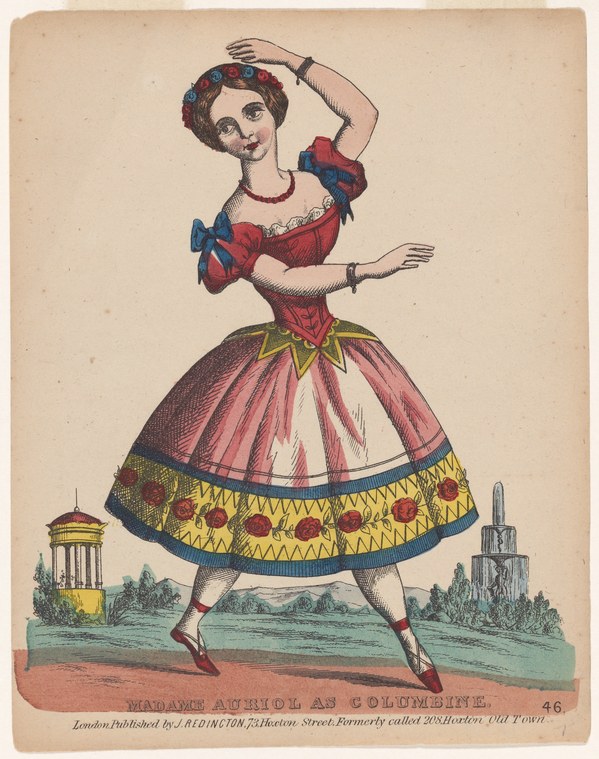
Madame Auriol as Columbine
Unknown artist
Public Domain
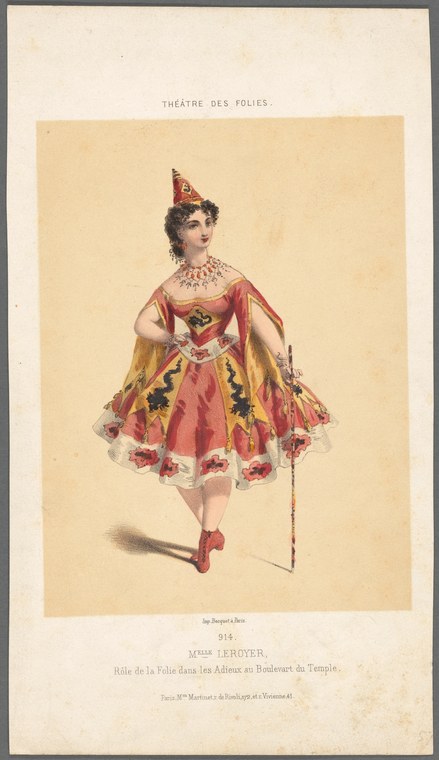
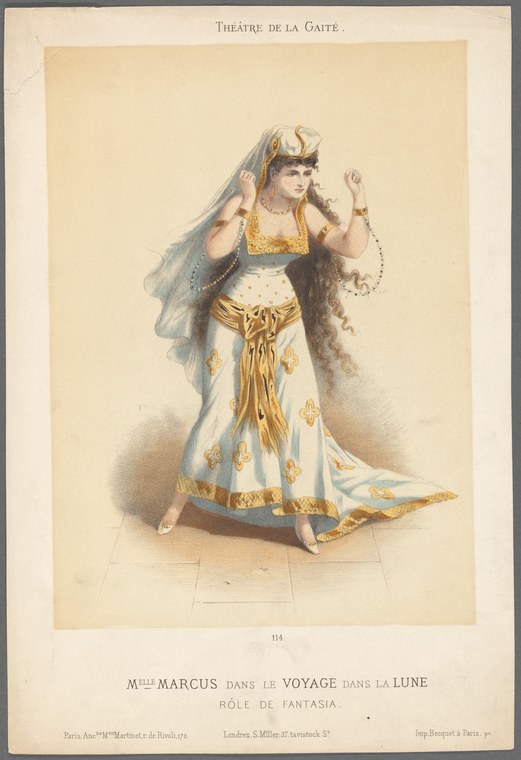
114. Melle. Marcus dans Le voyage dans la lune, rôle de Fantasia, Théâtre de la Gaité
Unknown artist
Public Domain
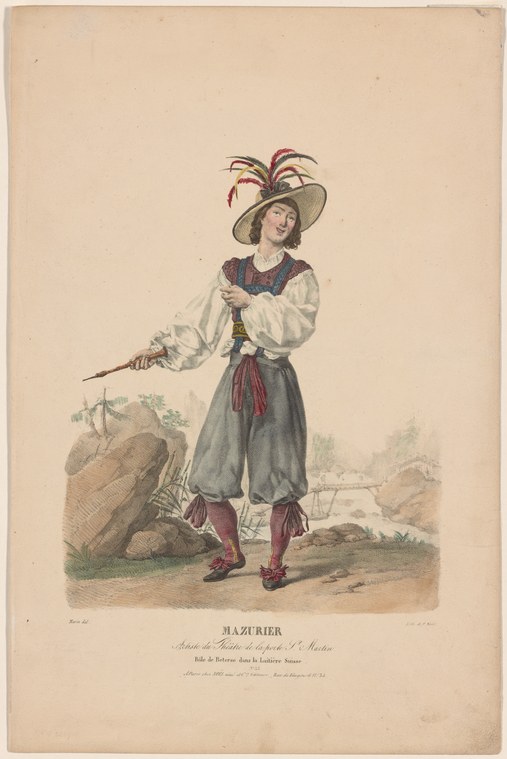
Mazurier artiste du Théâtre de la Porte St. Martin. Rôle de Beterse dans La laitière suisse
Unknown artist
Public Domain
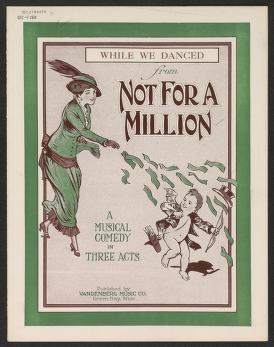
While we danced
Unknown artist · 1914
Public Domain
Continue Exploring
Lineage of Dance
500 years of dance evolution
Champions of Dance
Winners of marquee national & world titles
Language of Dance
161 dance terms & translations
Listening of Dance
Tempo, timing & musicality tools
Gallery of Dance
5,700+ artworks from museum collections
Attire of Dance
Evolution of dance dress across eras
Keep the thread going
Dance history, technique, and the occasional rabbit hole — in your inbox. Thoughtful, infrequent, unsubscribe anytime.
Free. No spam. One click to leave.