49 works in this view — arrow keys or swipe to move between them.
Dance in Art
Pas de quatre
Unknown artist
- Collection:
- Prints depicting dance
- Source:
- New York Public Library
- Rights:
- Public domain — free to use, share and adapt.
- Recorded as:
- Public Domain
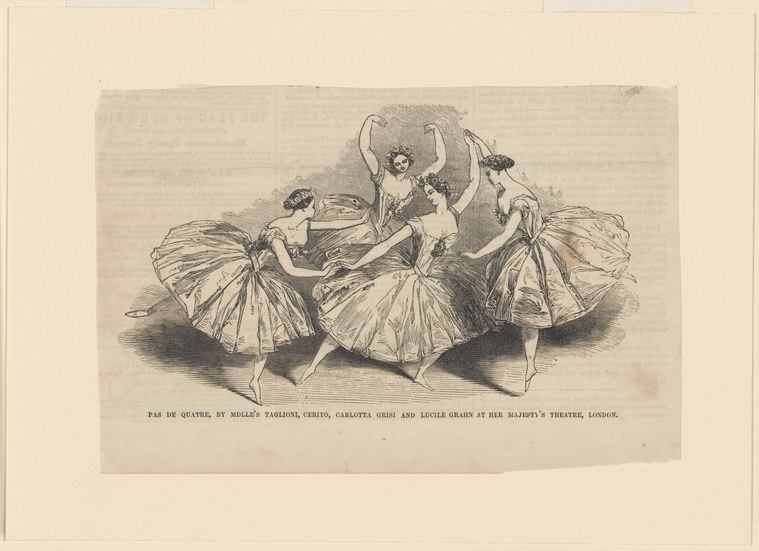
The Pas de Quatre represents a turning point in ballet history: the assertion that four prima ballerinas could share a stage as equals. This engraving is one of the primary visual records of that historic premiere and of how the dancers and choreography appeared to contemporary audiences. For historians of nineteenth-century ballet and costume, it is an invaluable primary document.
What you are looking at
Four women in classical ballet dress occupy the composition in a tightly grouped formation suggesting synchronized movement. Each wears a voluminous tulle skirt gathered at the waist, the fabric arranged to suggest mid-twirl or suspended motion, and each has her hair styled in the fashion of the mid-nineteenth century. A fifth figure, darker and less distinct, appears in the background at the center, possibly representing an accompanist or male dancer. The women's bodies are arranged in a diamond or square pattern facing slightly outward, their arms raised and positioned to create a sense of unity and mirrored action. The engraving is rendered in fine cross-hatching that gives dimensional form to the skirts and creates subtle modeling on the dancers' torsos and faces. The setting is minimal—no stage or scenery is indicated—and the composition focuses entirely on the dancers themselves and their formal arrangement.
The dancing
The four dancers occupy roughly equivalent positions in space, each with raised arms and an elevated carriage suggesting the refined posture of classical ballet. Their legs are not clearly visible beneath the expansive skirts, but the positioning of their bodies and the angle of their spines suggest weight distributed evenly and controlled lift. The dancers' arms are held aloft in positions consistent with classical port de bras, though the exact arm line varies slightly among them, suggesting individual interpretation within a unified choreography. The arrangement—four dancers of equal prominence—indicates an ensemble piece in which no single dancer dominates.
The dance depicted
This is the Pas de Quatre, the most celebrated short ballet of the nineteenth century. Premiered at Her Majesty's Theatre in London in 1845, it was choreographed by Jules Perrot and danced by four of the era's greatest ballerinas. The print's caption identifies the dancers as Carlotta Grisi, Cerito, Grahn, and Lucile Grahn, confirming the London premiere cast. The Pas de Quatre was revolutionary for presenting four prima ballerinas of equal rank in a single piece—a diplomatic achievement in an era of fierce rivalry. The ballet consisted of variations for each dancer followed by a coda in which all four performed together. This image captures that unified ensemble moment: the four dancers in matching costumes, their synchronized positions creating visual harmony while individual artistry shines through subtle variations in arm placement and body angle.
How it was made
This is an engraving, a print medium that allowed for wide and relatively affordable circulation. The fine hatching and careful gradation of tone suggest steel engraving, which could produce large editions without loss of detail—important for a work commemorating a celebrated theatrical event. The technique requires skill in capturing movement within a static medium; the artist has done this by choosing a moment of suspension and by suggesting the arc and volume of the skirts. Engravings of this type were common merchandise in theaters and popular prints shops, reaching audiences well beyond those who could attend performances, and serving as both souvenir and advertisement.
About this work
This is a commemorative engraving of the Pas de Quatre, one of the most historically significant ballets of the nineteenth century. It documents the four greatest ballerinas of its age performing together in a moment of unified ensemble dancing. The work belongs in a dance gallery as a record of a revolutionary choreographic achievement and as evidence of how ballet was visualized, circulated, and remembered in its own time. The print preserves the appearance of the dancers, their costumes, and the formal arrangement of the piece for posterity—a function engravings served before photography made such documentation routine.
How to look at it
Attend to the arrangement of the four dancers and how the artist has used symmetry and variation to suggest both unity and individuality. Notice how the skirts—the dominant visual element—are rendered with sufficient volume and texture to suggest the continuous motion of Romantic tutus, even though the bodies beneath are nearly invisible. The slight differences in arm carriage and body angle among the four dancers, though subtle, suggest that the artist understood this was not a rigid geometric pattern but a moment within flowing choreography. The presence of the fifth figure in the background hints at the theatrical context of performance, even though the focus remains on the dancers themselves.
The period
The 1840s were the height of the Romantic ballet era, when the ethereal, weightless quality of dance was prized and when female dancers, en pointe and in tutus, dominated the stage. The Pas de Quatre arrived at a moment when ballet was undergoing rapid technical and artistic change. Carlotta Grisi, Marie Taglioni, Fanny Cerrito, and Lucile Grahn represented different national traditions (Italian, Swedish, Italian, Danish) and different styles, yet Jules Perrot's choreography created a framework in which each could display individual artistry while contributing to an ensemble whole. The theatrical engraving was a standard form of popular culture in this period—a way to document and publicize major performances for audiences across Europe.
Where it lives
The work is held in the New York Public Library's prints collection devoted to dance imagery. The caption identifying it as depicting the dancers at Her Majesty's Theatre, London, confirms its status as a theatrical souvenir and primary document of the performance.
Dance in this work
Questions about this work
Who were the four dancers in the Pas de Quatre?
According to the engraving's caption, they were Carlotta Grisi, Cerito, Grahn, and Lucile Grahn. They represented four of the greatest ballerinas of the 1840s and came from different national traditions—Italian, Swedish, Italian, and Danish respectively. Their ability to perform together in a single work was a remarkable diplomatic and artistic achievement.
When was the Pas de Quatre first performed?
The ballet premiered in 1845 at Her Majesty's Theatre in London. It was choreographed by Jules Perrot specifically for this historic assembly of four prima ballerinas.
Why is the Pas de Quatre important in ballet history?
It was revolutionary for presenting four ballerinas of equal rank in a single work, at a time when prima donnas typically competed rather than collaborated. The piece demonstrated that ensemble work could showcase individual artistry while creating collective beauty. Its structure—individual variations followed by a unified coda—influenced ballet choreography for generations.
How does an engraving like this document dance?
The artist has chosen a moment of ensemble stillness or suspension and rendered it with enough detail to show costumes, body positions, and spatial relationships. Engravings could be produced in quantity and distributed widely, making them important records of performances that were otherwise ephemeral. They shaped how audiences who could not attend the performance imagined it.
More dance artwork





