49 works in this view — arrow keys or swipe to move between them.
Dance in Art
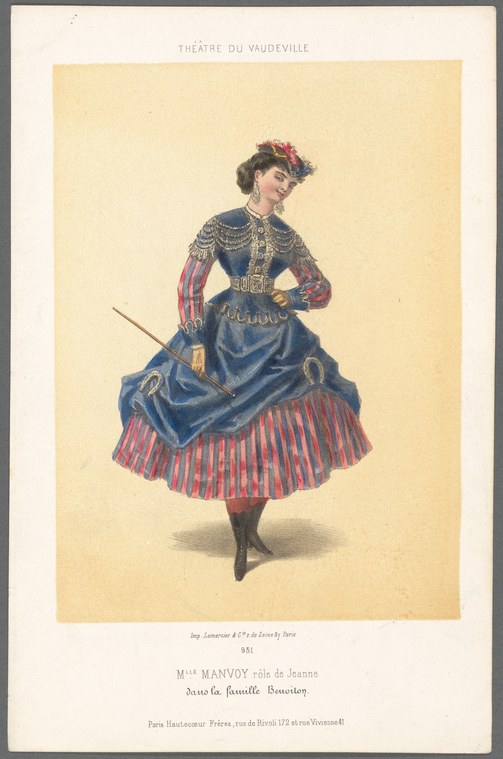
931. Melle. Manvoy, rôle de Jeanne dans La famille Benoiton, Théâtre du Vaudeville.
Unknown artist
- Collection:
- Prints depicting dance
- Source:
- New York Public Library
- Rights:
- Public domain — free to use, share and adapt.
- Recorded as:
- Public Domain
This image documents a specific moment in European theatrical dance history—the vaudeville tradition that blended comic acting, character work, and dance spectacle. It preserves the exact costume and pose of a performer whose work would otherwise be known only through reviews and playbills, showing us the material reality of how 19th-century stage femininity, character, and theatrical authority were constructed and displayed. For dancers and historians studying the genealogy of theatrical character work and the aesthetics of the 1860s stage, it is concrete visual evidence.
What you are looking at
A single female figure dominates a cream-colored ground, posed in a three-quarter stance with her body angled to the viewer's right. She wears an elaborate dark blue dress with ornate gold embroidery across the bodice and sleeves, paired with a striking red-and-gold striped skirt that creates a visual anchor at the base of the composition. The skirt flares dramatically, suggesting movement—or the potential for it. She holds a long stick or wand in her right hand, extending it diagonally upward, and her left hand rests at her waist in a posed, composed manner. Her dark hair is crowned with flowers or decorative plumage. The figure casts a shadow on the ground, and the entire composition has the character of a theatrical costume study or performance portrait, rendered in what appears to be hand-colored lithographic or engraving technique.
The dancing
The dancer's posture is upright and dignified, with her weight settled on both feet rather than in active motion. Her shoulders are held back; her arm extended upward with the stick creates a diagonal line of tension through the upper body. The pose suggests a moment of display or presentation rather than mid-movement—a classic theatrical "attitude" or stance meant to be held and admired. The extended arm and the stick reading as a possible dance property (rather than a walking stick) suggest deliberate gesture and control. Her other arm's placement at the waist is conventional for stage presentation of the period.
The dance depicted
The costume and pose align with mid-19th-century theatrical dance, most likely French vaudeville stage performance, as indicated by the catalogue reference to Théâtre du Vaudeville and the character name Jeanne from *La Famille Benoîton*. The stick or wand suggests a prop-based comedic or character dance number rather than classical ballet. The ornate, almost military-inspired embroidered bodice and the vivid red striping of the skirt point toward a burlesque, character, or comic theatrical dance tradition—possibly a parody of military dress or a comic servant role. The overall presentation is more about costume spectacle and character than the technical display of classical dance vocabulary.
How it was made
This is a hand-colored engraving or lithograph, a popular and reproducible medium for theatrical costume documentation and advertisement in the mid-19th century. The fine linear detail in the embroidery and the precise rendering of fabric folds and texture suggest engraving; the subtle color gradations in the skirt suggest hand-coloring with watercolor or tinted ink. This technique allowed multiple copies to be produced and distributed to audiences, critics, and collectors—making it a form of theatrical publicity and archival record simultaneously. The quality of reproduction and the care taken with detail indicate this was a valued commodity, not a cheap ephemeral print.
About this work
This is a costume and character portrait of Mlle. Manvoy in a leading role in the French vaudeville *La Famille Benoîton*, documented in the form of a hand-colored engraving popular for stage promotion in the 1850s–1870s. The work captures both the spectacle of theatrical dress and the posed elegance expected of stage performers of the period. It belongs to a substantial archival tradition of theatrical costume prints that recorded the visual experience of mid-19th-century commercial theater before photography became standard. For historians of dance and theater, such prints are primary evidence of what was worn, how the body was positioned for display, and what visual impression the performance intended to make on its audience.
How to look at it
Notice the deliberate stillness of the pose—this is not a caught moment of movement but a composed presentation, the way a performer would hold a position for the audience to appraise both body and costume. The extended stick and the turned stance create theatrical presence and silhouette rather than ballet's weightlessness. Observe how the eye is drawn downward to the skirt's red striping, which would create visual dynamism and movement potential even as the figure stands composed; this is costume design at work, heightening the impression of liveliness. The close attention to embroidery detail and the formal framing signal that this figure's worth is tied to her costume, her role, and her stage presence—a different visual logic than classical ballet portraiture.
The artist
The print is credited to "Imp. Lemercier à l'r de la Rue II à Paris-Victoria I"—a reference to the Lemercier printing house, a major Parisian lithographic and engraving firm active from the early 19th century onward. Lemercier was known for high-quality color printing and theatrical documentation. The individual artist (draftsperson or engraver) is not named. This was typical practice: theatrical costume prints were commercial products, and the printer's name carried more weight than the artist's.
The period
This print dates to the height of French vaudeville's popularity, when the Théâtre du Vaudeville was a major Paris entertainment venue (mid-19th century). Vaudeville represented a cosmopolitan, commercially savvy form of theatrical entertainment blending music, comedy, dance, and spectacle—distinct from classical ballet but equally central to dance culture of the era. The 1860s–1870s saw intense documentation of theatrical performers through lithography and engraving, reflecting both the celebrity culture of the period and the competitive drive of theaters to promote their stars. Costume prints like this one were collected by enthusiasts, used for advertisement, and preserved as records of memorable performances.
Where it lives
The work is held in the New York Public Library's collection of prints depicting dance. It belongs to a tradition of theatrical documentation prints collected systematically in the late 19th and 20th centuries, often acquired as archives of performance history rather than as fine art objects.
Dance in this work
Questions about this work
What is *La Famille Benoîton*?
*La Famille Benoîton* was a popular French farce and vaudeville piece of the mid-19th century, known for its satirical treatment of middle-class manners and social climbing. It ran in multiple theaters and spawned numerous adaptations. Mlle. Manvoy's role as Jeanne was a character role within this comic framework—likely a servant, companion, or comic foil rather than a romantic lead.
Is this a ballet dancer?
Not in the classical sense. The costume, the stick or wand, and the upright posed stance indicate this is a theatrical or vaudeville performer—a character dancer or actress-dancer. The elaborate embroidered bodice and the militaristic or ornamental flavor of the dress suggest a character role with comic or spectacle elements rather than the ethereal grace associated with romantic ballet of the same era.
Why is she holding a stick?
The stick is most likely a theatrical property associated with her character—possibly a cane, swagger stick, or wand used for comic effect or character definition. It could also indicate a military-themed costume or parody. Without seeing the actual performance or reading a detailed playbill, the exact dramatic function is uncertain, but it marks this as a prop-based character dance rather than pure movement.
How was this print made?
This appears to be a hand-colored engraving or lithograph produced by the Lemercier printing house in Paris. The image was first rendered in line (likely engraved), then hand-colored with watercolor or tinted ink. This technique allowed for both precise detail and subtle color gradation, and copies could be reproduced and sold to theaters, collectors, and the public.
More dance artwork





