49 works in this view — arrow keys or swipe to move between them.
Dance in Art
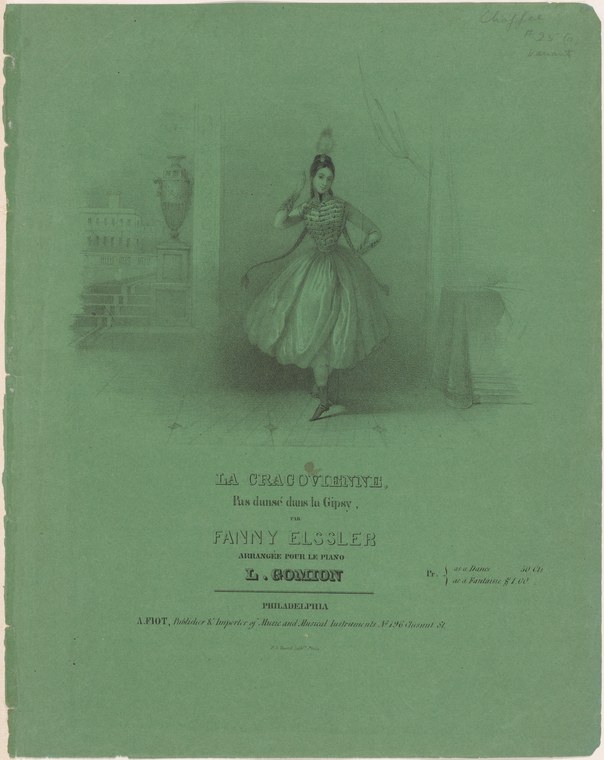
La cracovienne, pas dansé dans La gipsy, par Fanny Elssler
Unknown artist
- Collection:
- Prints depicting dance
- Source:
- New York Public Library
- Rights:
- Public domain — free to use, share and adapt.
- Recorded as:
- Public Domain
Fanny Elssler was a transformative figure in global dance history, and this portrait records her during her triumphant American tour. The image also demonstrates the central tension of Romantic ballet: its appetite for the exotic and the national, alongside its commitment to ethereality and otherworldliness. The Cracovienne as depicted here is neither folk nor balletic—it is a Romantic fantasy of the dancer's power to transcend geography and gravity.
What you are looking at
A young woman in Romantic-era theatrical dress stands alone in an architectural interior, her body angled in a pose of arrested movement. She wears a fitted corseted bodice with short puffed sleeves and a long skirt that falls to mid-calf, with what appears to be a gauzy overlay or hem treatment typical of the 1830s–40s ballet aesthetic. Her arms are raised and extended—the right arm higher and more extended, the left lower—in the lifted, ethereal carriage of Romantic ballet. Her head is inclined upward, her gaze directed away from the viewer. Behind her, to the left, stands a classical urn on a pedestal; to the right, a tall architectural element suggests a palazzo or interior colonnade. The whole composition is rendered in fine pencil or pen work on the tinted paper, with areas of shadow suggesting volume and atmosphere. The pose suggests a moment of yearning or spiritual elevation—the characteristic aesthetic of Romantic ballet heroines.
The dancing
The single figure is captured in a stance that distributes weight between both feet while projecting an impression of weightlessness. The raised arms and lifted sternum convey the épaulement and upper-body lift fundamental to Romantic ballet technique. The body is not rigidly vertical but curves slightly, with a gentle backward incline through the torso—a hallmark of the period's idealization of the female dancer as ethereal and otherworldly. The pose does not depict active footwork; rather, it freezes a moment of suspended, contemplative extension.
The dance depicted
The title identifies this as *La Cracovienne*, a pas dansé (solo dance) performed by the Austrian-Italian dancer Fanny Elssler in *La Gipsy*. The Cracovienne (also Krakowiak) is a lively Polish folk dance in duple meter, traditionally featuring vigorous footwork and turned-out positions. However, this image shows no such vigor. Instead, Elssler is depicted in a moment of romantic languor far removed from the dance's folk character—a visual contradiction that likely reflects how mid-19th-century ballet adapted and sentimentalized ethnic and regional dances. The print was published in Philadelphia by A. Fiot, suggesting it circulated as a souvenir of Elssler's North American tour (1840–1842), one of the most celebrated dance tours of the era.
How it was made
This is a lithographic print, hand-colored or colored during printing. The fine linear work, the tonal gradations, and the capacity to capture delicate drapery and facial expression are consistent with lithography of the 1840s. Lithography's ability to produce soft tonal effects and fine detail made it the dominant medium for theatrical portraiture and dance imagery in this period, allowing for rapid, affordable circulation of images of celebrated performers. The colored tinting—the pale green ground and the subtle modeling of light—are typical of hand-colored lithography.
About this work
This is a theatrical portrait of one of the most celebrated dancers of the Romantic era, captured during a moment of international stardom. Fanny Elssler was known for her dramatic presence, her technical brilliance in both classical and character dances, and her ability to embody exoticism and passion—qualities that made her the rival and complement to the ethereal Marie Taglioni, the other dominant ballerina of the 1830s–40s. The print documents not only Elssler's appearance but also the aesthetic conventions through which early 19th-century ballet transformed folk and regional material into refined spectacle. The contradiction between the Cracovienne's folk origins and the Romantic languor depicted here is itself historically significant: it shows how metropolitan ballet domesticated and sentimentalized the dances of other cultures.
The work belongs in this collection as evidence of how dance was circulated, consumed, and imagined during the Romantic ballet era. It is not a stage documentation but a celebrity image, a souvenir of presence and fame.
How to look at it
Notice the lifted carriage and the ethereal extension of the arms: these register as Romantic ballet convention to a trained eye, even though the title promises a Polish folk dance. The architectural setting—the urn, the colonnade—signals not a stage set but a timeless, idealized space. Observe the incline of the head and the direction of the gaze, which suggest interiority rather than spectacle. The artist has chosen not a moment of action but a moment of reverie, characteristic of how Romantic ballet froze female dancers in states of longing or otherworldliness. This is not documentary but idealization.
The artist
The print is credited in the imprint to L. Bonoton as arranger or publisher. The lithographer is not named. This was standard practice for theatrical prints of the period: celebrated dancers were the draw, not the artists who rendered them. The work was published by A. Fiot of Philadelphia, who issued a series of theatrical and dance prints in the 1840s for consumption by audiences on both sides of the Atlantic.
The period
This print dates to the height of the Romantic ballet era and specifically to the period of Elssler's American fame (1840–1842). The 1830s and 40s saw the global ascendancy of ballet as a European art form, with female dancers at its center. Marie Taglioni had pioneered Romantic ballet in Paris; Elssler, a rival and a different kind of dancer, represented a more earthy, dramatic, and technically virtuosic tradition. Both women toured internationally, and both generated vast quantities of printed imagery—lithographs, engravings, and later photographs—that constructed celebrity and made dance available to those who would never see it live. The Cracovienne itself was part of the broader Romantic appetite for character dances and national exotica: the early 19th century saw the rise of dances identified with Spain (*Cachucha*), Hungary, Russia, and Eastern Europe, all filtered through the aesthetic and technical framework of classical ballet.
Where it lives
The work comes from the New York Public Library's collection *Prints depicting dance*. It is a published theatrical print, issued as a commercial commodity and souvenir during Elssler's American tour. The imprint attributes it to A. Fiot (Philadelphia bookseller) and L. Bonoton.
Dance in this work
Questions about this work
Who was Fanny Elssler?
Fanny Elssler (1810–1884) was an Austrian-Italian dancer and one of the two most celebrated ballerinas of the Romantic era (the other being Marie Taglioni). She was known for her dramatic presence, her technical brilliance, and her ability to dance both classical ballet and character dances. She toured internationally, including a famous tour of North America in 1840–1842, which generated enormous celebrity and vast quantities of printed imagery.
What is the Cracovienne?
The Cracovienne (or Krakowiak) is a lively Polish folk dance in duple meter, traditionally featuring vigorous, rhythmic footwork and turned-out leg positions. In Romantic ballet, character dances like the Cracovienne were incorporated as interludes or solo dances within larger ballets, reframed and refined according to the aesthetic standards of classical technique. The folk dance was thus transformed into metropolitan spectacle.
Why does this look so ethereal if it's supposed to be a folk dance?
This illustrates a central feature of Romantic ballet: the domestication and sentimentalization of folk and national material. The Cracovienne, as a folk dance, was vigorous and earthy. But Romantic ballet's aesthetic demanded ethereality, spirituality, and gravity-defying extension. The image shows the dancer not in action but in a suspended, dreamy moment—a Romantic fantasy rather than a folk representation.
What is lithography?
Lithography is a printing technique based on the principle that oil and water do not mix. An image is drawn on stone with a greasy medium; the stone is wetted and inked, and the ink adheres only to the drawn areas. Paper is pressed against it to create the print. Lithography allowed fine detail, tonal subtlety, and rapid, inexpensive production in multiple copies, making it ideal for theatrical and celebrity portraiture in the 19th century.
More dance artwork





