49 works in this view — arrow keys or swipe to move between them.
Dance in Art
Mlle. Camargo
Unknown artist
- Collection:
- Prints depicting dance
- Source:
- New York Public Library
- Rights:
- Public domain — free to use, share and adapt.
- Recorded as:
- Public Domain
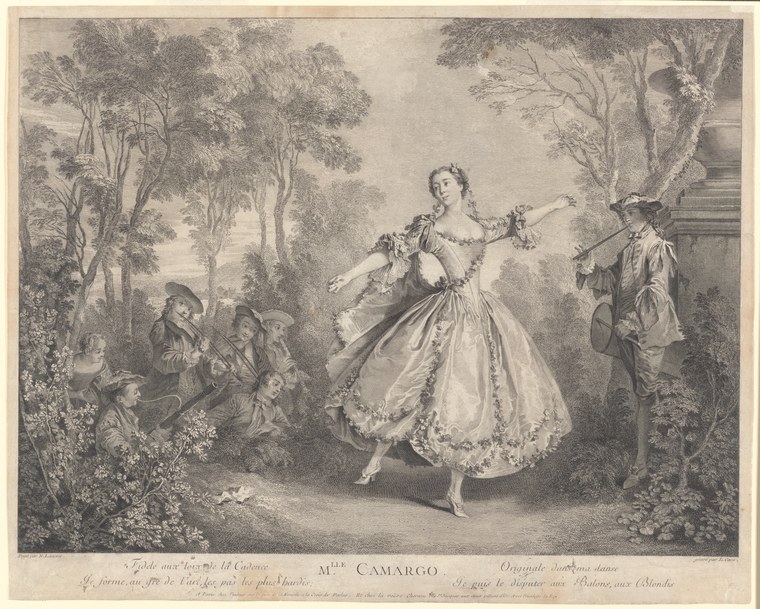
Camargo was a pivotal figure in the professionalization and elevation of dance as a theatrical art form; prints like this one show how her fame was actively promoted and consumed by the public. The image documents not just a dancer but a moment of celebrity culture—her name is printed on the engraving, and her likeness was deemed worthy of expensive reproductive technology, marking her as a star of comparable status to famous actors and singers.
What you are looking at
An elegant outdoor garden scene in which a woman in a full, ornately decorated gown dances or poses at the center, her body caught in graceful motion with one arm extended and the other gesturing expressively. She wears a pale silk dress with deep flounces and decorated hem, and her dark hair is styled in the fashion of the mid-18th century. Around her stand four male musicians or attendants in the livery of the period—one plays a stringed instrument (likely a theorbo or lute), another holds what appears to be a bagpipe or wind instrument, and two others stand conversing. The setting is a wooded park or garden, with tall trees framing both sides of the composition and architectural elements visible in the distance on the right. The lighting is soft and diffused, typical of engraved landscape work, and the entire scene is rendered in fine parallel lines characteristic of professional engraving technique.
The dancing
The central female dancer stands in a distinctly elevated, lifted posture with her weight forward on one leg and the other leg extended or about to move. Her upper body is open, with one arm raised and bent, the other extended outward at roughly waist height—a frame that suggests trained courtly movement rather than folk dancing. Her torso is erect and her head is held high. The four male attendants are static figures positioned around her, creating a composition that focuses all visual attention on the woman as the principal dancer. There is no closed hold or partnership dancing; the woman dances solo while the musicians provide accompaniment.
The dance depicted
This appears to depict a solo court dance of the Baroque or early Rococo period, most likely a minuet or related courtly dance from the mid-18th century. The inscription at the bottom (legible as 'Mlle Camargo') identifies the dancer as Marie-Anne de Cupis de Camargo, the famous French ballerina of the 1730s–1740s who was known for her brilliant footwork, elevation, and theatrical presence. The garden setting, the accompanying musicians, and the elegant isolation of the solo dancer suggest a pastoral or theatrical context rather than a ballroom. Camargo was celebrated for dancing in theatrical productions and public performances, and this image likely represents her in a moment of performance or rehearsal, capturing the elegance and technical control for which she was renowned.
How it was made
This is an engraving, rendered in fine burin work with careful cross-hatching to create tonal depth and form. The technique allows for precise rendering of the clothing's texture and the intricate details of the garden setting. Engravings of this type and quality were expensive to produce and were distributed among educated and affluent audiences—they served as both artworks and commercial prints documenting famous performers and fashionable entertainment. The fact that this work was published and circulated (it is now held in the New York Public Library collection) indicates it was a commercial success, meaning Camargo was a celebrity of sufficient interest to justify the engraver's effort.
About this work
This is an 18th-century engraving depicting the celebrated French ballerina Marie-Anne de Cupis de Camargo in a moment of solo dance, set in an idealized garden landscape with musical accompaniment. Camargo was one of the most famous dancers of her era, known for her technical skill and star quality, and she was frequently the subject of prints and paintings during her lifetime. This particular engraving captures her in an attitude of elegant repose and motion, her body expressing the refinement and control demanded by court dance of the period. It belongs in a dance history gallery both as a record of an individual artist's fame and as evidence of how dance was commercialized, celebrated, and circulated as entertainment in the 18th-century public sphere.
How to look at it
Observe the positioning of Camargo's body: she is not in a static pose but caught mid-movement, with her raised arm and extended leg suggesting a step or turn executed with lift and control. The graceful curvature of her body and the careful placement of her supporting leg indicate an artist familiar with dance technique—this is not an invented or exaggerated form, but a recognizable moment from a real performance vocabulary. Notice how the four male attendants frame her and draw the eye inward; the composition is deliberately designed to make her the absolute focus. The garden setting and soft lighting give the image a theatrical or dreamlike quality, appropriate to a star performer's self-presentation.
The artist
The artist is not recorded in the catalogue, but this is a professional engraving of high quality from a Parisian print workshop, likely produced during or shortly after Camargo's active performance years (1730s–1740s). The inscription in French and the references to 'Mlle Camargo' and a theatrical scene suggest a Parisian origin and an audience of French-speaking elites. Similar prints of famous performers were produced by commercial print houses throughout the 18th century; they were often created from drawings by established artists and engraved by specialist craftspeople whose names might or might not appear on the final print.
The period
The mid-18th century saw the rise of the professional ballet dancer as a celebrity figure, particularly in Paris and London. Before Camargo's era, dance had been largely an aristocratic courtly practice or a subordinate element of theatrical spectacle. Camargo, along with her contemporary and rival Marie Sallé, helped transform dance into a solo performance art with paying audiences and critical attention. The engraving form itself was the dominant medium for circulating images of famous performers before photography; prints were affordable luxury goods that spread the image of stars across Europe. The Rococo garden setting and the pastoral mood reflect the era's taste for elegant, intimate scenes of leisure and refinement.
Where it lives
This engraving is part of the New York Public Library's collection of prints depicting dance. It is a commercial print, likely issued in Paris in the 1730s or 1740s, and represents the kind of ephemeral but durable cultural document that circulated among educated consumers of the period.
Dance in this work
Questions about this work
Who was Marie-Anne de Cupis de Camargo?
Camargo (1710–1770) was a French-Italian ballerina who became a celebrity performer in Paris during the 1730s and 1740s. She was famous for her technical brilliance, her rapid footwork, and her willingness to dance in shorter skirts that displayed her legs—then a scandalous innovation. She performed in theatrical productions and was a rival and contemporary of Marie Sallé. She effectively helped invent the modern ballet dancer as a professional solo artist.
What dance is she performing?
The image does not specify a particular named dance, but the garden setting, the solo performance format, and the elegant courtly dress suggest a minuet or a related courtly dance of the Baroque or early Rococo period. Camargo was trained in the academic ballet technique of her era and would have performed many different dances; this engraving captures a generalized moment of elegant solo performance rather than a specific choreography.
Why was this engraving made?
It was a commercial product—an expensive but profitable print issued to capitalize on Camargo's fame. Prints of famous performers were luxury goods sold to wealthy collectors, and they served both as artworks and as a form of celebrity promotion. This particular print shows Camargo at the height of her fame and was likely issued during or shortly after her active performing years.
What does the garden setting mean?
The pastoral setting is partly decorative and partly conventional—Rococo taste favored elegant natural landscapes as frames for scenes of leisure and pleasure. In the context of a theatrical performer, the garden also evokes an idealized, romantic context that elevated the dancer above ordinary life and framed her as the subject of aesthetic contemplation and fantasy.
More dance artwork





