49 works in this view — arrow keys or swipe to move between them.
Dance in Art
Alcine
Unknown artist
- Collection:
- Prints depicting dance
- Source:
- New York Public Library
- Rights:
- Public domain — free to use, share and adapt.
- Recorded as:
- Public Domain
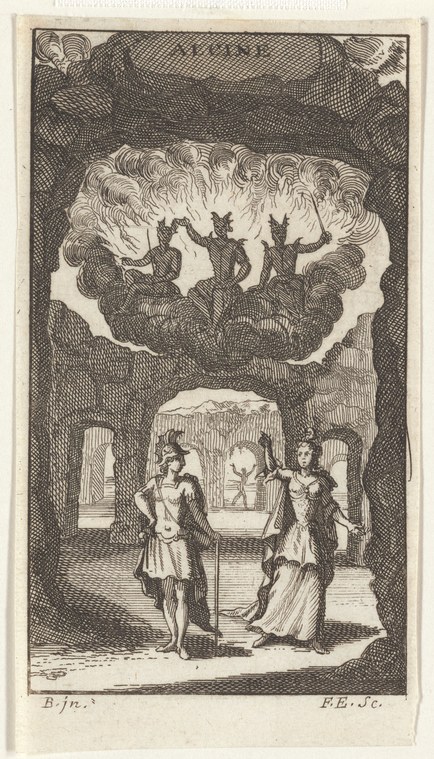
Alcine scenes were among the most visually spectacular and technically ambitious entertainments of the Renaissance and Baroque courts, requiring elaborate machinery, music, and choreographed movement. This engraving provides rare visual evidence of how artists imagined and represented the supernatural body in theatrical dance. For historians of early modern spectacle, the work is invaluable; for dancers and choreographers, it documents a moment when the body's expressiveness was enlisted not for virtuosity or social grace but for transcendent metamorphosis.
What you are looking at
A theatrical scene divided into two registers showing the enchantress Alcine and her court. In the upper portion, three demonic or supernatural figures with elaborate headdresses emerge from or float above swirling clouds and flame-like forms, their bodies contorted in impossible poses suggesting flight or levitation. Below, in a columned interior space, Alcine stands at center in a long dress, flanked by two attendant figures in classical drapery. The architectural setting—with its classical columns and arched ceiling—suggests an interior palace or temple, while the upper register's turbulent sky and supernatural figures indicate magical or enchanted space. The entire composition uses dense hatching and linear marks characteristic of engraving to build form, shadow, and the distinction between the terrestrial and magical realms.
The dancing
The three upper figures display extreme bodily contortion: twisted spines, raised arms, and splayed limbs that defy anatomical norm, suggesting demonic or otherworldly beings in ecstatic or convulsive states. Their poses are frontal and centripetal, drawing the eye upward. Below, Alcine and her attendants stand in relatively stable, erect postures; the two attendants flank her symmetrically, their arms at their sides or gesturing with measured restraint. The contrast between the chaotic upper bodies and the composed lower figures is deliberate—a visual hierarchy of the magical versus the courtly.
The dance depicted
This image likely depicts a scene from an operatic or ballet treatment of Ludovico Ariosto's *Orlando Furioso*, specifically the court of the enchantress Alcine, a popular subject in Italian and European court spectacle of the 16th–18th centuries. The contorted upper figures are not performing conventional dance but rather theatrical phantasmagoria—supernatural beings summoned through magic. The lower register may represent a court dance or procession, though the figures are too still to suggest active movement. The work treats dance not as a social or athletic practice but as an element of spectacular theater, where the body becomes a vehicle for representing the supernatural and impossible.
How it was made
This is an engraving, as indicated by the uniform linear hatching, sharp edges, and tonal modeling built entirely from parallel and crossed lines. The technique allows fine detail and strong black-and-white contrast, essential for depicting both architectural precision below and turbulent, ethereal forms above. Engravings of this type circulated widely as prints and were accessible to educated audiences interested in theater design and classical narrative. The skillful use of line to render both solid architectural space and immaterial supernatural forms demonstrates sophisticated command of the medium.
About this work
This engraving depicts a scene from theatrical spectacle based on Ariosto's *Orlando Furioso*, showing the court of the enchantress Alcine. The work is a document of early modern theatrical design and the role of the body in representing magic and the supernatural. It belongs in a gallery of dance in art because it captures a specific moment in European theater history when dance, spectacle, and magical illusion converged in court entertainments and operatic productions. The distinction between human courtly gesture (below) and demonic or superhuman contortion (above) reveals how artists understood the dancing body as a tool for narrative and wonder.
How to look at it
Observe the artist's compositional strategy: the rigid geometry of the architectural frame below contrasts sharply with the turbulent, sinuous forms above. Notice how the engraver uses line weight and density to distinguish the solid, knowable world of the court from the fluid, unstable realm of enchantment. The three upper figures are frozen mid-contortion, at a moment of maximum physical impossibility—the artist has chosen not a moment of repose but one of extreme transformation. This choice reveals the early modern fascination with the body as a site capable of transcending natural law.
The artist
The artist is unknown, though the inscription 'B. fin.' and 'E.L.S.C.' appear on the print. The work likely comes from a theatrical context—either a court spectacle, an operatic production, or a print series documenting famous theatrical scenes. The engraving style and subject matter suggest Italian or Northern European origin, probably 16th–17th century. Without further documentation, the creator's identity and workshop remain uncertain, though the technical skill visible in the rendering of both architectural and supernatural forms indicates a trained professional engraver.
The period
The *Orlando Furioso* narratives were among the most popular subjects in European court spectacle from the mid-16th century onward. The character of Alcine—a powerful enchantress whose magic transforms landscapes and bodies—offered opportunities for spectacular visual display, including elaborate machinery, transformations, and supernatural choreography. This period saw the development of intermezzi and early opera in Italian courts, where dance, music, and theatrical illusion were integrated into unified spectacles. The engraving likely documents or celebrates one such production, capturing the moment when the body became a site of magic.
Where it lives
The work is held in the New York Public Library's collection of prints depicting dance. It is catalogued under the general rubric 'Prints depicting dance' and may be part of a larger series or portfolio documenting theatrical scenes. The inscription marks visible on the print suggest it was produced as an independent or serial print intended for circulation among educated audiences with interest in spectacle and classical narrative.
Dance in this work
Questions about this work
What story is this from?
The print illustrates a scene from Ludovico Ariosto's *Orlando Furioso*, one of the most popular epic poems in Renaissance Europe. Alcine is an enchantress whose magical powers allow her to transform landscapes, summon spirits, and bewitch mortals. This scene likely depicts her court or a moment of magical summoning. The *Orlando Furioso* narratives were frequently adapted for court theater, opera, and spectacle throughout the 16th–18th centuries.
Are those figures dancing?
Not in the conventional sense. The upper figures are contorted in poses that suggest supernatural possession or magical transformation rather than choreographed dance. The lower figures stand in courtly posture but are too static to indicate active movement. The work blurs the boundary between dance, theater, and spectacle—the body is deployed for visual wonder and narrative effect rather than as a performer executing steps.
When and where was this made?
The catalogue record does not specify date or place of origin. Based on the engraving technique, the style of the architectural rendering, and the subject matter, the work likely dates to the 16th or 17th century and probably comes from Italy or Northern Europe. The artist's initials appear on the print but have not been conclusively identified.
How was this print used?
As an engraving, this work circulated as an independent print or as part of a series documenting theatrical scenes. Such prints served multiple purposes: they recorded spectacular entertainments for audiences who had not witnessed them, they spread knowledge of new theatrical designs and conventions across Europe, and they provided visual models for artists and impresarios planning their own productions.
More dance artwork





