49 works in this view — arrow keys or swipe to move between them.
Dance in Art
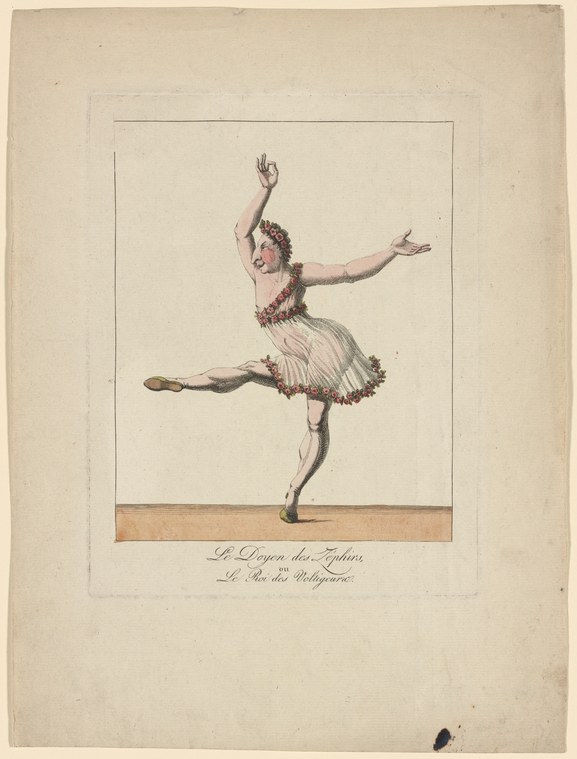
Le doyen des Zéphirs; ou Le roi des voltigeurs
Unknown artist
- Collection:
- Prints depicting dance
- Source:
- New York Public Library
- Rights:
- Public domain — free to use, share and adapt.
- Recorded as:
- Public Domain
This print preserves evidence of how a celebrated dancer—whose name we may or may not recover—was marketed, remembered, and celebrated in the 18th-century theater. It shows the physical ideal of the period: not the courtly, turned-out elegance of the Baroque, but a new kind of aerial, weightless virtuosity. For historians, it documents the vocabulary and aspirations of ballet at a moment when technique was becoming standardized and published.
What you are looking at
A single female dancer is shown in a moment of suspended, virtuosic movement against a plain background with a narrow tan stage floor. She stands on one leg in a high relevé or jump position, with the supporting leg extended behind her in a fully stretched line, the foot pointed. Her upper body is held upright with both arms raised and spread wide—the right arm extended to the side at shoulder height, the left raised higher toward vertical. Her head is turned to face forward, with curled hair styled in the fashion of the late 18th century. She wears a fitted bodice decorated with a ruffled or pleated trim in contrasting color (pink or rose), and a short, full skirt with multiple tiers of ruffles or scalloped edges, also decorated with ornamental trim. The skirt, rendered in pale green or cream, is caught mid-movement, flaring outward and upward around her body. She wears heeled slippers in a darker tone. The pose demonstrates extreme flexibility and control: the torso is held vertically while one leg is fully extended behind, creating the aesthetic of weightless elevation. The composition is spare and formal—the figure is centered, the background is plain, and a thin ruled border frames the entire scene. A caption in French script appears below the figure on the tan stage floor.
The dancing
A single dancer in an arabesque-like position, supported on one leg with the other extended fully behind, achieving a striking vertical line through the supporting side. Both arms are raised in an open, expansive frame—neither in closed position nor in a tight epaulement—with the upper body held in perfect vertical alignment despite the extreme extension of the free leg. The dancer's weight is fully on the ball of the supporting foot in a high relevé or demi-pointe, suggesting significant strength. The pose emphasizes line, elevation, and control rather than traveling movement or partnered interaction.
The dance depicted
This is a theatrical dance of the late 18th century, almost certainly a solo from the French or Italian stage tradition of the period. The pose and costume—particularly the shortened skirt with ruffled tiers and the heeled shoe—align with the vocabulary of *pantomime* or *ballet d'action* as it was performed in the 1780s–1790s. The extreme extension of the leg behind the body while maintaining vertical uprightness is characteristic of the academic ballet vocabulary being codified in this period, particularly the arabesque position. The title *Le Doyen des Zéphirs* ('The Senior of the Zephyrs') and *Le Roi des Voltigeurs* ('The King of the Vaulters') both refer to aerial, soaring movement—zephyrs are gentle winds, voltigeurs suggests vaulting or tumbling—and the image captures a moment of apparent weightlessness. This may represent a specific celebrated dancer or a stock character from the pantomime tradition.
How it was made
This is a hand-colored engraving or etching, likely from the final quarter of the 18th century. The lines are clean and fine, the image is outlined in a ruled rectangular border (typical of dance prints of this period), and the figure is rendered in outline with selective color wash—pink for the bodice trim, green or cream for the skirt, and flesh tones for the exposed skin. The technique allowed for mass production and distribution as a souvenir or advertisement of a celebrated dancer or role. The use of hand-coloring indicates a work of some pretension and cost, likely aimed at patrons of the theater or collectors of dance imagery.
About this work
This is a late 18th-century engraving documenting a moment from a French or Italian theatrical dance, depicting a solo performer in a virtuosic pose that epitomizes the emerging grammar of academic ballet. The print records both the physical achievement of a specific dancer and the aesthetic ideals of the period—weightlessness, vertical elongation, and the beauty of line. It belongs in the history of dance imagery as evidence of how choreography was promoted, celebrated, and disseminated to a literate public before photography, and as a window into what the educated eye of the 1780s–1790s valued in a dancing body.
The work is significant because it captures a transitional moment: the old vocabulary of court and theatrical dance is giving way to the codified positions and lines that would define Romantic ballet half a century later. The dancer's body, the artist's eye, and the print technology together document the cultural investment in dance as spectacle and virtuosity.
How to look at it
Focus on the moment the artist chose to freeze: not a traveling step or a partnered interaction, but an instant of apparent suspension, when the dancer seems to defy gravity. Notice how the body is held: the torso vertical, the free leg fully extended, the arms raised and spread in an open, expansive gesture. This is not a pose of repose but of effort held in perfect control. The framing—centered, formally composed, with the stage floor marked by a thin line—mimics the engraved portraits of theatrical stars that circulated in the 18th century. Observe also the costume: the shortened skirt is practical for movement and display; the ruffled tiers are decorative but also allow the line of the leg and the movement of the garment to be seen. The pale color and translucency of the skirt would have read as ethereal in the theater, enhancing the impression of weightlessness.
The period
This work was created in the final quarter of the 18th century, a moment of radical change in theatrical dance across Europe. The old court dances and Baroque spectacles were giving way to *ballet d'action*—narrative ballets performed by professional dancers in theaters, informed by pantomime and increasingly governed by a codified academic vocabulary. This period saw the publication of Beaumont's *Chorégraphie* (1700) and the emergence of figures like Jean-Georges Noverre, whose *Lettres sur la danse* (1760) called for ballet without masks, for narrative coherence, and for the dancer's body as the primary instrument of expression. The engraving tradition of theatrical portraiture flourished in this period: major cities in France, Italy, and England produced and circulated prints of celebrated dancers in iconic roles or signature poses. Hand-colored engravings served as both souvenirs and advertisements, distributed to patrons and collectors. The costume and pose in this print—the shortened skirt, the heeled shoe, the extreme extension of the leg, the open arm position—all belong to this transitional moment.
Where it lives
The work is held in the New York Public Library's Prints collection documenting dance. It is an example of the 18th-century theatrical engraving tradition, a genre of promotional and commemorative prints produced for the theater-going public.
Dance in this work
Questions about this work
What is the dancer doing in this pose?
The dancer is executing or demonstrating an arabesque-like position—a fully extended line with one leg stretched behind the body while the supporting leg holds the torso upright. The height of the relevé (the rise on the ball of the supporting foot) and the extreme extension suggest a moment of elevation or lightness. The arms are open and raised, contributing to the impression of soaring or weightless flight that the title references.
Why is the skirt so short and ruffled?
The shortened, ruffled skirt was standard dress for theatrical dancers of the late 18th century. It allowed freedom of movement for the legs, displayed the line of the extended limb, and showed off the intricate footwork. The ruffles were both decorative and functional—they caught light and motion, enhancing the spectacle of the dance.
What does the French title mean, and how does it relate to the image?
*Le Doyen des Zéphirs* means 'The Senior of the Zephyrs' and *Le Roi des Voltigeurs* means 'The King of the Vaulters.' Both titles refer to light, airy, soaring movement—zephyrs are gentle winds, voltigeurs suggests vaulting or tumbling. The image captures this idea through the apparent weightlessness of the pose and the elevation of the dancer's body.
How do we know this is from the late 18th century?
The costume, the pose, the technique, and the print style all point to the 1780s–1790s. The shortened skirt with ruffled tiers, the heeled slipper, the hair styling, the academic vocabulary of the arabesque position, and the engraving technique with hand-coloring are all consistent with theatrical dance prints of that period. The vocabulary and ideals of ballet were changing rapidly in these decades, moving toward the codified academic vocabulary we recognize today.
More dance artwork





