49 works in this view — arrow keys or swipe to move between them.
Dance in Art
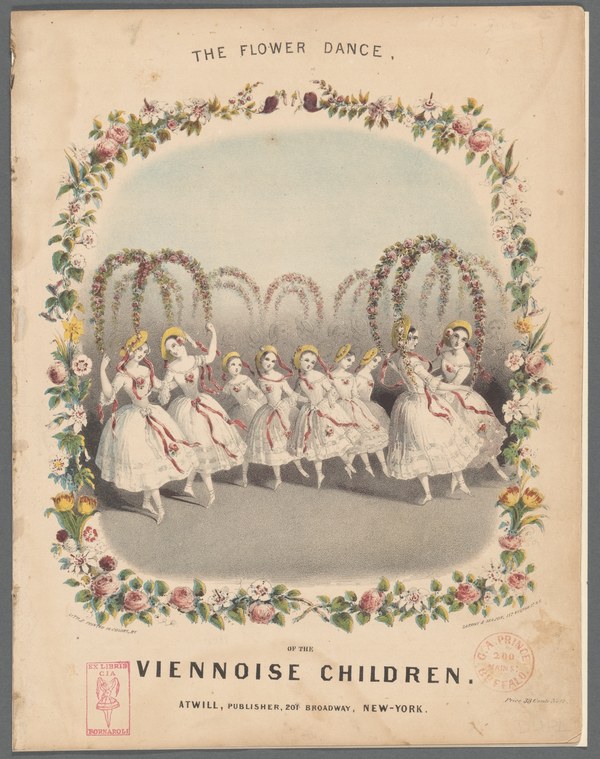
The flower dance, of the Viennoise Children
Unknown artist
- Collection:
- Prints depicting dance
- Source:
- New York Public Library
- Rights:
- Public domain — free to use, share and adapt.
- Recorded as:
- Public Domain
This print is one of very few surviving visual records of how children actually performed dance in 19th-century commercial theater and music halls, showing the gap between aspiration (classical ballet positions and framing) and reality (modest training, decorative arrangement, theatricality over technique). It also exemplifies the Victorian obsession with spectacle, youth, and sentimentality—using children and flowers as interchangeable elements of aesthetic fantasy.
What you are looking at
Ten young girls in white classical ballet costumes dance in a formal line beneath two large floral archways, suggesting a theatrical or ceremonial setting. The archways are constructed from flowering vines and potted plants—roses, wisteria, and other blooms in pink, purple, and yellow—creating an ornamental garden effect. The girls wear simple white dresses with short skirts, their arms raised and bodies arranged in a symmetrical formation characteristic of corps de ballet work. The floor is neutral and shadowed; the composition is framed by the elaborate decorative borders of flowers that occupy more visual weight than the dancers themselves. The overall tone is one of refined, domestic spectacle—a parlor entertainment or academy exhibition rather than a professional stage production.
The dancing
The ten dancers stand in a loose rectangular formation, their bodies arranged for visual symmetry rather than technical precision. Most have their arms raised in a simple, generalized port de bras—neither the rigorous geometry of classical ballet technique nor the elaborate arm positions of academic training. Their posture is upright and their legs appear to be in a basic standing position or a shallow plié. The nearest figures to the viewer are clearest; those further back dissolve slightly into the composition. No pointe shoes are visible, and the proportions and execution suggest these may be child performers with minimal technical training, or a deliberate stylization for the sake of decorative effect.
The dance depicted
This is almost certainly a pantomime or theatrical tableau from the Victorian-era children's entertainment tradition, possibly a music-hall or private academy presentation. The title references the Viennoise Children—a likely performing troupe—and the 'Flower Dance' is a standard drawing-room number from 19th-century theatrical entertainment for and about children. The dance itself appears to be choreographed primarily for visual arrangement and symmetry rather than technical virtuosity. The archways of living flowers are integral to the conceit: the dancers are presented as part of an animated garden tableau. This falls within the broader tradition of romantic and sentimental theatrical display, closer to pantomime or commercial spectacle than to academic ballet.
How it was made
This is a chromolithograph, identifiable from the delicate hand-coloring and the characteristic dot-pattern registration of color separation typical of commercial theatrical prints of the 1870s–1880s. The publisher Atwill of New York specialized in theatrical ephemera and sheet-music covers; the dimensions and format suggest this is a song cover or playbill illustration. Lithography allowed rapid, economical reproduction for mass distribution to middle-class households, making the work both a souvenir of a live performance and an advertisement for sheet music tied to the same production. The technique's soft tonal range suits the sentimental, decorative aesthetic of Victorian children's entertainment.
About this work
This is a chromolithographic cover or advertisement for a theatrical performance or musical composition associated with the Viennoise Children, a performing troupe active in the mid-to-late 19th century. The 'Flower Dance' was a form of light theatrical entertainment aimed at or featuring children, combining simple choreography with elaborate visual spectacle—in this case, floral archways that dominate the composition. The work sits within the broader category of Victorian theatrical commerce: the marriage of children's performance, sentimental aesthetics, and mass-produced imagery for domestic consumption. It documents a specific mode of dance and entertainment that was highly popular but rarely formally documented, making prints like this valuable evidence of how children danced, what they wore, and what audiences found compelling about staged youth performance.
How to look at it
Notice how the flowers occupy as much visual space as the dancers—they are not merely background but co-subjects. The symmetrical arrangement of the children emphasizes geometric pattern over movement or narrative; this is a frozen moment of visual display rather than a snapshot of kinetic dance. Observe the stillness of the poses: the arms are held rather than moving, and the bodies appear posed rather than captured mid-motion. This reflects a key difference between 19th-century theatrical dance for children (which prized tableaux, formations, and decorative effect) and later ballet modernism (which emphasized flow and technical display).
The artist
The artist is not recorded. The work was published by Atwill of Broadway, New York, a significant theatrical publisher of the era who produced sheet music, playbills, and theatrical illustrations in large quantities. The chromolithographic printing was likely contracted to one of New York's major lithographic firms. These prints were typically unsigned or credited to the publisher rather than the individual artist.
The period
This work dates to the 1870s–1880s, when children's theatrical performance in America was undergoing significant commercialization. The 'Viennoise Children' may have been a European import or an American troupe styled to evoke Continental sophistication. Victorian culture idealized childhood and invested heavily in elaborate, sentimental stage presentations for family audiences. Simultaneously, romantic ballet was in decline as an art form; instead, ballet technique was absorbed into music hall, pantomime, and children's entertainment, where it functioned as one element of visual spectacle rather than as sustained virtuosity. The floral aesthetic reflects the broader Victorian fascination with naturalism, decoration, and the theatre as a space where nature and artifice collide.
Where it lives
The print is held in the New York Public Library's collection of prints depicting dance. It is catalogued as theatrical ephemera—specifically, promotional material for a commercial performance or musical composition by or featuring the Viennoise Children, published by Atwill of New York.
Dance in this work
Questions about this work
Who were the Viennoise Children?
They were likely a mid-to-late 19th-century performing troupe, possibly European in origin or styled to suggest Continental sophistication. No detailed historical record survives, but their presence in American theatrical commerce (via Atwill's publications) indicates they were popular enough to justify commercial sheet music and promotional imagery. They may have performed in major cities and toured regionally.
What is a 'Flower Dance'?
A form of light theatrical entertainment combining simple choreography with elaborate visual spectacle—in this case, dancers arranged beneath and among floral decorations. These numbers were popular in Victorian music halls, pantomimes, and children's entertainment, where they served to showcase both youth performers and the theatre's technical capabilities (floral arrangements, stagecraft).
Are these trained ballet dancers?
Probably not in the rigorous, academic sense. The positions and execution visible in the print suggest either child performers with minimal technical training or a deliberate stylization that prioritizes decoration and symmetry over virtuosity. Victorian children's entertainment did not require or emphasize the discipline of classical ballet technique; aesthetic effect mattered more than form.
What is this object? Is it a poster?
It is most likely a sheet-music cover or a promotional print associated with a musical composition titled 'The Flower Dance.' Atwill published both theatrical playbills and sheet music in chromolithographic form. The work would have been displayed in music shops, concert halls, or homes, serving both as advertising and as a souvenir of live performance.
More dance artwork





