49 works in this view — arrow keys or swipe to move between them.
Dance in Art
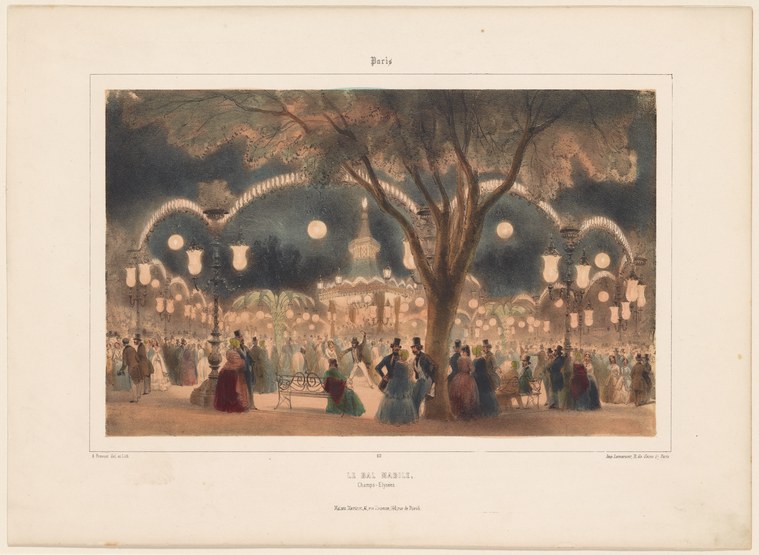
Le bal Mabile, Champs-Elysées
Unknown artist
- Collection:
- Prints depicting dance
- Source:
- New York Public Library
- Rights:
- Public domain — free to use, share and adapt.
- Recorded as:
- Public Domain
Mabilé represents a crucial moment in dance history—the rise of the commercial public ballroom and the democratization of ballroom dancing in the nineteenth century. As a lithograph, it is a primary visual document of how dance and public leisure were experienced, represented, and circulated as consumer images. For historians and dancers, it shows the sheer popularity and social centrality of ballroom dancing in the urban leisure culture of the period.
What you are looking at
A vast outdoor ball in a public garden or park at night, lit by gas lamps that glow against the dark sky. Hundreds of figures in evening dress fill the foreground and middle distance, many standing in small groups or couples, others in apparent conversation. The architecture of a grand pavilion or ballroom with ornate ironwork rises behind them, its bright windows and interior lights glowing warmly against the night. A large tree dominates the left side of the composition, its branches spreading across the upper portion of the scene. The crowd extends deep into the picture space, creating a sense of vast social gathering. The hand-coloring in warm tones—golds, flesh tones, and muted greens—emphasizes the festive, evening atmosphere. The overall mood is one of leisure and spectacle: a fashionable public event drawing crowds for an evening of music and dancing.
The dancing
The figures are rendered in miniature, making it impossible to discern precise footwork or holds, but their posture suggests a mix of promenading, standing conversation, and couples facing each other in the standard upright frame of ballroom dance. Many are oriented toward each other or toward the pavilion. The dress is uniformly formal: the men in dark suits and the women in long evening gowns with crinolines that create the silhouettes characteristic of mid-nineteenth-century fashion. No specific dance hold—waltz position, quadrille formation, or other—is clearly legible at this scale.
The dance depicted
This is Mabilé, the famous public dance hall at the Champs-Élysées in Paris, which opened in 1840 and operated through the mid-nineteenth century. Mabilé was known for both ballroom dancing and the quadrille in particular, especially the "Quadrille des Mouchoirs" and other spectacular staged variations performed by professional dancers. The scene shows the social dancing that accompanied such performances: couples and promenaders in a massive public ballroom lit by gas light. The sheer number of figures and the outdoor setting (or garden-adjacent setting) under lamps is consistent with Mabilé's famous spectacle and reputation as a destination for evening entertainment. The scale of the crowd and the prominence of the gas lighting are defining features of how this venue was perceived and depicted.
How it was made
This is a hand-colored lithograph, a technique that allowed rapid production and wide circulation. The composition and style suggest a French commercial print, likely from the 1840s–1850s. The outlines appear to have been drawn on stone and printed in a pale ink, then carefully colored by hand (or in workshop batches) with watercolor or gouache. Lithography's ability to render large crowds and atmospheric effects—the glow of the lamps, the night sky, the depth of the garden—made it ideal for this subject. Such prints were sold as popular souvenirs and records of fashionable Parisian life, reaching middle-class households and travelers.
About this work
This hand-colored lithograph documents Mabilé, the iconic Parisian public dance hall of the nineteenth century, at its height as a destination for fashionable evening entertainment. The work captures the scale and spectacle of the venue—a garden or garden-adjacent ballroom lit by gas lamps and crowded with hundreds of figures in formal evening dress. While individual dancers and specific dance steps are not legible at this distance, the image records the social world of mid-nineteenth-century ballroom dancing: the mingling of couples, the promenading, the architecture of leisure, and the technology of public illumination that made such evening events possible and desirable. Mabilé was famous for both the quadrille and the waltz, and for hosting both amateur dancers and professional performers.
How to look at it
Stand back from the image to absorb the scale and atmosphere rather than searching for legible footwork. The composition uses the large tree and the lit pavilion to create depth and focus the eye toward the center of the crowd. Notice how the artist has handled the gas lamps—small glowing circles that anchor the night setting and suggest both the real technology and the allure of evening leisure. The formality of the dress and the orderliness of the crowd, despite its size, communicate the respectability and fashionability of the event. The hand-coloring adds warmth and immediacy to what was a commercial print.
The period
Mabilé opened in 1840 at the Champs-Élysées and operated through the 1860s, becoming one of the most famous public dance venues in Europe. It coincided with the peak popularity of the waltz and quadrille in Parisian high society and the emerging public ballroom culture for the middle classes. The 1840s–1850s saw the rapid expansion of lithographic printing and hand-coloring as a mass-market medium for recording fashionable life, social events, and urban entertainment. The gas lighting visible in this print was itself a new technology that made evening public events more spectacular and more visible to artists and printers. Mabilé was celebrated in prints, literature, and gossip as the epitome of Parisian elegance and pleasure.
Where it lives
This work is held in the New York Public Library's collection of prints depicting dance, classified as a dance-related image but not separately catalogued with artist or date information. It is a commercial lithograph of the type mass-produced and sold in Paris during the mid-nineteenth century.
Dance in this work
Questions about this work
What was Mabilé and why was it famous?
Mabilé was a public dance hall that opened in 1840 on the Champs-Élysées in Paris and became one of the most celebrated entertainment venues of the era. It was known for both amateur social dancing and elaborate staged quadrille performances by professional dancers, particularly the 'Quadrille des Mouchoirs' and other variations. It attracted a fashionable crowd and was frequently depicted in prints and literature as the epitome of Parisian pleasure and modern leisure.
Can you see what dances people are doing in this image?
The figures are too small and distant to make out specific dance steps or positions with certainty. However, the formal dress, the upright postures, and the historical context strongly suggest waltzes and quadrilles, the two dominant ballroom dances of the period. The presence of both couples and larger group formations is consistent with how both dances coexisted in such venues.
How was this print made and distributed?
This is a hand-colored lithograph, a technique that allowed images to be drawn on stone, printed in quantity, and then colored by hand in workshop batches. Lithography was the dominant commercial print medium of the nineteenth century and made images like this affordable and widely available to middle-class Parisians and tourists as souvenirs and records of fashionable life.
When was this printed?
The catalogue record does not provide a date, but the style, subject, and technique suggest the 1840s–1850s, during Mabilé's peak years of operation and fame. The fashion and gas-lighting technology visible in the image are consistent with this period.
More dance artwork





