49 works in this view — arrow keys or swipe to move between them.
Dance in Art
Le philtre
Unknown artist
- Collection:
- Prints depicting dance
- Source:
- New York Public Library
- Rights:
- Public domain — free to use, share and adapt.
- Recorded as:
- Public Domain
This work shows how Romantic-era theatre used dance and physical pose to embody invisible forces—magic, love, enchantment—making the internal visible through extreme gesture. For historians of dance, it documents the aesthetic priorities of early 19th-century stage practice: the arch, the lift, the isolation of a single figure, and the use of the body to express narrative and emotion.
What you are looking at
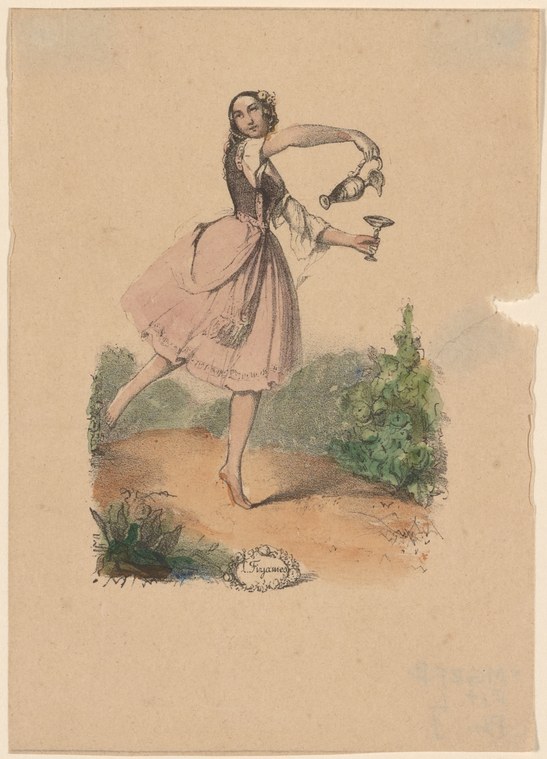
A young woman stands alone in a sunlit landscape, caught mid-movement in a moment of dramatic gesture. She wears a pale pink skirt and a dark bodice with long sleeves, her hair crowned with flowers and adorned with a ribbon or veil streaming behind her. Her body is arched backward in an exaggerated lean, one arm extended upward holding what appears to be a small vial or potion bottle—the "philtre" of the title—while her other arm curves gracefully at her side. The pose is supremely theatrical, her weight impossibly balanced on one leg with the other extended. She stands on bare earth scattered with small plants and stones; darker foliage frames the scene at left and right. The image is hand-colored, with soft greens and earth tones in the landscape and pale wash in the sky, giving the scene the quality of a romantic dream or fairy tale.
The dancing
The dancer's frame is entirely vertical and arched, creating an extreme backbend that reads as emotional rather than technical. Her supporting leg is nearly straight, suggesting classical training, while her free leg hangs in an easy extension. Both arms are lifted and separated, the upper arm creating a diagonal line of energy upward. The pose is one of abandon or rapture—the body surrendered to the power of the potion she holds. There is no partner, no ensemble; she is isolated in her emotional moment.
The dance depicted
This appears to be a theatrical or literary illustration rather than a documentation of actual dance technique. The pose—an extreme arch with extended limbs—evokes Romantic ballet vocabulary of the 1830s–1840s, particularly the arabesque or attitude, but executed here in service of narrative rather than technical display. The work illustrates a moment from theatre or literature (likely a ballet or pantomime) in which a character experiences the supernatural or magical effects of a love potion. The exaggerated backbend reads as emotional surrender or enchantment rather than a reproducible step.
How it was made
This is a hand-colored engraving or lithograph, most likely French, executed with fine line work in the figure and looser treatment in the landscape. The technique allows for the dramatic clarity of the figure against a softly rendered setting. The hand coloring—applied after printing—creates the pale, romantic palette typical of early 19th-century theatrical and literary illustration. The precision of the line work in the figure's anatomy and drapery and the soft handling of the setting suggest a professional reproductive print, possibly created for a theatrical program or illustrated book rather than a unique work.
About this work
This is a theatrical or literary illustration capturing a moment of magical transformation through dance. The woman's exaggerated arch and uplifted arms convey emotion and surrender rather than technical virtuosity, placing the image squarely in Romantic-era dance aesthetics. The title *Le philtre* (The Love Potion) signals that the dance is narrative and character-driven—a moment from a story or ballet rather than a generic dance scene. The image belongs in a dance gallery because it shows how movement and pose were used on stage to express interiority and the supernatural, and because it documents the Romantic ideal of the dancing body as a vehicle for emotion and magic rather than merely technical display.
How to look at it
Observe the extreme backward arch of the body and the way both arms lift away from the torso, creating a sense of rapture or surrender. The artist has chosen the moment of maximum emotional and physical extension, not a moment of balanced control. Notice how the potion bottle, held aloft, becomes the focal point—the source of the magic that has transformed the woman's body into this exaggerated, uncontrolled pose. The bare feet and the natural setting (rather than a ballroom or stage architecture) suggest a fairy-tale or fantastical world outside ordinary social space.
The artist
The artist is not recorded. The style and subject matter suggest a professional French theatrical illustrator working in the 1830s–1840s, when illustrated theatrical prints were a major art form and commodity. Such prints circulated widely among theatre-goers and readers of romantic literature, serving as both souvenirs and documents of stage design and performance.
The period
This image belongs to the Romantic era in European dance and theatre, a period (roughly 1820–1850) when ballet became absorbed in narrative, emotion, and the supernatural. Ballets such as *La Sylphide* (1832) and *Giselle* (1841) featured ethereal female characters, magical transformations, and poses of emotional extremity. The love potion was a common narrative device in Romantic literature and theatre. The aesthetic values visible here—the arch, the vertical line, the isolation of the figure, the association of dance with emotion and magic—are hallmarks of this period.
Where it lives
This work is held in the New York Public Library's collection of prints depicting dance. It is a reproductive print—a theatrical or literary illustration—intended for circulation and public viewing rather than a unique work of fine art.
Dance in this work
Questions about this work
What is a philtre?
A philtre (or philter) is a magical potion, typically one that induces love or desire. In Romantic-era theatre and literature, love potions were common plot devices used to explain sudden emotional or behavioral transformation. The woman's exaggerated physical abandon in this image suggests she has been overcome by the magical effects of the potion she holds.
Is this a real ballet?
Not necessarily a specific named ballet, though the style and subject matter align with Romantic ballet of the 1830s–1840s. It may illustrate a scene from a ballet, a pantomime, or a literary work adapted for the stage. Without additional documentation, we cannot identify the exact source.
What dance technique is she performing?
This is not a precise technical demonstration but rather a theatrical pose expressing emotion and narrative. The extreme arch and extended limbs draw on Romantic ballet vocabulary—particularly the arabesque and attitude—but are used here for emotional and magical effect rather than to show mastery of technique.
Why are her feet bare?
Bare feet in theatrical imagery of this period often signaled the supernatural, the natural world, or escape from social convention. They place the figure outside the ballroom or formal social space, emphasizing the magical or otherworldly nature of the moment.
More dance artwork





