49 works in this view — arrow keys or swipe to move between them.
Dance in Art
Fanny Cerrito; Theatrical portraits [on mount with review and reproductions]
Unknown artist
- Collection:
- Prints depicting dance
- Source:
- New York Public Library
- Rights:
- Public domain — free to use, share and adapt.
- Recorded as:
- Public Domain
Fanny Cerrito was a major figure in the development of romantic ballet and one of the first Italian dancers to achieve international stardom on the European stage. This portrait is valuable evidence of how dancers' images were circulated, commodified, and canonized in the 19th century, and of the aesthetic conventions—costume, posture, framing—that defined the public identity of a prima ballerina.
What you are looking at
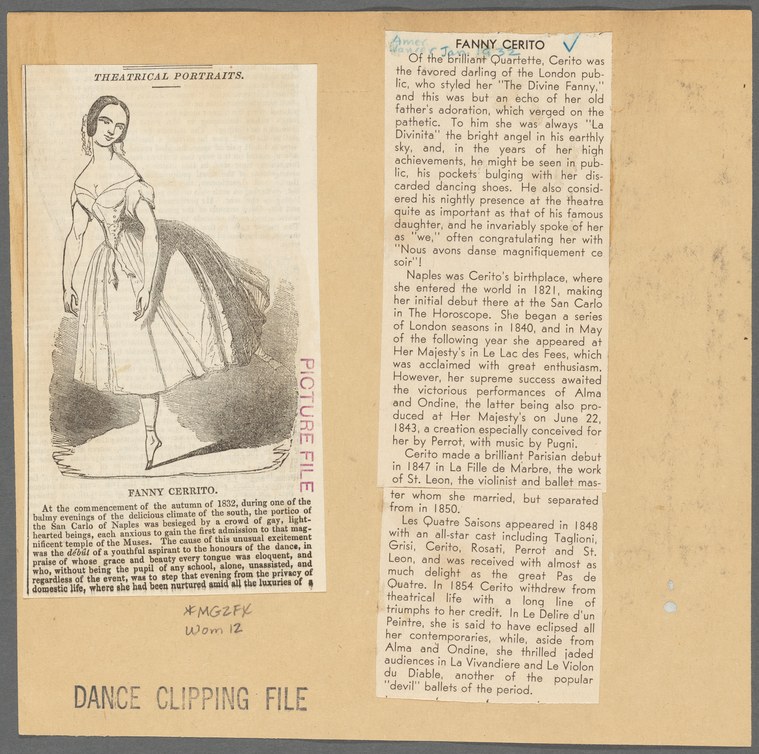
This is a theatrical portrait of Fanny Cerrito, a celebrated Italian ballerina of the 19th century, presented as an engraved figure study mounted with accompanying text. The dancer is shown in three-quarter view, standing in a composed pose wearing a romantic-era ballet costume: a fitted bodice, a bell-shaped skirt reaching to mid-calf, and pointe shoes. Her posture is upright and graceful, with one arm extended and the other positioned at her side in the refined port de bras characteristic of the period. The engraving employs fine lines and cross-hatching to render the volume and texture of the costume, with careful attention to the folds of the skirt and the delicate delineation of her upper body. She wears her dark hair pulled back, and her expression is serene and dignified. The mounted page includes a substantial biographical text on the reverse or adjoining area, establishing this as an educational theatrical print intended to commemorate the dancer's career and significance.
The dancing
Cerrito's frame is formal and perfectly balanced, her weight centered and grounded. Her arms are positioned in a classical ballet port de bras—one arm gently raised and extended, the other held gracefully at her side or on her hip. Her posture is erect with elongated line through her torso, and her legs are straight, with her weight distributed evenly. The pose suggests neither active movement nor dramatic gesture, but rather the dignified carriage expected of a prima ballerina in a formal portrait.
The dance depicted
This is a portrait of Fanny Cerrito (1817–1909), one of the most celebrated Italian ballerinas of the romantic period and a major figure in European ballet between 1840 and the 1860s. The biographical text confirms her international renown and her performances in London, Paris, and across Europe. The costume and pose are consistent with romantic ballet of the mid-19th century—the bell-shaped tutu, pointe shoes, and classical port de bras all situate her within the aesthetic of romantic ballet. The engraving captures not a moment from performance but the official image of a prima ballerina at the height of her fame.
How it was made
This is a wood or steel engraving, a reproductive process that allowed theatrical portraits to be widely distributed as prints and collectibles. The fine linear marks and cross-hatching are characteristic of engraving technique, which enabled high definition and the reproduction of subtle details in costume and physique. The mounting with printed biographical text suggests this was part of a bound or assembled series—'Theatrical Portraits' appears at the top—making it a commercial publication aimed at theater-goers, collectors, and those invested in theatrical culture. The text's length and the quality of the engraving indicate this was a premium product, circulated among educated audiences rather than as a cheap ephemeral print.
About this work
This is a mid-19th-century engraved theatrical portrait of Fanny Cerrito, one of Europe's leading romantic ballet dancers. The work combines a formally composed figure study in classical ballet costume with substantial biographical and career information, creating a commemorative object that served both as a celebrity portrait and as a historical record. The engraving documents not only Cerrito's appearance and the costume conventions of romantic ballet, but also the apparatus by which theatrical fame was managed and circulated in the 19th century—through collected prints, mounted biographical materials, and the veneration of individual dancers. This particular mount, labeled 'Dance Clipping File,' suggests it was assembled as part of a deliberate archive, a practice that preserved theatrical ephemera and made dance history tangible for later researchers.
How to look at it
Observe the formal, composed pose: this is not a dancer captured mid-movement, but a carefully arranged studio portrait intended to convey dignity and grace. The engraver has used fine cross-hatching to articulate the volume of the tutu and the refined structure of the bodice, demonstrating technical mastery of the medium. The text accompanying the portrait is as important as the image—read both together to understand how theatrical fame and legacy were documented and transmitted in this period.
The artist
The engraver is not recorded in the catalog. The work is part of a printed series titled 'Theatrical Portraits,' suggesting it was produced by a commercial publishing house as part of a systematic project to document leading performers of the era. Such series were common in the 19th century and often attributed to the print publisher rather than to individual engravers.
The period
This portrait dates from the peak of the romantic ballet era, approximately 1840–1860, when ballet was one of Europe's premier theatrical attractions and individual dancers achieved celebrity status comparable to opera singers. Romantic ballet emphasized ethereal, elevated movement, and costumes including the bell-shaped tutu and pointe work became standardized. The engraving format was the primary means of circulating theatrical images before photography became dominant; collected prints of celebrated performers were avidly purchased by middle- and upper-class audiences.
Where it lives
This mount is part of the New York Public Library's 'Dance Clipping File,' a collection assembled to preserve theatrical ephemera. The artifact comprises an engraved portrait plate, printed biographical text, and archival mounting, suggesting it was both a commercial object of its time and later treated as historically valuable material worthy of preservation.
Dance in this work
Questions about this work
Who was Fanny Cerrito?
Fanny Cerrito (1817–1909) was an Italian prima ballerina who became one of the most celebrated dancers of the romantic era. She was known for her technical brilliance, her dramatic abilities, and her international stardom, performing across Europe and collaborating with leading male dancers and choreographers of her time.
What does the costume tell us about romantic ballet?
The bell-shaped tutu, pointe shoes, fitted bodice, and the dancer's upright, graceful carriage are all hallmarks of romantic ballet aesthetic. This costume represented an idealization of femininity and ethereal movement that was central to the romantic period in dance (roughly 1830–1870).
Why was this portrait mounted with biographical text?
Theatrical portraits of the 19th century were often published as collectible prints with accompanying biographical information, serving as both souvenirs and historical records. This practice allowed theaters and print publishers to capitalize on performer celebrity while creating a distributed archive of theatrical culture.
What is the 'Dance Clipping File'?
The Dance Clipping File at the New York Public Library is an archival collection of theatrical ephemera—programs, prints, photographs, and mounted materials—assembled to preserve the history of dance as it was documented and distributed in its own time.
More dance artwork





