49 works in this view — arrow keys or swipe to move between them.
Dance in Art
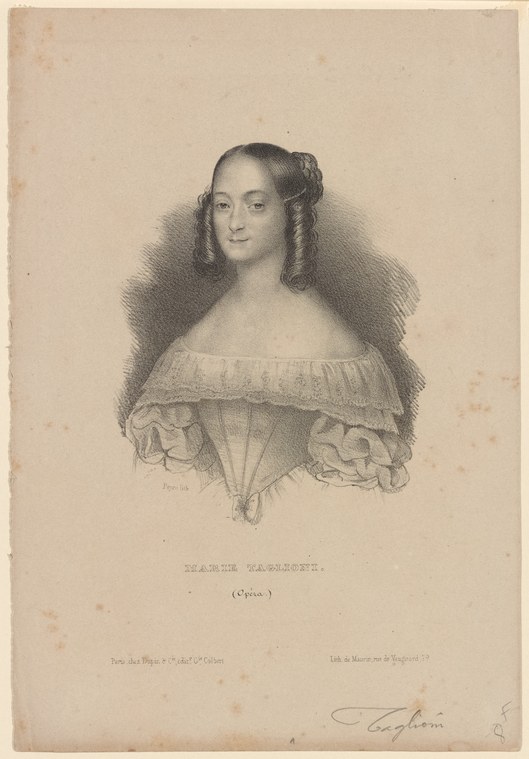
Marie Taglioni, Opéra
Unknown artist
- Collection:
- Prints depicting dance
- Source:
- New York Public Library
- Rights:
- Public domain — free to use, share and adapt.
- Recorded as:
- Public Domain
Taglioni's *La Sylphide* (1832) was the foundational work of Romantic ballet, and this portrait is evidence of how intensely her image was circulated and consumed during her lifetime. The engraving shows how ballet was marketed as spectacle and celebrity in the 19th century, and how the costume—the off-shoulder muslin dress and gauzy overskirt—became the visual shorthand for Romantic ballet itself.
What you are looking at
A half-length portrait of a young woman, shown against a neutral cream background with subtle shading that creates volumetric depth around the shoulders and neck. She is depicted in three-quarter view, turning her head slightly toward the viewer with a composed, serene expression. Her dark hair is arranged in ringlets and braids characteristic of the 1830s–1840s, with longer curls framing her face and a more elaborate arrangement at the back of the head. She wears a theatrical costume: an off-shoulder dress of white muslin or silk with a broad, ruffled neckline that exposes the collarbone and upper chest. The sleeves are short and puffed, and beneath the neckline is a fitted bodice with vertical pleating or fluting that creates a columnar silhouette. Over her shoulders is draped a gossamer shawl or veil—possibly the gauzy skirt of a romantic ballet tutu—that falls lightly away from the body. The image is executed as an engraving or lithograph, with fine hatching and cross-hatching to model the face and create shadow, and the print shows the wear and foxing consistent with a 19th-century work on paper.
The dancing
The dancer's posture is upright and serene, with the weight evenly distributed and the shoulders relaxed. Her arms are not visible, cropped below the frame—a compositional choice that emphasizes the head, neck, and the silhouette of the upper torso and costume. The lack of dynamic gesture or movement suggests this is a portrait of repose rather than a captured moment of performance, a convention of theatrical portraiture in which the sitter embodies the character or ideal of the role rather than enacting a specific step or sequence.
The dance depicted
The subject is identified in the inscription as Marie Taglioni (Opéra), the most celebrated ballerina of the Romantic era. Taglioni was the principal dancer of the Paris Opera and the international star of *La Sylphide* (1832), in which this image appears to show her costume. The off-shoulder dress, ruffled neckline, and gauzy overskirt are consistent with the sylph's costume as depicted in engravings and lithographs of the 1830s. This is not an action image but a costume study—a form of theatrical portraiture intended to document and publicize the appearance of the dancer in her most famous role.
How it was made
This is a lithograph or engraving, a mass-produced print medium that allowed for wide circulation and affordable distribution to a broad audience. The fine lines and hatching suggest stone lithography or steel engraving, both capable of capturing subtle tonal gradations. The technique's precision and the image's formal composition—centered bust within a rectangular frame—indicate it was produced as a commercial theatrical print, likely issued by a Paris publisher to capitalize on Taglioni's celebrity and to serve as a souvenir or fan memento.
About this work
This is a lithographic portrait of Marie Taglioni, the defining ballerina of the Romantic ballet era, depicted in the costume of the sylph from *La Sylphide*. The work is a theatrical portrait rather than a narrative scene, freezing the dancer in a moment of composed repose that was intended to present an ideal of grace and otherworldliness. It is a document of both fashion and dance culture: it records the appearance of the most celebrated dancer of her time in her most iconic role, and it demonstrates how 19th-century ballet audiences consumed dance through printed images, theatrical souvenirs, and the cult of the individual star dancer.
How to look at it
Attend to the costume: the ruffled off-shoulder neckline, the fitted bodice with vertical pleating, and the transparent overskirt are the key markers of Romantic ballet dress. The artist has chosen a moment of stillness and direct address—Taglioni meets the viewer's gaze with composure—rather than a dynamic movement. This is typical of theatrical portrait conventions, in which the sitter's authority and presence are conveyed through stillness and frontality rather than action. Notice also the fine detail of the ringlets and braids in the hair, rendered with precision to convey luxury and grooming, and the subtle shading around the face to suggest the dancer's delicate beauty.
The artist
The print is unsigned and the artist is unknown. Theatrical portraits were produced by commercial print publishers in Paris, Lyon, and London in considerable number during the 1830s and 1840s; the style and execution suggest a competent professional lithographer or engraver working in this market, but individual attribution is not possible without additional documentation.
The period
This image dates to the era of Romantic ballet, when the Paris Opera Ballet was at the height of its prestige and when individual dancers—especially *prima ballerinas*—became international celebrities. Taglioni dominated this period; *La Sylphide* premiered in 1832 and was her signature role for the rest of her dancing career. The off-shoulder Romantic tutu, the ethereal aesthetic, and the emphasis on the ballerina's weightlessness and otherworldliness were central to the ideology of Romantic ballet, which valued the illusion of the supernatural and the spiritual over technical display. Lithographic portraiture flourished in this period as a way to merchandise theatrical stars and to allow fans and collectors to own images of their favorite performers.
Where it lives
This work is held in the New York Public Library's collection of prints depicting dance. It is a lithograph or engraving, a form of commercial theatrical print produced in Paris in the 1830s–1840s.
Dance in this work
Questions about this work
Who was Marie Taglioni?
Taglioni (1804–1884) was the most famous ballerina of the 19th century and the defining dancer of the Romantic era. She was the star of the Paris Opera Ballet and created the role of the Sylph in *La Sylphide* (1832), a landmark work that established the aesthetic of Romantic ballet. Her fame extended across Europe, and her image was widely reproduced in prints.
What is *La Sylphide* and why is it important?
*La Sylphide* (1832) was the first great Romantic ballet and is still performed today. It tells the story of a mortal man's infatuation with a supernatural sylph, and the ballet's choreography, music, and visual design—especially the ethereal costume—became the template for Romantic ballet. Taglioni's performance in the role made her immortal.
Why is the costume off-shoulder and so diaphanous?
The Romantic tutu was designed to convey weightlessness, ethereality, and otherworldliness. The off-shoulder neckline and the transparent skirt were meant to create an illusion of the dancer as a spirit or supernatural being. This reflected the era's fascination with the supernatural and with ballet as an art form that transcended the human and the earthly.
How were dancers promoted in the 19th century?
Theatrical portraits like this one were mass-produced as lithographs and engravings and sold to the public as souvenirs and collectibles. Fans could buy prints of their favorite dancers in costume, much as people collect celebrity photographs today. This commercial trade in dancers' images was central to their fame and box-office appeal.
More dance artwork





