49 works in this view — arrow keys or swipe to move between them.
Dance in Art
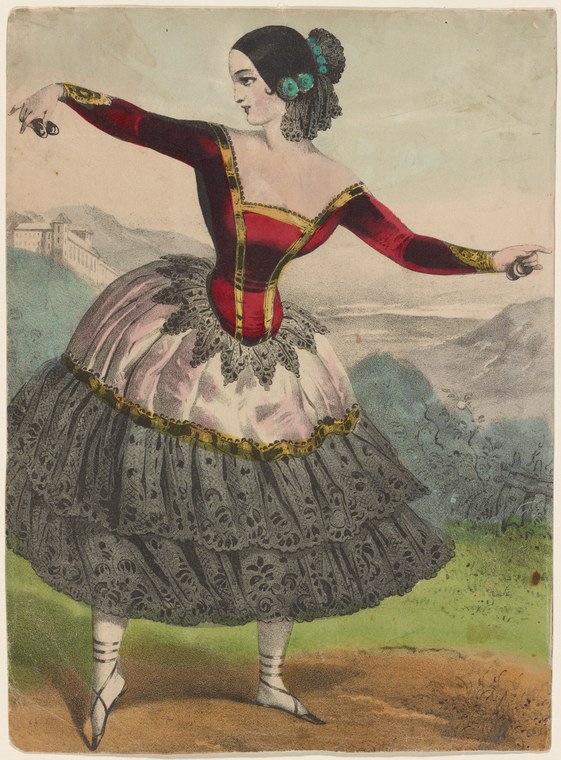
Mlle Augusta dancing the Cachucha
Unknown artist
- Collection:
- Prints depicting dance
- Source:
- New York Public Library
- Rights:
- Public domain — free to use, share and adapt.
- Recorded as:
- Public Domain
The Cachucha was one of the defining solo roles of Romantic ballet, performed by the era's greatest dancers and beloved by audiences across Europe and America. This print is a primary document of how the dance looked on stage, what a ballerina's costume and body position conveyed to contemporary viewers, and how the theatrical imagination transformed Spanish regional dance into an elite art form.
What you are looking at
A female dancer in theatrical costume strikes a dramatic pose against a mountainous landscape backdrop. She stands in profile, weight forward on her left leg en pointe, right leg extended behind in an arabesque line. Her upper body twists toward the viewer, both arms extended in an open, graceful frame—left arm reaching forward, right arm curved back. She wears a deep red velvet corsage or bodice with gold trim, beneath which swells a massive skirt of pale silk-like material, gathered and ruffled at the hem, layered with dark patterned lace or embroidered fabric creating a voluminous bell shape typical of mid-nineteenth-century theatrical dress. At her neck and in her dark hair pinned in a low knot are touches of blue-green, possibly feathers or ornament. The setting is an open landscape with soft greens and grays suggesting hills or mountains in the distance; the lighting is warm and diffused, creating no harsh shadows. The entire scene has the quality of a hand-colored lithograph or engraving, with softly graduated tones.
The dancing
A single female figure dominates the composition, her body arranged in a classical ballet pose that emphasizes extension and line. Her weight rides forward over a pointed left foot; the right leg extends behind in arabesque, creating the characteristic ballet silhouette of length and lift. Her arms form an open port de bras, with the left arm reaching forward at roughly shoulder height and the right arm curved back and slightly down, a configuration that balances the forward tilt of her torso and suggests sustained control rather than explosive movement. Her head is turned toward the viewer, profile view, with a composed, distant expression. The pose is held and displayed, not caught mid-action—this is a portrait of a dancer in a signature moment.
The dance depicted
This depicts the Cachucha, a popular Spanish or Spanish-influenced theatrical solo of the 1830s–1850s, most famously associated with the dancer Fanny Elssler. The pose and the theatrical context—the Romantic-era costume, the pointe work, the arabesque line—confirm this is a Romantic ballet representation. The title credits 'Mlle Augusta,' likely referring to Augusta Maywood or another prominent ballerina of that era who performed the Cachucha. The dance was originally a Spanish folk form but was absorbed into ballet repertory and became a showpiece for virtuoso female dancers; this image shows the ballet version in its theatrical refinement. The Cachucha was danced as a solo with castanets and often incorporated Spanish regional movement vocabulary alongside classical ballet technique.
How it was made
This is a hand-colored lithograph or possibly a hand-colored engraving, recognizable from the soft modeling of tone, the subtle gradations in the skirt and landscape, and the characteristic color palette of early-nineteenth-century theatrical prints. The medium allowed for mass production and relatively affordable distribution to audiences and collectors, making this the kind of image that circulated widely in theaters, print shops, and parlors. The hand-coloring gives each impression a slightly individual quality while maintaining the crispness of a printed line. The technique was suited to theatrical portraiture: it could capture fine details of costume and ornament while creating an idealized, luminous quality in the figure.
About this work
This is a theatrical portrait print of a Romantic-era ballerina performing the Cachucha, a Spanish-inflected solo that was a major vehicle for female virtuosity in the 1830s and 1840s. The work captures both the technical achievement (the arabesque, the pointe work) and the exotic theatrical fantasy (the voluminous layered skirt, the Spanish-influenced costume) that made Romantic ballet such a compelling spectacle. It belongs in a dance collection as evidence of how ballet absorbed and repackaged folk and regional forms, and how such dances were memorialized and promoted through the print culture of the period.
How to look at it
Notice how the artist has chosen an open, balanced pose rather than an action moment—this is a display of the dancer's line and beauty rather than a snapshot of virtuosity in motion. The extended arabesque and reaching arms create a sense of effortless grace and elevation, qualities that Romantic ballet prized above technical flash. Observe the costume: the massive skirt is not merely decorative but theatrical, designed to catch light and motion, to transform the dancer's leg work into a visual spectacle. The landscape setting, though distant and soft, removes the figure from any recognizable stage and places her in a realm of fantasy and aspiration—a visual trope of Romantic-era dance imagery.
The period
This print dates to the Romantic ballet era (c. 1830–1850), when European ballet underwent a radical transformation. Pointe work, gossamer tutus, ethereal narratives, and the cult of the ballerina as muse came to dominate the art form. Exotic and regional dances—Spanish, Italian, Scottish, Oriental—were incorporated as solos or character pieces that allowed ballerinas to display virtuosity while evoking fantasies of elsewhere. The Cachucha in particular became a star vehicle after Fanny Elssler's triumphs in Paris and London; it remained in the repertory for decades and was danced by leading ballerinas including Elssler, Carlotta Grisi, and others named Augusta or of comparable fame. Lithographic portraiture of famous dancers was a major commercial and social phenomenon, creating a celebrity culture around individual performers.
Where it lives
This work is held in the New York Public Library's prints collection, which specializes in theatrical and dance imagery from the eighteenth century onward. It is one of many such prints documenting celebrated dancers and roles of the Romantic ballet era.
Dance in this work
Questions about this work
What is the Cachucha?
The Cachucha is a Spanish solo dance that became a star vehicle in Romantic ballet during the 1830s–1850s. It combined Spanish regional movement and flavor (often danced with castanets) with classical ballet technique, and was performed by the era's greatest ballerinas as a showcase for virtuosity and exotic appeal. It remained popular in ballet repertory well into the twentieth century.
Why is the dancer on pointe?
Pointe work became standard for European female classical ballet in the early nineteenth century; it was relatively new and was seen as a marker of technical refinement and elite artistry. By the time this print was made, dancing on the points of the toes was the expected vocabulary for a professional ballet dancer, and it appears here as both technical accomplishment and aesthetic ideal.
Who was Mlle Augusta?
The catalogue does not identify the specific dancer, but she was likely one of the prominent ballerinas of the 1830s–1850s who performed the Cachucha. Augusta Maywood, a French-born dancer who became a star in Europe and America, is one possibility; there were also other dancers known by that name during the period. Without further documentation, the dancer's full identity cannot be confirmed.
How was this print made and distributed?
This is a hand-colored lithograph or engraving, a medium that allowed for relatively inexpensive mass production. Such prints were sold in theater lobbies, print shops, and through subscription, making famous dancers accessible as visual culture to a broad audience of theater-goers and collectors. Each hand-colored impression was slightly individual, giving purchasers a sense of owning a unique artifact.
More dance artwork





