49 works in this view — arrow keys or swipe to move between them.
Dance in Art
Fanny Elssler's favourite dances
Unknown artist
- Collection:
- Prints depicting dance
- Source:
- New York Public Library
- Rights:
- Public domain — free to use, share and adapt.
- Recorded as:
- Public Domain
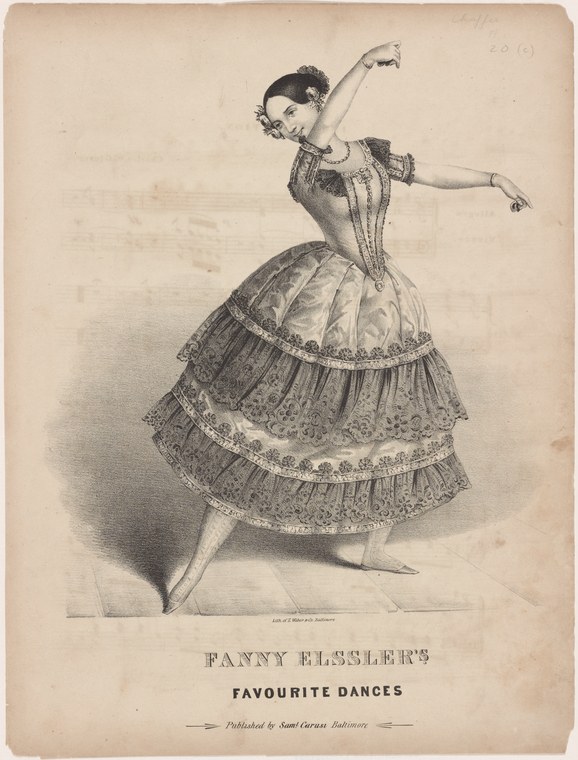
Fanny Elssler was one of the two most famous ballerinas of her era, and her American tours (1840–1842) were landmark events that introduced thousands of North Americans to Romantic ballet at the height of its popularity. This image, published during or shortly after her tour, is material evidence of her star power and of the commercial machinery that promoted dance to the public. For historians, it documents how a specific dancer was marketed, what her costume actually looked like, and how her virtuosity was understood and represented in the visual culture of her time.
What you are looking at
A female dancer in mid-performance, captured in a three-quarter view against a plain background. She wears a fitted dark bodice with short sleeves and ornamental detail across the chest, paired with a voluminous skirt composed of three deep tiers of white fabric trimmed with decorative borders and scalloped edges. The skirt is caught mid-swirl, creating a dramatic bell shape that extends to mid-calf, revealing her legs and feet in ballet slippers. Her dark hair is gathered up with what appears to be a decorative comb or ornament. Her right arm is raised overhead with the elbow bent, fingers delicately extended, while her left arm is extended outward at shoulder height. Her pose suggests a moment of spiraling or turning, with her weight on one leg and her body angled to create dynamic forward momentum. The print is a black-and-white engraving or lithograph, rendered with fine cross-hatching that gives the fabric substantial texture and shadow.
The dancing
A single female dancer in a turned-out stance, en relevé or on pointe, with her weight clearly supported on one working leg. Her supporting leg is extended and straight, while the upper body remains upright despite the rotational pose. Both arms are positioned in a soft, rounded frame typical of Romantic ballet—one arm curved overhead in an S-position, the other extended to the side at shoulder height with a gentle curve at the elbow. The fingertips are delicate and extended. Her head follows the line of the raised arm, creating the unified vertical line that defines ballet carriage of the mid-19th century. The pose reads as a pirouette or sustained turn captured mid-action.
The dance depicted
This is romantic-era ballet, almost certainly depicting the classical style that dominated European stages in the 1830s–1850s. The title references Fanny Elssler, the celebrated Austrian ballerina who was one of the great stars of this period and a rival to Marie Taglioni. Elssler was known for her technical precision, speed, and elevation, as well as for her performances of character dances and national variations alongside classical roles. The costume—the fitted bodice, the three-tiered skirt with ornamental trim, the short sleeves—is consistent with the formal ballet costume of the Romantic period. The pose and frame suggest a classical variation or solo, possibly a moment from one of her signature roles or a technically demanding piece that showcased her pirouettes and turns.
How it was made
This is a black-and-white engraving or lithograph, judging from the fine parallel line-work (cross-hatching) used to model form and shadow, particularly in the folds of the skirt and the bodice. The technique suggests mechanical reproduction rather than a unique print; multiple impressions would have been pulled from the same plate or stone. The inscription at the base reads 'Fanny Elssler's Favourite Dances' and credits 'Published by S. & Craner, Baltimore.' This indicates the work was produced for commercial circulation in the United States, likely as a souvenir or promotional image during or after one of Elssler's American tours (she visited the U.S. in 1840–1842). The high finish and careful rendering suggest it was aimed at a middle-class audience familiar with theatre and able to afford framed prints.
About this work
This is a portrait of the Romantic-era ballerina Fanny Elssler, rendered as a promotional engraving by an American publisher during the height of her fame. It documents both a specific dancer and a moment in ballet history when European celebrities toured North America and their images were reproduced and sold to enthusiastic fans. The print captures the aesthetic of Romantic ballet—the ethereal, turned-out posture, the ornate short skirt, the delicate arm position—while also serving as a commercial image that made Elssler's celebrity tangible to an American public. It belongs in a dance archive as evidence of 19th-century ballet performance, of the celebrity culture surrounding dance, and of how dance images were produced and consumed.
How to look at it
Notice the artist's attention to the technical detail of the skirt—the way the three tiers are individually rendered, the decorative scalloped borders, the way the fabric is caught in motion and shows depth through cross-hatching. This specificity tells us the engraver understood and valued the visual distinctiveness of ballet costume. Look at her posture: her spine is perfectly upright, her weight is centered over a single supporting leg, and her arms are held with a soft curve and lifted frame—these are hallmarks of trained ballet technique. The raised arm and turned head create a moment of rotation or spin, frozen at an instant of balance and control. The plain background isolates the figure and emphasizes her silhouette, a convention of 19th-century theatrical portraiture that made the dancer herself the subject, not the stage.
The artist
The artist is not recorded in the catalogue, but the print was published by S. & Craner of Baltimore. The engraving style and quality suggest a professional theatrical print shop operating in the mid-19th century American market. Such publishers typically employed skilled engravers and worked from original drawings or paintings by theatre artists, often working from life sketches or existing portraits. The anonymous engraver would have been familiar with depicting dancers and understood how to render the technical and aesthetic details of Romantic ballet costume and pose.
The period
This print dates to the Romantic ballet era, when the genre dominated European and American theatrical stages. Ballet had become fashionable with a broad middle-class audience, and famous dancers—especially female principal dancers—were celebrities whose likenesses were widely reproduced and sold. Fanny Elssler's American tour (1840–1842) was a major cultural event, comparable in scale to the later success of Anna Pavlova. At the same time, printmaking and lithography had made theatrical portraiture affordable and accessible; a middle-class theatre-goer could purchase an engraved souvenir of their favourite star for a few cents. This image sits at the intersection of celebrity culture, theatrical tourism, and mass commercial reproduction.
Where it lives
The print is held in the New York Public Library's collection of prints depicting dance, part of the Library's broader holdings on theatre and performance. It is a commercial engraving, one of what was likely a large print run, and its survival reflects its popularity and circulation in 19th-century America.
Dance in this work
Questions about this work
Who was Fanny Elssler?
Fanny Elssler (1810–1884) was an Austrian ballerina and one of the two greatest stars of the Romantic ballet era, alongside the French dancer Marie Taglioni. She was celebrated for her technical brilliance, her speed and elevation, and her dramatic presence. She was also known for her character dances and national variations—particularly a famous Cachucha—which showcased a different side of her artistry. Her American tour in 1840–1842 was a landmark event that introduced thousands of North Americans to ballet at the height of its popularity.
What was Romantic ballet?
Romantic ballet, which dominated the 1830s–1850s, was a theatrical style that emphasized ethereal beauty, poetic narratives (often involving supernatural or exotic subjects), and the technical virtuosity of the female dancer. The costume—the short, full skirt (eventually the tutu), the fitted bodice, the pale tights and soft ballet slippers—became the standard uniform of classical ballet and is still recognizable today. Female dancers were elevated to the status of principal artists, and stars like Taglioni and Elssler became celebrities.
How do we know this is a commercial print?
The inscription at the base identifies it as 'Published by S. & Craner, Baltimore,' which means it was produced by a commercial theatre print shop for sale to the public. The engraving technique—fine parallel lines creating tone and shadow—is consistent with mass-produced theatrical portraiture of the 1830s–1840s. Multiple impressions would have been pulled from the same plate and sold to fans and theatre-goers, making Elssler's image affordable and accessible.
What does her pose tell us about ballet technique?
Her upright spine, turned-out legs, lifted arms, and apparent single-leg support reveal the fundamental principles of classical ballet training: verticality, rotation, control, and grace. The moment captured—a sustained turn or pirouette—was a signature display of technical skill. The delicate arm position and soft frame convey the aesthetic of Romantic ballet, which valued beauty and fluidity alongside technical precision.
More dance artwork





