49 works in this view — arrow keys or swipe to move between them.
Dance in Art
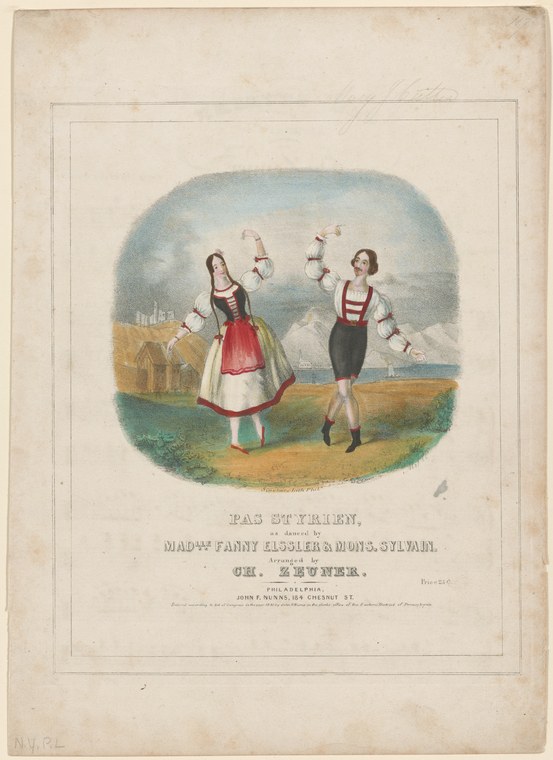
Pas styrien, as danced by Madlle. Fanny Elssler & Mons. Sylvain
Unknown artist
- Collection:
- Prints depicting dance
- Source:
- New York Public Library
- Rights:
- Public domain — free to use, share and adapt.
- Recorded as:
- Public Domain
This image is crucial evidence for understanding how Romantic-era ballet was marketed, remembered, and consumed by the public. It shows us not a moment of choreographic innovation but a moment of theatrical presentation—the pose and costume that audiences paid to see and then took home as a souvenir. For dance historians, it reveals how the Pas Styrien was staged: the flower garlands, the symmetrical partnering, and the frank address to the audience are all features of the divertissement tradition that dominated ballet's relation to folk dance.
What you are looking at
A hand-colored lithograph or engraving depicting two dancers in a pastoral outdoor setting. On the left stands a woman in traditional Alpine costume: a black bodice with white puffed sleeves, a red skirt, and a white apron. She holds a small bouquet or garland of flowers in each raised hand. To her right, a male dancer in black knee breeches, white stockings, and a red and white embroidered waistcoat or jacket mirrors her pose with arms raised, also holding flowers. Behind them stretches a landscape with rolling hills, a distant village or settlement, and a blue-grey sky. The figures are centered in an oval vignette framed by a double-line border. The composition emphasizes symmetry and parallel positioning, suggesting a formal courtship or celebratory moment characteristic of folk dance display pieces.
The dancing
Both dancers stand upright with arms raised to approximately shoulder height, holding flower garlands. Their bodies face forward toward the viewer rather than toward each other, suggesting a presentation pose rather than an intimate encounter. The woman's posture is open and frontal; the man mirrors this orientation exactly. The raised-arm position and the small objects held in the hands—flowers or decorated wreaths—are the primary narrative and gestural content. Neither figure leans, turns sharply, or displays the dynamic weight shifts of a waltz or turning figure; instead, both occupy a stable, stationary position that emphasizes the costume and the flowers as focal points.
The dance depicted
The title identifies this as the Pas Styrien, a couple dance from the Alpine (Styria/Steiermark) region, as danced by the celebrated French-Austrian ballerina Fanny Elssler and her partner Monsieur Sylvain. The Pas Styrien was a showpiece of the Romantic ballet era, typically performed as a divertissement in theatrical productions. It drew on folk material from the Styrian region but was formalized and theatricalized for the concert stage. The image captures not the narrative movement of the dance itself—no leap, turn, or rhythmic step is evident—but rather the opening or closing attitude: the formal presentation of the two dancers in their regional costume, holding flowers as tokens of courtship or celebration. This was a staple image type for marketing star performers of the era.
How it was made
This is a hand-colored lithograph or tinted engraving, evidenced by the soft gradation of color (particularly in the sky), the linear border, and the regular hatching visible in the background. The technique allowed for relatively rapid, affordable reproduction and wide distribution as a marketing image. Color was applied by hand after printing, which explains minor variations in saturation and occasional color register shifts. This was the dominant format for theatrical publicity and celebrity portraiture in the 1830s–1840s, appealing to urban audiences who attended or wished to attend ballet performances. The image was likely sold individually as a souvenir or collected in theatrical scrapbooks.
About this work
This is a promotional image of Fanny Elssler, one of the greatest ballet stars of the Romantic era, in the role of the female dancer in the Pas Styrien. The work documents both the star system of 19th-century ballet and the taste for folk-inflected choreography that characterized mid-Romantic ballet. Elssler (1810–1884) was celebrated across Europe and America for her technical brilliance and earthy, spirited performance style—qualities this image attempts to convey through the confident frontal pose and the Alpine costume with its bright red skirt. The Pas Styrien itself was a vehicle for displaying both classical training and folk authenticity, appealing to the period's growing interest in European regional cultures. The image is one of hundreds of similar prints that created and circulated the visual identity of the Romantic ballet star.
How to look at it
Look at the symmetry: the artist has positioned the two dancers as mirror images, neither dominant, both presenting their bodies to the viewer. This frontal, symmetrical composition is typical of folk-derived or character dance presentations in the ballet of this era—the choreography is being presented for inspection rather than narrated as a dramatic moment. Notice the costume detail: the embroidered waistcoat, the puffed sleeves, the red skirt are all the genuine materials of Alpine folk dress, or close approximations, indicating that the Pas Styrien aspired to authenticity even in its theatricalized form. The flowers are the narrative key: they signal courtship, celebration, and the benign, festive mood of the piece. Finally, observe Elssler's face and posture: confident, frontal, meeting the viewer's eye—this is a star taking her bow, not a character lost in a story.
The artist
The artist is not recorded in the catalogue. The lithograph was published by John F. Newall at 46 Cheapside, London, placing it within the London theatrical print trade of the 1830s–1840s. Newall was a commercial publisher specializing in theatrical portraiture and dance prints. The quality of the drawing and hand-coloring suggests a competent professional workshop rather than a fine artist, and the image is likely derived from a theatrical sketch or a daguerreotype rather than a life study.
The period
The 1830s and 1840s were the height of the Romantic ballet era. Fanny Elssler emerged in this period as a rival to Marie Taglioni, each embodying different ideals: Taglioni the ethereal, airborne sylph; Elssler the grounded, sensual, technically brilliant performer. Elssler's signature roles—the Sylphide, La Gitana, and roles in folk-inflected divertissements like the Pas Styrien—showcased her ability to combine classical technique with character and earthiness. The Pas Styrien itself reflected the period's fascination with the Alpine regions, part of broader Romantic interest in folk culture, nationalism, and picturesque landscape. The lithographic print trade boomed during this era, making theatrical images accessible to the middle-class public who could not always afford a theater ticket but could afford a penny or shilling print.
Where it lives
The work is held in the Prints depicting dance collection at the New York Public Library. It is a published theatrical print, one of thousands that circulated as individual sheets or were bound into scrapbooks and theatrical archives. The publisher, John F. Newall, was based in London, suggesting this was sold to a British or Anglo-American audience.
Dance in this work
Questions about this work
Who was Fanny Elssler?
Fanny Elssler (1810–1884) was an Austrian dancer who became one of the greatest ballet stars of the Romantic era. She was technically brilliant, and her style was known for its earthiness, sensuality, and character. She rivaled Marie Taglioni as the preeminent ballerina of the 1830s–1840s. Her career took her across Europe and to the United States, where she was celebrated as a celebrity performer.
What is a Pas Styrien?
The Pas Styrien is a couple dance derived from Alpine folk tradition, choreographed for the concert stage. 'Pas' means 'step' or 'dance,' and 'Styrien' refers to Styria (Steiermark), a region in Austria. It typically featured a woman and man in folk costume performing a formal, symmetrical dance with character and earthy charm. It was a popular divertissement—a standalone showcase number—in the ballet of the 1830s–1850s.
Why were these prints made?
Theatrical prints were made to promote performances, to preserve the memory of celebrated performances, and to satisfy the demand of the public for images of star performers. They functioned much as today's posters, lobby cards, and celebrity photographs do. A single performance might generate multiple prints, sold individually or collected. They were affordable souvenirs for theater-goers and important tools for the theater trade.
What technique was used to make this print?
This is a lithograph or tinted engraving printed in black and then hand-colored with watercolor or gouache. The hand-coloring explains why each print is slightly different. This hybrid method was cost-effective and allowed rapid production in the theater district of London, where prints were in high demand.
More dance artwork





