49 works in this view — arrow keys or swipe to move between them.
Dance in Art
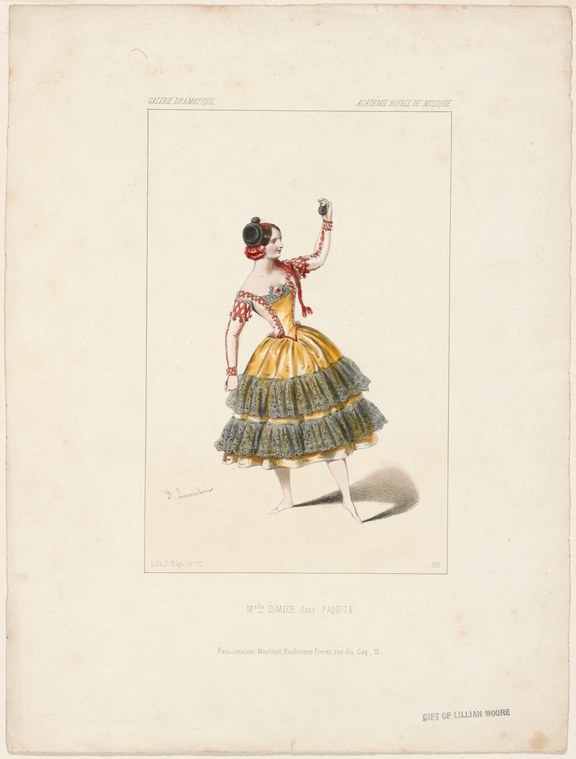
Melle. Dimier, dans Paquita.: Académie Royale de Musique
Unknown artist
- Collection:
- Prints depicting dance
- Source:
- New York Public Library
- Rights:
- Public domain — free to use, share and adapt.
- Recorded as:
- Public Domain
This is a dated, named record of a specific dancer in a specific ballet at a specific theater—exactly the kind of material that anchors theater history and performance genealogy. The print shows what early Romantic ballet costume actually looked like on a stage dancer, and how the body was posed and promoted to audiences, making it invaluable evidence for understanding performance practice and the visual culture of the Opéra.
What you are looking at
A solo female dancer in theatrical dress stands in a three-quarter pose against a plain background, her body angled away but her face turned toward the viewer. She wears a yellow silk skirt with two tiers of gray lace or gauze flounces, their edges articulated with fine parallel lines suggesting pleating or gathering. Her upper body is fitted: a white corseted bodice with red or coral sleeves and decorative frogging across the front. A red hat with a dark brim and plume sits at an angle on her dark hair. Her arms are raised in a graceful attitude, the right arm extended upward and slightly back with the palm open and relaxed, the left arm curved across her body. Her weight appears settled on her right leg, the left slightly bent and extended. The pose has an arrested quality—not quite a full extension, but a moment of display. The background is plain paper without scenery or props. The whole composition is rendered with refined color work, hand-finished with watercolor or gouache over what appears to be a lithographic base.
The dancing
A single dancer in a lyrical, almost balletic attitude: the body held upright and composed, the arms soft and open rather than holding a partner. The right arm rises in an arabesque-like gesture; the left curves inward in a supported frame. The weight distribution and the slight curve through the torso suggest a balletic port de bras and épaulement—the characteristic carriage that marks classical ballet technique. The extended left leg and the angle of the body suggest a moment between steps, a pose chosen for its elegance rather than its action.
The dance depicted
This appears to be a costume study or portrait of a dancer in a romantic-era ballet, most likely from the 1830s–1840s Paris Opéra. The dress—the full skirt, the corseted waist, the theatrical sleeves, the hat as headdress—matches the silhouette of early Romantic ballet, and the pose is consistent with the port de bras and stance taught in classical technique of that period. The inscription identifies the subject as Melle. Dimier dancing in *Paquita*, a ballet choreographed by Joseph Mazilier and first performed at the Académie Royale de Musique (the Paris Opéra) in 1846. Without seeing the full costume of the ballet as performed, we cannot determine her exact role—she may be dancing the title role or a secondary part in the corps or soloists—but her solitary, composed stance suggests a featured role.
How it was made
This is a hand-colored lithograph, a technique that allowed rapid mass production of theatrical portraits while maintaining fine detail and rich color. The base image appears to have been drawn on stone and printed in one or more passes; the costume colors—the yellow silk, the red sleeves, the gray lace—were then applied by hand to individual impressions. This technique was standard for dancers' likenesses in the 1830s–1850s, circulated to fans and sold in theater lobbies and print shops, making them accessible to a broad audience beyond the aristocracy. The quality of finish and the presence of a publisher's name at bottom suggest a professional theatrical print house rather than fine art reproduction.
About this work
This is a theatrical portrait of a named dancer in a named ballet at a named venue: historical evidence rendered as image. Melle. Dimier danced in *Paquita* at the Académie Royale de Musique, Paris; this print recorded her in that role for circulation and sale. It belongs to a vast visual archive of 19th-century ballet that documented dancers' fame and bodies at a moment when dance was increasingly professionalized and commodified. The image shows us not only the costume and pose but also the conventions of how dancers were represented: the isolation, the graceful attitude, the emphasis on the line of the body, the formal distance between dancer and viewer. For students of dance history, theatrical portraiture, and 19th-century ballet aesthetics, prints like this are primary sources of practice and style.
How to look at it
Note the stillness and formal address: Dimier is not caught mid-gesture but posed for view, facing the viewer across the paper's plane. The attitude of the arms—one raised, one curved—is a display of the dancer's line and the period's ideal of grace: the body arranged for maximum elegance rather than maximum motion. The detail lavished on the costume—the hand-colored yellow silk, the individual pleats and lace, the frogging of the bodice—shows what the audience came to see: the outfit as much as the body. This is theatrical documentation in the service of fame.
The artist
The artist is not recorded in the catalogue. The print was published by Martinet, a major Parisian theatrical print publisher and lithographer of the 1830s–1860s. Martinet's workshop produced portraits of dancers, actors, and singers throughout this period, establishing a visual archive of performance that influenced how the public knew performers before photography became standard.
The period
This print dates to the height of Romantic ballet, when the Paris Opéra was the dominant force in European dance and ballerinas—particularly dancers like Marie Taglioni and, later, Carlotta Grisi—were international celebrities. *Paquita* (1846) was a vehicle for the newly fashionable Spanish flavor in European dance: it featured Spanish-derived choreography and costumes, part of the Romantic era's fascination with exotic and national subjects. Theatrical portraiture was at its peak; lithographic printing had made dancers' images affordable and collectible, and dancers' portraits were as common in parlors as autographed playbills.
Where it lives
The print is held in the New York Public Library's collection of prints depicting dance, catalogued as a gift from Lillian Moore, a major 20th-century dance historian whose personal collection of dance imagery became foundational to the NYPL's holdings.
Dance in this work
Questions about this work
What ballet is this from?
*Paquita*, choreographed by Joseph Mazilier, premiered at the Académie Royale de Musique (Paris Opéra) in 1846. The ballet was set in Spain and became a popular vehicle for dancers seeking to showcase technical brilliance and dramatic presence. It survives in later versions, including the Ballets Russes adaptation and contemporary stagings.
Who was Melle. Dimier?
The historical record of Dimier is limited; she was a dancer at the Paris Opéra in the 1840s, but detailed biographical information is scarce. This print is one of the primary records of her work. Such theatrical portraits were the main way dancers' images circulated and were preserved before photography.
How was this print made?
It is a hand-colored lithograph: an image drawn or transferred onto a stone, printed in black or pale ink, and then hand-colored with watercolor or gouache. This technique allowed mass production while maintaining the quality and finish expected for theatrical promotion. A skilled colorist would apply the colors to multiple impressions by hand, making each copy slightly individual.
What does the costume tell us?
The dress—full skirt with lace flounces, fitted bodice, decorative sleeves, feathered hat—is characteristic of 1840s Romantic ballet. The Spanish inflection (the feathered hat, the style of the frogging) reflects the ballet's setting. For costume historians and dancers, such images are primary evidence of how ballet dress was actually constructed and worn on stage.
More dance artwork





