49 works in this view — arrow keys or swipe to move between them.
Dance in Art
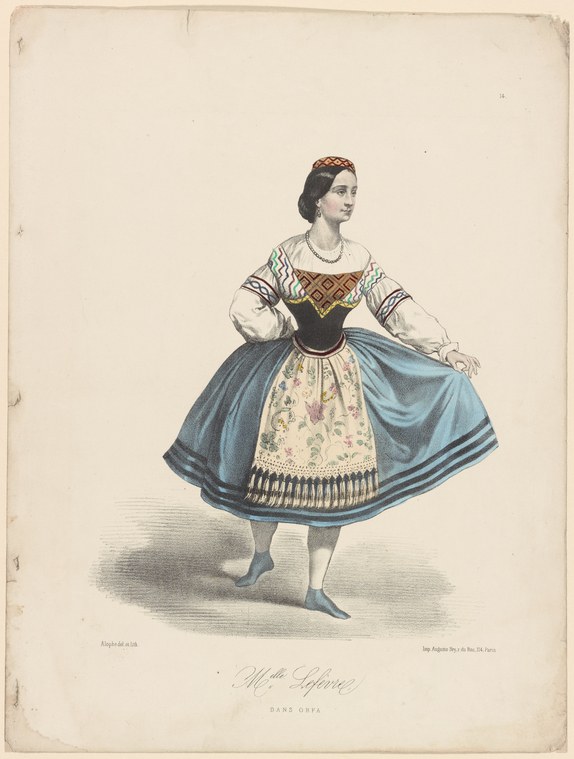
Melle Lefèvre, dans Orfa
Unknown artist
- Collection:
- Prints depicting dance
- Source:
- New York Public Library
- Rights:
- Public domain — free to use, share and adapt.
- Recorded as:
- Public Domain
This work is one of thousands of theatrical portraits produced in the nineteenth century, yet the survival of the sitter's name and the specificity of the role make it a rare document of an individual performer's repertory. For historians of Romantic ballet and theatrical dance, such portraits provide crucial visual evidence of how dancers were dressed, presented, and marketed to audiences, and they remain among the few records we have of many now-forgotten dancers and roles.
What you are looking at
A single female dancer is shown in a three-quarter pose against a plain background, wearing the costume of a mid-nineteenth-century European theatrical dancer. She wears a white chemise with puffed sleeves decorated with a geometric pattern in red and black, a black corset or bodice cinching the waist, and a full skirt in pale blue with horizontal stripes and a decorative border at the hem. Her dark hair is pulled back and topped with what appears to be a small headdress or ornament. She holds her skirt out to one side with her right hand, displaying the voluminous fabric, while her left arm hangs naturally. Her pose suggests a moment of stillness or pause rather than active movement—a presentation pose typical of theatrical portraiture of the era. The figure is rendered with delicate hand-coloring in watercolor or similar medium over what appears to be a lithographic base, giving the print both the precision of the printed line and the subtlety of applied pigment.
The dancing
The dancer stands in a relaxed contrapposto with her weight on one leg, the other leg free and slightly advanced. Her upper body is upright but not rigid, and her gaze is directed to the left, away from the viewer. The pose emphasizes the costume rather than demonstrating active choreography: this is a presentation of dress and figure rather than a moment of dynamic movement. Her arm positions—one hand lifting the skirt, one at her side—are modest and controlled, consistent with the decorum expected of a mid-nineteenth-century theatrical dancer.
The dance depicted
This is a theatrical portrait of a named dancer, Melle Lefèvre, most likely in a role titled "Orfa" (the inscription reads "Melle Lefèvre dans Orfa"). The work documents a specific theatrical role, but the pose itself reveals little about the movement vocabulary of that role. The costume—a Romantic-era tunic with puffed sleeves, corseted waist, and full skirt—suggests a European balletic or theatrical dance context of the mid-nineteenth century, consistent with Romantic ballet aesthetics. Without more information about the role of Orfa, the specific dance forms employed cannot be determined from the image alone, though the theatrical and balletic context is evident.
How it was made
This is a hand-colored lithographic print, a technology and format that dominated theatrical portraiture in Europe from the 1830s to 1860s. The process combined a lithographic base (allowing precise rendering of costume detail and facial features) with subsequent hand-coloring in watercolor or gouache, applied selectively to enhance the figure against the plain ground. This hybrid technique was economical enough to allow mass production of theatrical portraits for sale to audiences, yet retained enough manual skill to give each print subtle variation and immediacy. The technique had a wide circulation among theaters and their audiences across Europe and America.
About this work
This is a mid-nineteenth-century hand-colored lithographic portrait of a theatrical dancer named Melle Lefèvre performing in a role titled "Orfa." The work documents both the costume conventions of Romantic-era theatrical dance and the practice of circulating named portraits of performers to audiences. The figure is rendered in the presentation style typical of theatrical portraiture: a static, frontal pose that prioritizes the display of costume over the representation of movement. The inscription links the image to a specific performance, though the date and location of that performance are not recorded. As a document of theatrical practice and dress, and as a printed artifact of the mid-nineteenth-century theater-going public, it belongs in a gallery of dance in art.
How to look at it
Attend to the costume in detail: the geometric pattern on the sleeves, the construction of the skirt, the delicate embellishment at the hem. These details document how dancers were actually dressed on stage. Notice also the pose—a stillness that contrasts with the energy of actual dance. This is not a moment captured mid-movement, but rather a formal presentation, the theatrical equivalent of a photographic portrait sitting. The hand-coloring creates depth and dimensionality that the black lithographic line alone could not achieve, and the selective use of color (the blue skirt, the red pattern on the sleeves) guides the viewer's eye to the costume.
The artist
The artist is not recorded in the catalogue, but the print bears a printer's or publisher's mark at the bottom (partially visible as "Imp. Lith. [?]"). Hand-colored lithographic portraits of dancers were typically produced by commercial theatrical print publishers operating from major cities—Paris, London, Berlin, and Vienna were centers of production. These publishers employed teams of lithographers and colorists to meet demand from audiences who attended theaters in the evening and purchased prints the next day.
The period
This portrait dates to the Romantic era of European ballet, roughly 1830–1860, when the dancer's body had become a central subject of theatrical spectacle and commercial portraiture. During this period, the development of gas lighting in theaters, the rise of the star system, and the growth of an urban middle-class audience created both the demand and the market for theatrical prints. The costume—with its puffed sleeves, corseted waist, and knee-length skirt—is consistent with the Romantic ballet silhouette that emerged with works like La Sylphide (1832). The role of Orfa is not identified in standard ballet histories, suggesting it may have been a minor work, a regional production, or a work that did not survive into the twentieth century.
Where it lives
The work is held in the Prints collection at the New York Public Library, part of a larger collection of theatrical portraiture from the nineteenth century. It is catalogued as a print depicting dance, reflecting its function as a commercial theatrical document rather than a fine art object.
Dance in this work
Questions about this work
Who was Melle Lefèvre?
The catalogue record provides only the name and the role title. No other biographical information is recorded. She was likely a professional dancer working in Europe in the mid-nineteenth century, but beyond this portrait, details of her career, training, or repertory have not survived in the available record.
What was the role of Orfa?
The role is not identified in standard ballet or theatrical histories. It may have been a work performed in a minor theater or regional center, or a work that fell out of the repertory and left no other record. The costume suggests a Romantic ballet aesthetic, but without documentation of the work itself, its plot, choreography, or music cannot be determined.
How were these portraits made and sold?
Theatrical portraits were produced by commercial lithographic publishers, typically in major cities. They were hand-colored after printing, which allowed variation and added prestige. They were sold in theaters, music shops, and on the street to audiences who had just seen a performance, making them one of the primary means by which theatrical images circulated among the urban public before photography.
Why are there so many unnamed prints like this one?
Many theatrical portraits were printed without an artist's signature or attribution. Lithographic printing was a commercial, collaborative process involving printers, colorists, and publishers, and the individual contributions were often not recorded. In addition, many prints were damaged, lost, or discarded, and those that survive often lack documentation about their makers.
More dance artwork





