49 works in this view — arrow keys or swipe to move between them.
Dance in Art
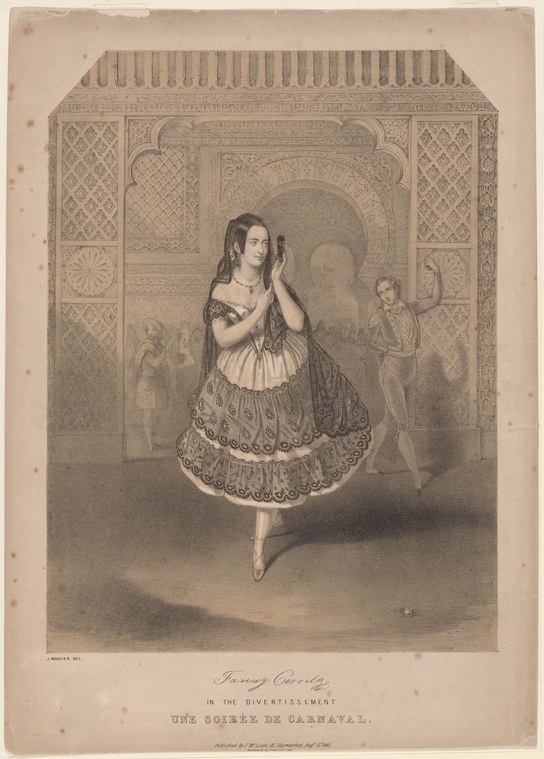
Fanny Cerrito [facsimile signature] in the divertissement Une soirée de carnaval
Unknown artist
- Collection:
- Prints depicting dance
- Source:
- New York Public Library
- Rights:
- Public domain — free to use, share and adapt.
- Recorded as:
- Public Domain
Cerrito was one of the defining interpreters of Romantic ballet technique and expressivity; this print documents both her prominence as a performer and the visual aesthetics that defined her era's dance. The image reveals how mid-nineteenth-century ballet was marketed and consumed through theatrical prints, shaping public memory and appetite for the art form.
What you are looking at
A young woman in performance costume stands alone in an ornate interior space, caught mid-movement with her body angled toward the viewer. She wears a tiered, heavily embellished skirt with scalloped edges and decorative patterns that rises to a fitted bodice, her dark hair pulled back and adorned. Her left arm is raised toward her head in a graceful gesture; her right arm hangs at her side. She stands on the balls of her feet in a light, lifted pose. The architectural setting behind her is lavishly decorated with patterned wall panels, pilasters, and a coffered ceiling, creating an impression of a grand ballroom or theatrical interior. Two faint figures are visible in the background—one at the left and one at the right—appearing to observe the performance. The lighting is soft and diffuse, creating subtle shadows that model the figure and emphasize the texture of the costume.
The dancing
The dancer's weight is lifted through the legs, rising on the balls of her feet in a light balletic stance. Her raised left arm curves gracefully from the shoulder, and her head tilts upward following the arm line in an expressive, romantic gesture. The pose suggests a moment of lyrical reflection or reverie rather than vigorous movement; the body is elongated and graceful rather than grounded. There is an ease and naturalness to the arm position and head tilt that speaks to trained classical technique applied with expressive intention.
The dance depicted
This is Fanny Cerrito, a renowned Italian ballerina of the mid-nineteenth century, performing in *Une soirée de carnaval* (A Carnival Evening), a divertissement—a short standalone entertainment or interlude featuring dance. The work appears to capture a moment of the dancer in her costume during performance, emphasizing the romantic, ethereal quality of mid-nineteenth-century ballet. Cerrito was known for her technical brilliance and interpretive gifts, and this image presents her in the lyrical, introspective register rather than displaying virtuosic footwork.
How it was made
This is an engraving, a reproductive print technique that allowed theatrical images to circulate widely to audiences who could not attend performances. The print's tonal subtlety—achieved through careful cross-hatching and stippled shading—allows the artist to convey both the material richness of the costume and the ethereal quality of the performer. The inscription at the bottom identifying Cerrito and the work is typical of theatrical prints made for sale to admirers and the general public, making this both a documentation of a performance and a commodity.
About this work
This is a mid-nineteenth-century engraved theatrical portrait documenting Fanny Cerrito, one of the most celebrated ballerinas of the Romantic ballet era, in a performance of *Une soirée de carnaval*. The print captures the dancer in a characteristic pose of Romantic ballet—lifted, graceful, introspective—within a richly decorated ballroom setting that situates the performance within a narrative of aristocratic leisure and refinement. As a reproductive print, it represents how Romantic ballet imagery reached audiences beyond the theater and how star dancers were celebrated as both artists and public figures.
How to look at it
Attend to the lift and elongation of the dancer's body and the way her arm and head work together to create a unified line of expression. The artist has captured not a moment of active virtuosity but of reflective presence—notice how the pose feels suspended and weightless rather than grounded. The richly decorated architectural background serves to frame and elevate the figure, a convention of nineteenth-century performance portraiture that situated the dancer within a world of luxury and refinement.
The period
Fanny Cerrito performed during the height of Romantic ballet in the 1840s and 1850s, an era when ballet had shifted from courtly spectacle to a theatrical art form emphasizing the ethereal, otherworldly qualities of the female dancer. The Romantic era celebrated a particular aesthetic: the ballerina on pointe, en tutu, often portraying supernatural or melancholic characters in narratives of longing and loss. Cerrito was a rival and contemporary of Marie Taglioni and Carlotta Grisi, the other supreme ballerinas of the age. Theatrical prints of performers were major commercial products in the nineteenth century; audiences collected them as souvenirs and as documentation of performances they had witnessed or wished they had.
Where it lives
This engraved print is held in the New York Public Library's collection of prints depicting dance, a holding that reflects the institution's historical role in preserving theatrical imagery and public culture.
Dance in this work
Questions about this work
Who was Fanny Cerrito?
Fanny Cerrito (1817–1909) was an Italian ballerina and one of the supreme performers of the Romantic ballet era. She was celebrated for both her technical facility and her expressive, nuanced interpretations of romantic roles. She performed throughout Europe and was particularly renowned in London and Paris, where she was a rival of Marie Taglioni.
What is a divertissement?
A divertissement is a short, self-contained dance entertainment, often performed as an interlude within a longer ballet or opera, or as a standalone piece. It typically showcases the technical and interpretive abilities of star dancers and often features music that allows for elaborate costume and set design.
What is this print a document of?
This engraving is both a theatrical portrait—a record of the dancer and her costume—and a commercial product sold to audiences as a souvenir. Such prints were the primary means by which theatrical performances reached the public imagination before photography became widespread, and they shaped how audiences remembered and valued performances.
What does 'Romantic ballet' mean?
Romantic ballet refers to the aesthetic and technical innovations of nineteenth-century ballet (roughly 1830–1870), characterized by pointe work, the tutu costume, supernatural or melancholic narratives, and an emphasis on the ethereal, otherworldly qualities of the female dancer. It was distinct from the courtly, virtuosic ballet of earlier periods.
More dance artwork





