49 works in this view — arrow keys or swipe to move between them.
Dance in Art
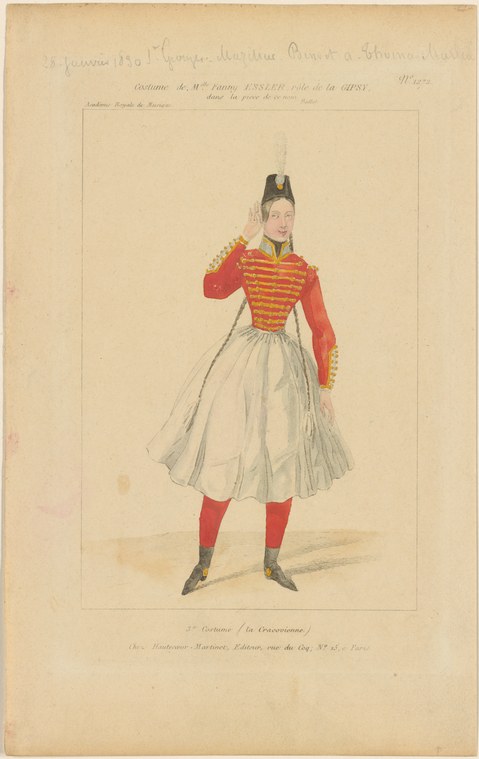
Costume de Melle Fanny Essler [sic], rôle de La gipsy, dans la piece de ce nom. Ballet.: Academie Royale de Musique. 3e costume (La cracovienne)
Unknown artist
- Collection:
- Prints depicting dance
- Source:
- New York Public Library
- Rights:
- Public domain — free to use, share and adapt.
- Recorded as:
- Public Domain
Fanny Essler was a historical figure of the first rank in ballet history, known for a contrasting style of Romantic dancing—earthy, sensual, and grounded in character work—that rivaled the ethereal, ethereal style of her contemporary Marie Taglioni. This image records not only the dress but the aesthetic fusion of folk culture and high theatrical art that defined Romantic ballet. For historians and dancers, it documents a vanished performance tradition and the visual language through which audiences of the 1830s understood 'national character' through costume and movement.
What you are looking at
A young woman in theatrical costume stands against a plain background in a pose of elegant stillness. She wears a striking red wool jacket with ornate gold-thread frogging and braid across the front, fitted to the waist, with the sleeves ending at the forearm. Her lower body is clothed in a voluminous skirt of pale cream or ivory silk, gathered from the waist and falling nearly to the ankle in soft, full folds that suggest movement even in stillness. Red wool stockings cover her legs, and dark shoes with a slight heel complete the ensemble. A tall headdress or comb of dark material rises from her hair, which is pulled back from her face in the severe style of the 1830s. Her posture is upright and formal, one arm raised slightly, the other at her side, in the dignified bearing expected of a prima ballerina in a costume study.
The dancing
A single figure stands in a frontal pose with minimal spatial depth. The body is held upright, the weight evenly distributed, suggesting the balletic carriage of the period rather than a moment caught in motion. The raised arm and slight turn of the shoulders convey poise and control. The abundant skirt dominates the lower half of the composition, its volume and folds rendered in delicate watercolor washes that emphasize the lightness of the silk against the heavier, more densely colored jacket. The overall effect is one of statuesque display rather than dynamic movement—a costume plate rather than a moment of choreography.
The dance depicted
This is a costume study for a Romantic-era ballet, specifically identifying the dress worn by the famous dancer Fanny Essler in the role of the gypsy woman (la gitana) in the ballet *La Gitana* (also known as *La Gipsy*), performed at the Académie Royale de Musique (the Paris Opéra) in the 1830s. The notation "3e costume (La cracovienne)" indicates this is her third costume in the ballet, worn for a Cracovienne (Polish dance) solo. Essler was one of the greatest performers of the Romantic ballet era, celebrated for her technique, dramatic presence, and the sensuality of her movement. The red jacket with its military-style frogging suggests the influence of folk costume, as Romantic ballets frequently drew on picturesque 'national' or 'exotic' dress to evoke faraway places. This image documents not the dance itself but the visual apparatus through which the dancer was presented to her audience.
How it was made
This is a hand-colored lithograph or engraving, likely hand-finished with watercolor or gouache over a printed base. The precision of the linear work—visible in the frogging, the seaming of the jacket, and the careful delineation of the headdress—suggests lithographic or engraving technique, while the soft washes of color in the skirt, stockings, and flesh tones indicate hand-coloring by brush. This was the standard reproductive technique for costume documentation in the early 19th century, allowing multiple copies to be made from a single stone or plate for circulation among ballet-goers, dancers, and students. Such prints were often sold as souvenirs in the foyers of theaters or as part of illustrated theatrical journals, serving both as costume reference and as promotional images of the dancer.
About this work
This is a costume documentation plate for a performance by Fanny Essler, one of the 19th century's most celebrated ballet dancers, in the Romantic-era ballet *La Gitana*. The print records the specific dress Essler wore while dancing a Cracovienne (Polish folk dance) variant within the larger ballet, combining the theatrical silhouette of Romantic ballet—the fitted bodice and voluminous skirt—with folk-inspired military detailing in the jacket. As a hand-colored lithograph or engraving, it belongs to a tradition of theatrical costume documentation that predates photography and served dancers, costumers, and theatergoers as a visual record of celebrated performances. The work is valuable not as a depiction of the dance itself, but as evidence of how Romantic ballet fused European folk imagery with the technique and presentation of the classical stage.
How to look at it
Attend first to the costume itself: the red jacket is rendered with precision, the gold frogging carefully delineated, and the material weight suggested by the slightly stiff appearance of the embroidered wool. The skirt, by contrast, is rendered with soft, delicate washes suggesting gossamer silk and the illusion of weightlessness—a visual economy that tells you this is Romantic ballet, where the upper body conveys character and drama while the skirt and the dancer's movement within it create the illusion of otherworldly lightness. The headdress and severe hairstyle, pulled back tightly, were essential to the silhouette of the period and allowed the face to be read clearly. The pose is formal and composed—not a frozen moment of choreography, but a presentation of the costume and the dancer's dignified bearing. Notice how the printmaker has used the plain background to isolate and showcase both the dress and the figure's silhouette.
The artist
The artist is not recorded in the catalogue. Hand-colored costume plates from Parisian ballet productions of the 1830s were often produced by theatrical publishing houses and printmakers in rapid succession to meet demand from audiences; many were unsigned or credited only to the publishing house. The style and execution are consistent with the standard theatrical lithography of the period, most likely produced in Paris within weeks of the ballet's premiere or a notable revival.
The period
This print dates to the height of the Romantic ballet era in Europe, when ballet had shifted from the formal court aesthetics of the 18th century toward narratives of exotic lands, folk culture, and supernatural themes. The 1830s and 1840s saw the rise of the prima ballerina assoluta—the dancer as star whose technical prowess and dramatic gifts were celebrated in lavishly produced ballets. Fanny Essler's rivalry with the Swiss dancer Marie Taglioni became legendary; where Taglioni embodied the ethereal, weightless ideal of Romanticism, Essler was celebrated for her technical precision, her earthy sensuality, and her ability to dance in character roles. *La Gitana* was one of Essler's signature vehicles, and the Cracovienne within it—a solo inspired by Polish folk dance—became a famous vehicle for her virtuosity. The theatrical print trade flourished in this period, with Paris as the center; thousands of such costume plates were produced and circulated, making ballet accessible to a broader public and serving as models for dancers and costumers throughout Europe.
Where it lives
The print is held in the New York Public Library's Prints collection, likely acquired as part of a broader collection of 19th-century theatrical prints documenting European ballet and opera. Such institutional collections gathered these ephemeral objects because they were recognized as historical documents of performance and costume practice.
Dance in this work
Questions about this work
Who was Fanny Essler and why does she matter?
Fanny Essler (1810–1884) was an Austrian-Italian dancer and one of the two greatest ballet dancers of the Romantic era, alongside Marie Taglioni. Where Taglioni embodied weightlessness and ethereality, Essler brought technical brilliance, dramatic characterization, and earthy sensuality to her roles. She was celebrated across Europe and America for her performances in character ballets, particularly *La Gitana*, *La Sylphide*, and *Esmeralda*. Her career transformed the possibilities for the prima ballerina assoluta.
What is a Cracovienne?
A Cracovienne (or Krakowiak) is a spirited Polish folk dance in a quick, march-like rhythm, typically in 2/4 time. In the context of Romantic ballet, the Cracovienne became a set piece—a solo or group number—where dancers performed technically brilliant variations inspired by (though not faithful to) the folk original. Essler's Cracovienne in *La Gitana* was famous for her technique and her command of rhythm.
How do we know this depicts Fanny Essler?
The inscription at the top of the print reads (in French) 'Costume of Mlle. Fanny Essler [sic], role of The Gypsy, in the play of that name. Ballet: Académie Royale de Musique. 3rd costume (The Cracovienne).' This is a direct attribution inscribed on the print itself by the publisher or artist.
What is this kind of print used for?
Costume plates like this served multiple purposes in 19th-century theater: they were sold to audiences as souvenirs and commemorative images; they circulated among dancers and costumers as reference materials for reproducing celebrated performances; they were published in illustrated theatrical journals and newspapers; and they functioned as promotional images advertising the ballet and the dancer. They were the closest thing to a photograph of a performance that existed before the invention of stage photography.
More dance artwork





