49 works in this view — arrow keys or swipe to move between them.
Dance in Art
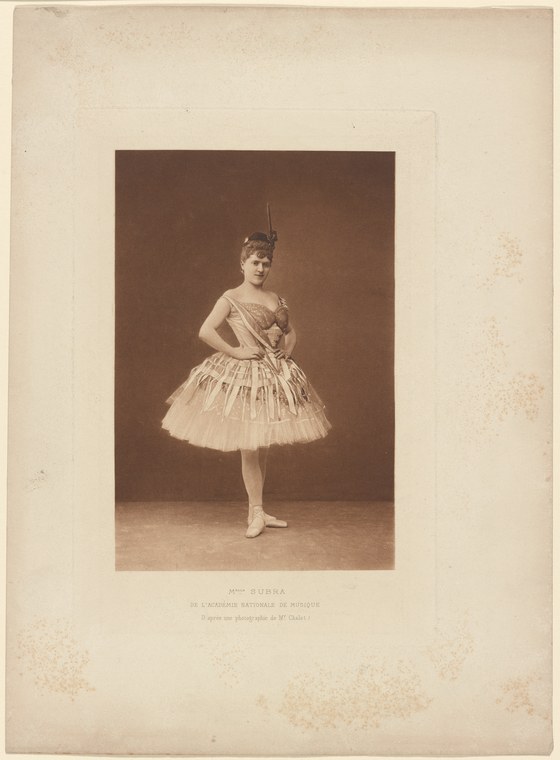
Melle Subra de l'Académie Nationale de Musique
Unknown artist
- Collection:
- Prints depicting dance
- Source:
- New York Public Library
- Rights:
- Public domain — free to use, share and adapt.
- Recorded as:
- Public Domain
This photograph reveals how nineteenth-century ballet dancers were publicly presented to audiences: as beautiful, classically trained professionals in iconic white tutus and formal poses. It is a document of theatrical publicity, costume design, and the commercialization of dance during the height of Romantic ballet's popularity.
What you are looking at
A young female dancer stands alone against a warm brown studio backdrop, posed in classical ballet position. She wears a fitted bodice in a peachy or salmon tone with short sleeves, and a voluminous white tulle skirt of knee length, characteristic of Romantic-era ballet costume. Her posture is upright and formal, weight balanced, with one leg extended slightly and arms positioned in a classical frame. Her hair is styled up with what appears to be a feathered or ornamental headdress. The photograph is mounted on cream card stock with a printed caption below identifying the subject and production. The lighting is even and studio-controlled, typical of theatrical portrait photography of the mid-to-late nineteenth century.
The dancing
The dancer stands in a controlled, formal pose suggesting classical training. Her frame is upright with shoulders back, arms held in a soft classical position, one leg bearing weight while the other is lightly pointed. There is no sense of active movement—this is a formal portrait pose rather than a captured moment of choreography. The body position and posture demonstrate classical ballet carriage and alignment. The single figure dominates the composition, isolated against the plain background in the manner of theatrical publicity portraits.
The dance depicted
This is a publicity portrait of a professional dancer at the Académie Nationale de Musique (the Paris Opéra Ballet). The costume—fitted bodice and full white tulle skirt—and the formal pose are consistent with Romantic ballet of the mid-nineteenth century. The dancer's classical alignment and the theatrical framing suggest she performed leading roles in the repertoire of that era. The image documents a professional theatrical dancer in her stage costume and makeup, though the pose itself is for the camera rather than a moment from actual choreography.
How it was made
This is a photograph printed as a salt print or albumen print, mounted on card stock with letterpress text below. The even studio lighting, neutral background, and formal composition are typical of mid-nineteenth-century theatrical portraiture. The photograph has been hand-tinted or printed in sepia tones. Such prints were standard publicity materials distributed by opera houses and collected by audiences, making this a mass-produced commercial product rather than a unique artwork—evidence of the growing fame and accessibility of professional dancers in the Second Empire period.
About this work
This is a mid-nineteenth-century theatrical portrait photograph of a professional ballet dancer at the Paris Opéra, posed in Romantic-era costume and classical ballet alignment. The image documents both the dancer's professional identity and the visual conventions of ballet as it was performed and promoted to the public. It belongs in a dance gallery as evidence of how ballet dancers were represented, marketed, and understood in the Victorian era—not as images of choreography, but as portraits of celebrated performers in their iconic stage dress.
How to look at it
Attend to the costume: the fitted bodice and voluminous white tulle skirt define the Romantic ballet aesthetic. Note the dancer's upright, controlled posture and classical arm position—this shows the aesthetic ideal of the period, not a moment of choreographic action. The studio setting and plain background isolate the figure, emphasizing the body and costume rather than narrative or setting. The formal frontality and symmetry are hallmarks of Victorian-era theatrical portraiture, designed to display the dancer to an imagined audience.
The artist
The photographer is not recorded. The work is part of the New York Public Library's collection of prints depicting dance, suggesting it was collected as documentary evidence of theatrical practice rather than as a fine art photograph. Studio portraiture of this kind was a standardized commercial practice in Paris during the mid-nineteenth century, with multiple photographers serving the opera and theatrical world.
The period
This photograph dates to the mature Romantic ballet period, when the white tutu, pointe work, and ethereal female protagonist had become standardized across European opera houses. The Paris Opéra Ballet was the most prestigious ballet company in Europe, and its dancers were celebrities whose portraits circulated widely. Such photographs were sold as souvenirs and collected by enthusiasts, making the dancer's image a commodity. The formal, frontal pose and studio setting reflect photographic conventions of the 1850s–1870s, before action photography became technically feasible.
Where it lives
This is a mounted photograph from the New York Public Library's collection of prints depicting dance. It was produced as a commercial theatrical portrait and publicity material for distribution and collection.
Dance in this work
Questions about this work
What does the costume tell us about ballet in this period?
The white tulle skirt and fitted bodice are the visual signature of Romantic ballet, which dominated European stages from the 1830s onward. The short skirt (knee-length) and pointe shoes reflect the emphasis on ethereal, weightless female dancers. This costume had become so iconic by mid-century that it defined ballet for the public, regardless of the actual choreography being performed.
Why is the dancer posing rather than captured mid-movement?
Studio portraiture of the 1850s–1870s required long exposure times, making action photography impossible. Dancers posed in formal ballet positions that conveyed their training and aesthetic ideal. These static portraits were how theatrical dancers were publicly represented and how audiences encountered their images outside the theater.
What was the Académie Nationale de Musique?
This was (and is) the official name of the Paris Opéra Ballet, the most prestigious ballet institution in Europe. Dancers at this institution held the highest professional status and were major celebrities in Parisian culture.
Who was Melle Subra?
The catalogue provides only her professional name and affiliation. Individual dancers' biographical information from this era is often sparse in surviving records, though she held a position at one of the world's most elite ballet companies.
More dance artwork





